


Payment workflow fraud can be hard to spot in a familiar routine: paying a supplier. Finance staff check an invoice against an order, confirm approval, and use the bank details held in the supplier file. Over time, that file becomes a trusted part of the process.
But what happens if someone changes the record that everyone relies on?
Consider a hypothetical small firm paying its regular parts supplier. The invoice matches the order, the amount looks right, and two employees approve the transfer. Neither realizes that someone has changed the supplier’s bank details. The payment passes the usual checks, but the money goes to an account the supplier never approved.
This example shows why a payment review needs to reach back to the records behind the transaction. Checking who approved a transfer helps only if staff can also trust the details they approved. A recent warning from India’s cybersecurity response agency, CERT-In, brings that risk into focus.
What CERT-In’s payment workflow fraud warning says
The Indian Computer Emergency Response Team, CERT-In, issued advisory CIAD-2026-0062 on November 20, 2026. It reports misuse of business records and sign-off steps within otherwise lawful payment systems. The reports reach beyond finance, including technology service providers and platforms that pay vendors or partners.
The advisory also describes a separate threat: AI-driven agentic offensive frameworks. These tools use AI agents to automate parts of a cyberattack. CERT-In found tools probing exposed systems and attacking login credentials, such as passwords. It also observed unauthorized access.
The advisory does not establish that AI caused each payment incident.
That distinction matters when teams decide what to fix. AI can speed up an attack. Meanwhile, staff may still trust a changed supplier file if their checks are weak. The firm in this article is hypothetical.
The proposed checks in this article are a practical review plan. Teams should adapt them to their systems and the rules that apply.
Two approvals can still rely on the same bad record
In the imagined firm, the first reviewer checks the invoice against the supplier screen. A second reviewer opens the same screen and approves the transfer. Both see the changed bank details. Neither knows that the record is wrong.
Payment workflow fraud can also involve changes to approval rights. Someone with broad rights might change which employee can approve a payment. So ask what each person can change. Include the rules that send work to the next approver.
The US standards agency NIST’s SP 800-53 control catalog provides useful design references. AC-5 covers how to split duties and set access rights to match. AU-6 covers how teams review audit logs. This catalog offers control ideas; each firm still needs to assess its own duties and risks.
For this review, draw the roles on one page. Mark who can change supplier data, approve that change, release money, and manage access. Also include provider staff with broad access and accounts used by software. A job title alone won’t show what the system lets someone do.
Prevent payment workflow fraud when supplier details change
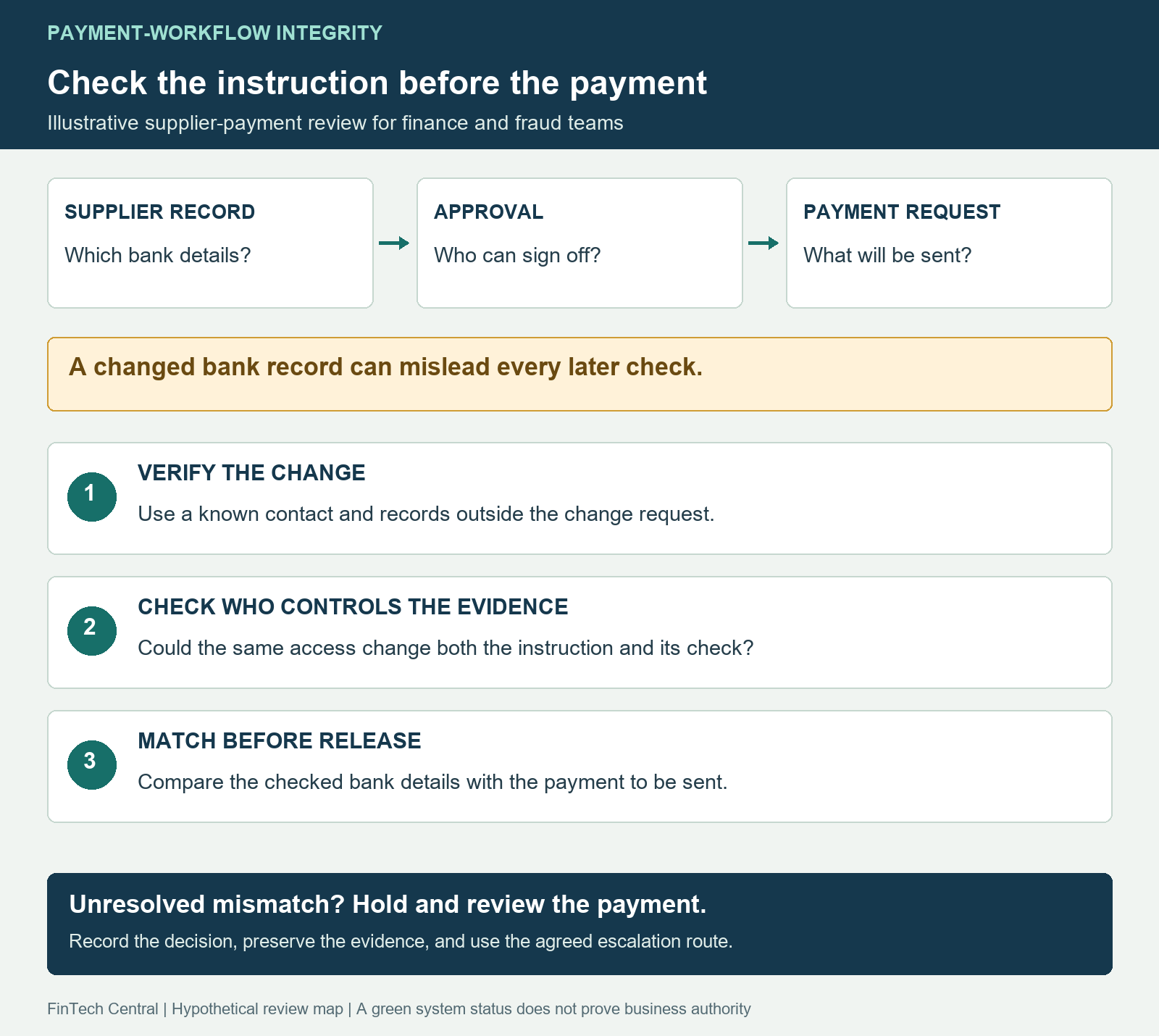
Start with changes that can send funds to the wrong account. A bank-account update needs its own check, even when the invoice has not changed. Before the next payment, record the change and the checks that support it.
The FBI’s business email compromise guidance advises verifying changes in account numbers or payment procedures. It also recommends finding a company’s phone number independently when checking a suspicious request. These checks help staff judge if a request is genuine. The wider system still needs security controls.
For this firm, a reviewer could call a known supplier contact. Use details held outside the change request. If the request changes the phone number too, staff need another trusted way to confirm it.
When staff cannot reach a trusted contact, ask a named manager to decide what happens next. Keep a record.
Keep the checked request with the payment file. Then the release team can match the bank details before sending funds. A later change should trigger fresh review. Otherwise, staff may approve one version and unknowingly pay another.
Test whether the second check is independent
Could one stolen provider account change both the bank details and the record used to check them? A second database or screen may still share the same person with full access. Check who can change those records before you trust them.
Our guide to verified lending data examines a related issue: a record’s source and permitted use matter to the decision built on it. For payments, also match the checked request to the one staff will send.
Monitor the business change and the payment together
To detect payment workflow fraud, review business changes alongside the payment. For example, staff might examine a supplier update alongside a change in approval rights and the next payout. Each event can look routine on its own, so link the records.
For this firm’s proposed test, keep the old and new supplier details. Record who changed them and when. Link the verification evidence and release decision. Then ask other staff to trace what happened without help from the suspected account holder.
An alert still needs an owner. Name who can hold the payment and who checks the request. Use a recorded process for urgent requests. Otherwise, an informal override may remove the check when it matters most.
If a provider runs part of the work, agree on the records and help the client can get. Try the route for urgent help during a test. Our AI vendor due-diligence guide discusses how testing, incident support, and exit arrangements can become usable buying conditions.
Rehearse the response to payment workflow fraud
Run a safe test with made-up supplier details and no live transfer. Give the team a valid invoice with changed bank details. Ask where staff would stop the change and check it. Then ask what they would need before release.
Next, make the usual supplier contact unavailable. Does the team hold the case or use an approved route for exceptions? Try a change after approval too. The exercise should reveal whether the payment screen still shows the version that staff checked.
If staff suspect a real fraud, start the incident plan and contact the bank or payment provider at once. Keep the records while the response team limits further harm and meets the reporting duties that apply. A recall request cannot guarantee recovery, so prevention and response need separate tests.
Measure the checks that actually worked
Track how often staff independently verify high-risk changes and how long unresolved cases wait. Also count exceptions, missing records, and cases that go ahead after a hold. Review delays so staff can clear genuine payments without dropping the checks.
Download the Payment-Workflow Integrity Checklist to record owners, evidence, and gaps in a review meeting. Use it to structure the review. Completing it does not establish regulatory compliance.
Return to the original invoice. The amount and purchase may be genuine, while the bank details are wrong. Before release, a named reviewer should explain why the firm owes the supplier and why these bank details are correct. The records supporting that check should sit beyond the payment changer’s control.
Follow the FinTech Briefing for practical analysis of financial AI and the controls around it.
FINTECH BRIEFING · A FUTURECENTRAL BRIEFING
Get practical financial AI analysis in your inbox.
Useful signals, focused analysis and decision questions on AI in banking, payments, lending, insurance, wealth and risk.
Free to subscribe. Confirm your email after signing up. Unsubscribe at any time.