
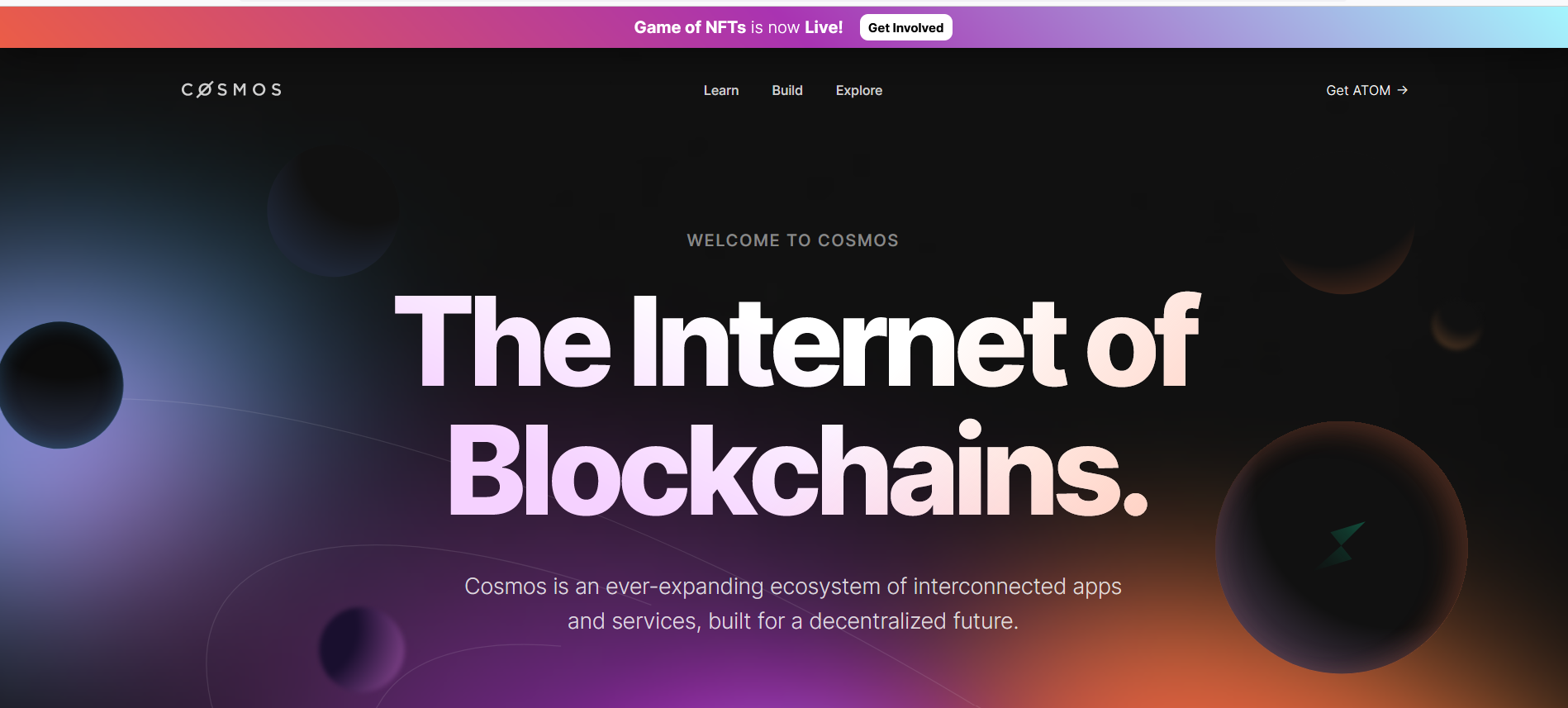
Cosmos is an open blockchain technology stack for building application-specific chains and connecting independent networks. The stack includes the Cosmos SDK, CometBFT and the Inter-Blockchain Communication protocol. The Cosmos Hub and its ATOM token are important parts of this landscape, but they are not identical to the entire ecosystem.
What Cosmos means
Cosmos is best understood as a family of open-source technologies and connected networks. Developers can use the stack to create a sovereign blockchain with its own logic, validator arrangements, fees and governance. Some chains then communicate through IBC.
The Cosmos Hub is one blockchain built with this technology. ATOM is its native staking and governance token. Owning ATOM does not represent ownership of every chain built with the Cosmos SDK, and activity elsewhere does not automatically accrue value to ATOM.
The Cosmos SDK
The Cosmos SDK is an open-source framework for application-specific blockchains and digital ledgers. Developers assemble modules for accounts, token transfers, staking, governance, fees and custom business logic.
Application-specific design provides control over execution, economics and upgrades. It also creates responsibility. Each chain team must manage code quality, validators, governance, operations and ecosystem support rather than inheriting everything from one general-purpose network.
CometBFT consensus
CometBFT handles networking, block production and Byzantine-fault-tolerant consensus for many Cosmos SDK chains. The Application Blockchain Interface connects the consensus engine to the chain’s state machine.
This separation lets developers customize application logic without rebuilding consensus from scratch. However, validator decentralization, stake distribution, node reliability and operational security still vary by chain.
How IBC connects blockchains
The Inter-Blockchain Communication protocol provides authenticated communication between independent ledgers. IBC clients track relevant consensus information, while connections and channels carry data packets for applications such as token transfers.
IBC is not a universal message bus that makes every blockchain trustworthy. Chains need compatible implementations and valid light-client assumptions. Relayers submit messages, but protocol verification—not trust in one relayer—determines whether packets are accepted.
IBC does not imply shared security
Two chains can communicate through IBC while maintaining separate validator sets and security budgets. If a smaller chain is compromised, assets originating there may become unsafe even when the receiving chain continues operating correctly.
Users should identify the origin chain, path and denomination of an IBC asset. A token transferred through a channel can represent an escrowed asset on another chain, and routing or channel changes can affect fungibility.
Cosmos Hub and ATOM
The official Cosmos Hub documentation describes ATOM as the Hub’s primary token. Holders can delegate ATOM to validators, participate in on-chain governance and pay for transactions according to network rules.
Staking rewards compensate validators and delegators for securing the Hub. They are not free yield. Token issuance, validator commission, slashing, price changes, taxes and the unbonding period affect the economic result.
Staking and validator risk
Delegators assign voting power to validators and receive a share of rewards after commission. Validator downtime or double signing can lead to penalties. A delegator therefore needs to assess uptime, commission, governance participation, security practice and concentration.
Staked tokens are less liquid during unbonding. Liquid-staking products can provide transferability, but they add smart-contract, issuer, peg and governance risks. Our liquid staking guide explains the broader trade-offs.
Governance on the Cosmos Hub
ATOM holders can vote on proposals involving upgrades, parameters, community funds and other Hub matters. Delegators who do not vote can inherit their validator’s vote under current rules, so active participation and validator choice matter.
Governance can coordinate change, but it also creates capture, apathy and execution risks. High nominal participation does not guarantee informed decisions. Users should read proposal text, implementation details and independent discussion.
Interchain Security
Interchain Security lets approved consumer chains use some or all of the Cosmos Hub validator set under defined models. Consumer chains can focus on application development while distributing agreed value to participating security providers.
This feature is specific, not automatic for every Cosmos chain. Top-N and opt-in designs can create different validator obligations and coverage. Consumer-chain software, economics and governance remain additional sources of risk.
Cosmos EVM and smart contracts
Cosmos EVM embeds an Ethereum Virtual Machine as a Cosmos SDK module. A chain can support Solidity contracts and common Ethereum tools while retaining access to native SDK features such as staking, governance and IBC.
EVM compatibility improves developer portability but does not make chains identical to Ethereum. Consensus, validators, fees, finality, governance and infrastructure remain chain-specific. Smart contracts also retain their own code and oracle risks.
Main Cosmos risks
- Chain-specific security: validator quality and stake concentration differ.
- IBC risk: client bugs, bad configuration or compromised origin chains can affect assets.
- Staking risk: slashing, commission, unbonding and token inflation affect returns.
- Governance risk: low participation or concentrated voting power can shape upgrades.
- Software risk: SDK modules, applications and smart contracts may contain flaws.
- Liquidity risk: smaller ecosystem assets can be difficult to exit during stress.
- Token risk: ATOM economics do not mirror the growth of every connected chain.
How to evaluate a Cosmos chain
- Identify its validator set and security model.
- Review stake concentration, uptime and governance participation.
- Check the exact Cosmos SDK, CometBFT and IBC versions.
- Understand token issuance, fees and value capture.
- Verify IBC channels, asset origin and liquidity.
- Inspect audits, upgrades and incident response.
For comparison with another scaling model, see our Ethereum scaling guide. Sovereign chains and rollups make different trade-offs around execution, settlement and security.
Cosmos outlook
Cosmos offers a mature modular stack for teams that want chain-level control and interoperability. The SDK, CometBFT and IBC support a network-of-networks model rather than one shared execution environment.
The model’s strength is sovereignty; its challenge is fragmentation. Long-term success depends on secure chains, reliable interoperability, usable developer tools and sustainable token economics. “Internet of blockchains” is a useful vision, but each connection still needs careful technical and economic evaluation.
FINTECH BRIEFING · A FUTURECENTRAL BRIEFING
Get practical financial AI analysis in your inbox.
Useful signals, focused analysis and decision questions on AI in banking, payments, lending, insurance, wealth and risk.
Free to subscribe. Confirm your email after signing up. Unsubscribe at any time.