

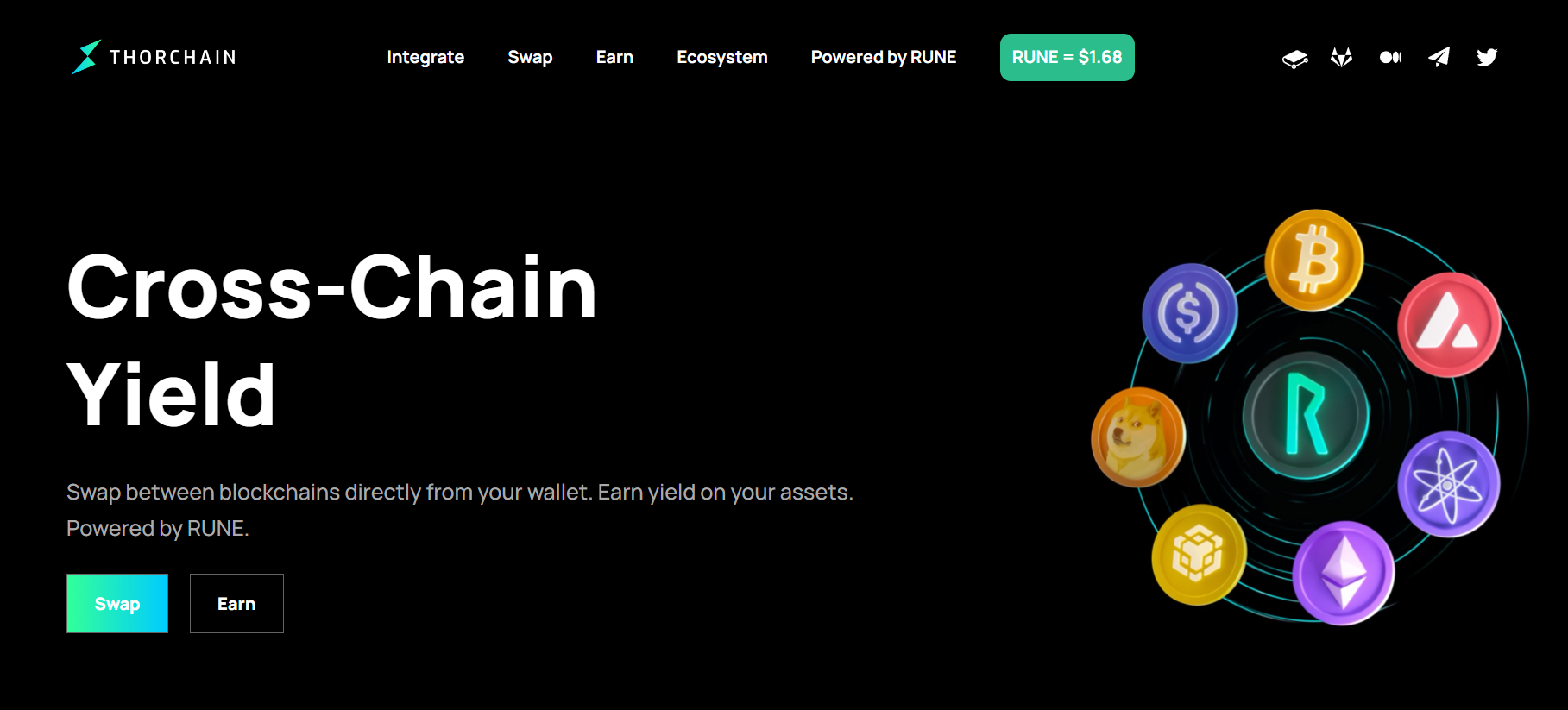
THORChain is an independent Layer 1 blockchain and decentralised exchange for swapping native assets across different networks. A user can exchange assets such as Bitcoin and Ether without depositing them with a centralised exchange or relying on a wrapped representation. The protocol achieves this through liquidity pools, RUNE settlement and threshold-controlled vaults.
This guide explains how THORChain swaps work, the role of RUNE and the liquidity, security and governance risks users should assess.
What Is THORChain?
THORChain is built with the Cosmos SDK and CometBFT consensus. Its nodes observe supported external chains, coordinate vault transactions and maintain the protocol’s state. The official THORChain documentation describes it as a Layer 1 decentralised exchange for native cross-chain swaps without centralised custodians.
The protocol is not a bridge in the usual sense. It does not simply lock Bitcoin and issue wrapped Bitcoin on another network. A swap delivers a different native asset to the user’s destination address.
How THORChain Swaps Work
- The user selects an input asset, output asset, amount and destination address through an interface.
- The user sends the input asset to a THORChain-controlled vault on its native chain.
- Nodes observe and confirm the deposit.
- The protocol prices the trade through the relevant liquidity pools, using RUNE as the settlement route.
- Nodes authorise an outbound transaction from the destination-chain vault.
- The user receives the native output asset after network processing.
A Bitcoin-to-Ether trade is economically routed through BTC:RUNE and ETH:RUNE pools even though the interface presents one swap. Slippage, pool depth, network fees and outbound delays affect the result.
The Role of RUNE
RUNE is the native asset of THORChain. It serves as the settlement asset in pools, is bonded by node operators for economic security and participates in incentives and governance signalling.
The official RUNE guide explains that external-asset pools pair assets with RUNE. This design avoids creating a separate pool for every possible asset pair, but it also makes the protocol and liquidity providers sensitive to RUNE’s price and economics.
THORChain Liquidity Pools
Liquidity providers deposit assets into pools and receive units representing their share. Swap fees and protocol incentives can increase the pool value, while price changes and arbitrage alter the quantities of each asset.
Providing liquidity is not equivalent to earning interest on a deposit. Returns depend on swap activity, pool composition, RUNE prices, incentives and withdrawal timing. A provider may hold fewer units of a rising asset than if it had simply held that asset.
THORChain Benefits
- native cross-chain swaps without ordinary wrapped assets;
- no central account or custodial exchange deposit;
- transparent pools and on-chain transaction history;
- integration through multiple wallet and exchange interfaces;
- permissionless access at the protocol layer;
- shared RUNE settlement that reduces the number of required pools.
Interfaces can still impose restrictions, collect data or contain malicious code. Users should distinguish the protocol from the website or wallet used to reach it.
THORChain Risks
Vault and threshold-signature risk
External assets are held in protocol vaults controlled collectively by nodes. Threshold signatures reduce reliance on one key but do not eliminate software, coordination or economic-security failures.
RUNE economic risk
RUNE is central to pool settlement and node bonds. Sharp price changes can affect incentives, liquidity and network security. Token design does not guarantee solvency under every market condition.
Liquidity and slippage risk
Large trades relative to pool depth receive worse prices. Network fees and outbound delays can add cost, while volatility between quote and completion can change the effective result.
Liquidity-provider risk
Pool providers face divergence loss, asset volatility, protocol bugs and incentive changes. Yield estimates are variable and should not be treated as guaranteed returns.
Smart-contract and chain risk
THORChain interacts with several external blockchains. A bug, chain halt, reorganisation or incompatible upgrade can interrupt deposits and withdrawals. Connected complexity expands the attack surface.
Interface and address risk
A malicious interface can substitute addresses or create incorrect memos. Cross-chain transfers may be irreversible, and sending an unsupported asset or malformed transaction can cause loss.
Governance and regulatory risk
Node decisions and protocol upgrades can change supported chains, parameters or products. Permissionless protocols may also face legal restrictions that affect interfaces, users or service providers.
Savers and Other THORChain Products
Savers Vaults allow single-asset participation through claims on synthetic assets and pool liquidity. THORChain’s own Savers documentation warns that the product is not risk-free and that entry, exit and outbound fees can exceed yield for short holding periods.
Users should verify whether lending or other features are currently active rather than relying on old promotional descriptions. Protocol products can be paused, changed or retired through network decisions.
How to Use THORChain More Safely
- Use an established interface linked from official sources.
- Verify input and destination addresses on the signing device.
- Check expected output, slippage tolerance and network fees.
- Start with a small test swap.
- Confirm both chains are operational and supported.
- Do not confuse estimated yield with guaranteed income.
- Understand the additional risks before providing liquidity.
- Keep records for tax and compliance obligations.
For comparison, see our atomic swaps guide and explanation of decentralised finance.
The Future of THORChain
THORChain addresses a genuine problem: exchanging native assets across isolated blockchains without a central exchange. Its architecture trades simple custody for a complex network of nodes, vaults, pools and incentives.
Users should evaluate the complete path from interface to external-chain settlement. Cross-chain convenience is valuable only when liquidity, economic security and operational controls remain strong.
This article is educational and does not constitute investment advice. Cross-chain protocols, liquidity pools and cryptoassets can result in total loss.