


Agentic payments raise a question: who gives the go-ahead once an AI agent has worked out what to do?
Consider two imagined requests. A shopper asks an agent to find a desk lamp and buy it. A finance head asks a treasury agent to move spare cash between company accounts before supplier bills fall due.
Both ask software to act for an owner. Yet the spending rights, checks, and routes for fixing mistakes need to fit each task. A good shopping tip says little about whether the agent may release a payment.
Two new sources help frame this choice. ChatGPT Wallet sets out a shopping flow with approval for each purchase. A Deutsche Bank–Ant Digital Technologies paper explores bounded execution in wholesale finance.
One is a limited product rollout. The other is a design whose gains still need proof.
What ChatGPT Wallet asks the buyer to approve
In its November 13 announcement, OpenAI says users check the items, total, and card. They approve with a security check such as Face ID or a fingerprint scan. A network token replaces real card details, keeping them away from the agent and merchant.
Launch access is through dots for US ChatGPT Pro users aged eighteen or older with eligible US-issued cards. Buying within preset limits is a future direction. Users approve each purchase at launch.
OpenAI says existing card protections apply to eligible merchant disputes. It does not promise a refund for every agent mistake.
For example, the desk lamp’s buyer should be able to spot a changed price or wrong item before spending. When testing any agent checkout, change the cart after review. Then ask whether approval still covers the request that reaches the payment system.
These are test questions. They do not describe Wallet features that OpenAI has not documented.
Wholesale agentic payments start with a mandate
The October 2026 Deutsche Bank–Ant Digital paper sets out how agents could act under clear rights granted by a firm that remains responsible. A mandate records those rights, their limits, and how to withdraw them. The paper covers cash management, cross-border payments, and trade finance. Its claims of value still need testing.
Its design keeps the agent’s reasoning apart from payment controls and settlement. It draws on the IMF’s three-layer framework: intent, authorization, and settlement. Choosing an action, allowing it, and moving the money are separate jobs.
In the paper’s approach, controls check each request against current conditions before money moves. People still take part in high-value, high-risk, and unusual cases. Conditions can change after a firm grants rights.
For our imagined treasury team, a first task could cover transfers between named company accounts within a daily cap. Paying a new supplier would fall outside those rights. If the agent spots an urgent bill, it could prepare a case for staff without gaining the right to pay it.
That is a test design. It does not show that a bank has proven the service at scale or saved money.
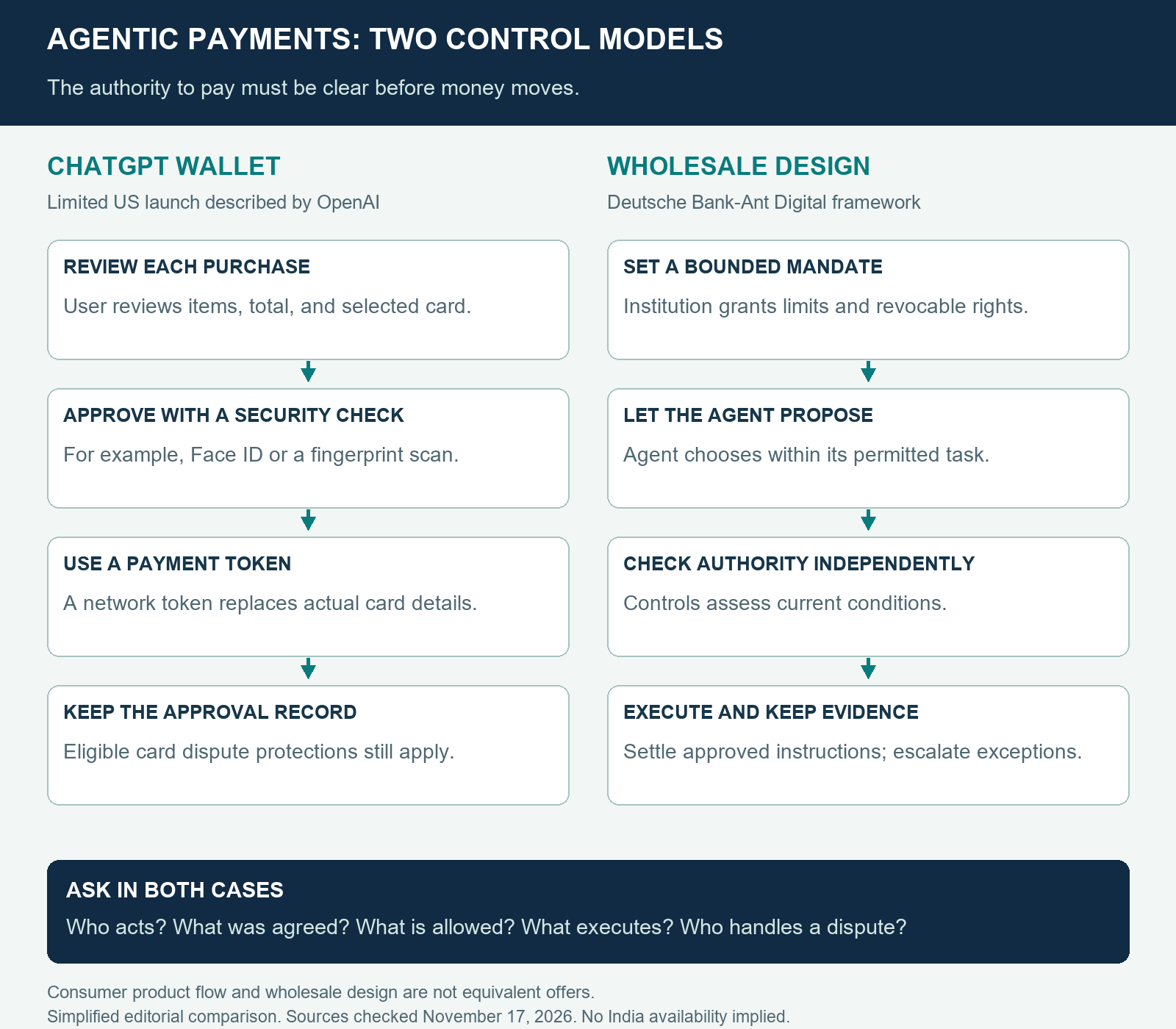
Test where agentic payments get their authority
The key is to find the approval step. A person can review one purchase. A treasury team may want software to repeat tasks within a grant. In both cases, the request must stay within the rights the owner gave.
Start with a changed-request test. Suppose the lamp’s seller changes the delivery charge after the buyer approves. In the treasury case, change the payee account after a manager grants the transfer rights. Ask the supplier to show how its system spots the change and checks whether the owner must approve again.
Next, withdraw the rights while work waits in a queue. A stop control should block new actions that no longer have permission. Also find which transfers the bank has already sent. Stopping new work and getting money back are different tasks.
Then test an uncertain payment status. If the system times out after sending a request, staff need to check whether money moved before trying again. The demo should show how the service avoids paying twice and matches its records to the bank’s record.
Finally, ask who handles a complaint. A wrong product, a payment made without permission, and an error in moving the money need different proof. Agree how the agent provider, merchant, app, and bank will help show what happened. The contracts and rules that apply will govern who must put things right.
What Indian teams can use for agentic payments
These sources do not show that ChatGPT Wallet is available in India. Nor do they prove the wholesale design is ready for every Indian use case. Before launch, local teams need to check the product, the payment system it uses, its contracts, and the rules that apply.
For a UPI agent proposal, begin with one customer request. Can staff link the software to a named firm and the customer’s current permission? Our UPI agent-registry guide explains why a register entry alone cannot prove spending rights.
For example, a small-business test could begin with an agent preparing supplier payments for review. Staff would still check the invoices and release the payments. After testing, the firm could consider a narrow grant for repeat payments. Its bank would need to support the required controls and approvals.
Measure the complete task. Include time spent fixing payees, handling failed requests, and matching payments to bills. Faster drafting adds little if staff then spend more time fixing errors.
Also check who can reach bank systems. The right to read a bill should not give the agent wider access to accounts or payment tools. Our payment API security guide covers controls at those interfaces.
A checklist before granting payment rights
Use these five questions to review an agentic payments proposal:
- Identity: Which person or firm does the agent act for, and who owns the service?
- Consent: What did the user agree to, and can the firm show the request they saw?
- Authority: Which payees, amounts, purposes, and time windows may it use? When must the owner approve again?
- Execution: Which controls check the live request? What happens after failures, repeat requests, expired grants, or withdrawn rights?
- Liability: Who handles a complaint? Which records survive, and which contracts and rules say how to put things right?
Finally, before buying, ask the supplier to walk through a changed payee, an expired grant, and a request with no clear result. A sales demo can hide these awkward cases. A test should bring them to light.
Start with drafting and review where the limits are easiest to enforce. Grant more rights only after the firm can show that the service works, keeps clear records, and handles failures well.
For more practical analysis, subscribe to the FinTech Briefing.
FINTECH BRIEFING · A FUTURECENTRAL BRIEFING
Get practical financial AI analysis in your inbox.
Useful signals, focused analysis and decision questions on AI in banking, payments, lending, insurance, wealth and risk.
Free to subscribe. Confirm your email after signing up. Unsubscribe at any time.