
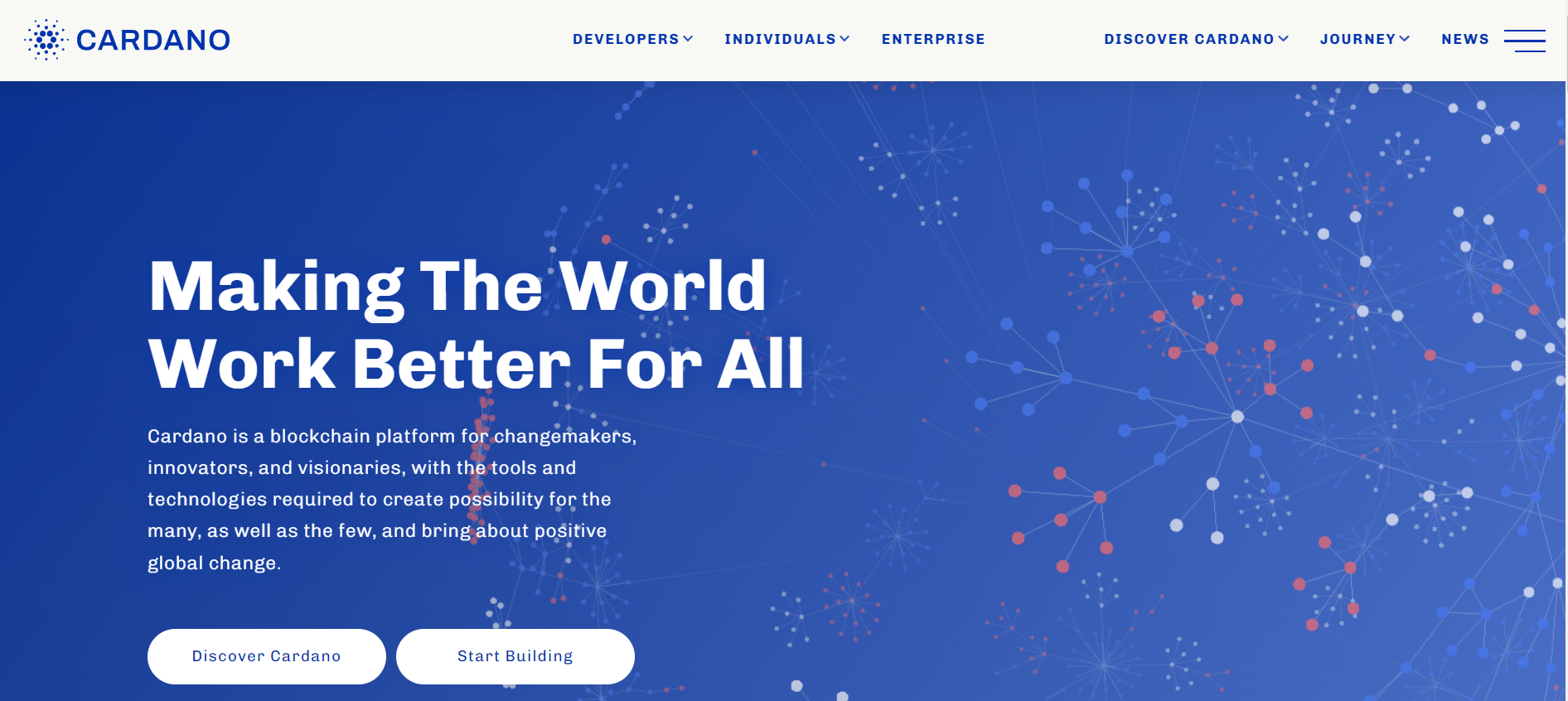
Cardano is a public proof-of-stake blockchain whose native asset is ADA. It uses the Ouroboros consensus family, supports smart contracts through Plutus, and now includes community-led on-chain governance. The network is designed for security and formal methods, but users should assess adoption, liquidity, governance and market risks rather than treating its research pedigree as an investment guarantee.

How Cardano works
Cardano records transactions on a distributed ledger maintained by stake pools. Ouroboros divides time into epochs and slots, then selects eligible pools to produce blocks according to stake and protocol rules. Unlike proof-of-work mining, this process does not require participants to compete through energy-intensive computation.
The official Cardano proof-of-stake documentation explains that ADA holders can delegate to a stake pool without transferring ownership of their coins. Rewards are variable, depend on protocol parameters and pool performance, and should not be described as guaranteed interest.
ADA and Cardano staking
ADA pays transaction fees, participates in staking and supports governance. Holders can run a pool or delegate to one while retaining the ability to spend their ADA. Delegation helps distribute stake across active operators, but users should compare saturation, fees, reliability and custody arrangements.
Smart contracts and native assets
Cardano supports smart contracts and decentralised applications through its extended UTXO accounting model and Plutus tooling. Developers can build exchanges, lending applications, identity tools, games and tokenisation projects. Native assets can be represented directly on the ledger, although application logic and user interfaces still introduce smart-contract and operational risk.
Readers comparing blockchain applications can also review our guides to ERC-20 tokens and non-fungible tokens.
Cardano governance today
The network has moved beyond the old roadmap language that described Shelley or Voltaire as future rollouts. Its current governance framework uses delegated representatives, stake pool operators and a constitutional committee. The official Cardano governance portal publishes recent proposals and decisions.
Community voting can make protocol development more accountable, yet participation may be uneven and proposals can be technically complex. Token-weighted influence, delegation behaviour and voter turnout therefore remain important governance questions.
Potential uses
- Payments: transferring ADA and supported native assets.
- DeFi: exchanges, lending, liquidity and collateral applications.
- Tokenisation: representing digital or real-world claims, subject to legal design.
- Identity and records: verifiable credentials and tamper-evident data.
- Governance: submitting and voting on network actions and treasury use.
Key Cardano risks
- Market risk: ADA can be highly volatile.
- Adoption risk: technical capability does not ensure users, developers or liquidity.
- Smart-contract risk: application code can fail even when the base chain operates correctly.
- Governance risk: low participation or concentrated delegation can affect decisions.
- Regulatory risk: token, staking and DeFi rules differ across jurisdictions.
- Custody risk: exchanges, wallets and lost keys can expose users to loss.
- Competition risk: other networks compete for developers, capital and applications.
A due-diligence checklist
- Verify wallet software and official contract or policy identifiers.
- Understand whether staking is self-custodied or exchange-controlled.
- Review pool fees, saturation and historical performance.
- Check application audits, liquidity and oracle dependencies.
- Follow governance proposals that may change parameters.
- Treat projected returns and token prices as uncertain.
The bottom line
Cardano is an established proof-of-stake network with ADA staking, smart contracts and live community governance. Its architecture is distinctive, but practical value depends on secure applications, sustained adoption and sound governance. Evaluate the current network rather than relying on an outdated development roadmap.
FINTECH BRIEFING · A FUTURECENTRAL BRIEFING
Get practical financial AI analysis in your inbox.
Useful signals, focused analysis and decision questions on AI in banking, payments, lending, insurance, wealth and risk.
Free to subscribe. Confirm your email after signing up. Unsubscribe at any time.