


AI in health insurance is changing how insurers assess risk, support wellness, process claims, and coordinate with third-party administrators. The clearest view of this shift is a connected operating system spanning the policyholder journey. Individual models form only part of it.
That distinction matters. A strong prediction model cannot repair a broken claims workflow. Faster document extraction does little if an exception still waits in an unmonitored queue. The value appears when data, models, human review, and service operations work together.
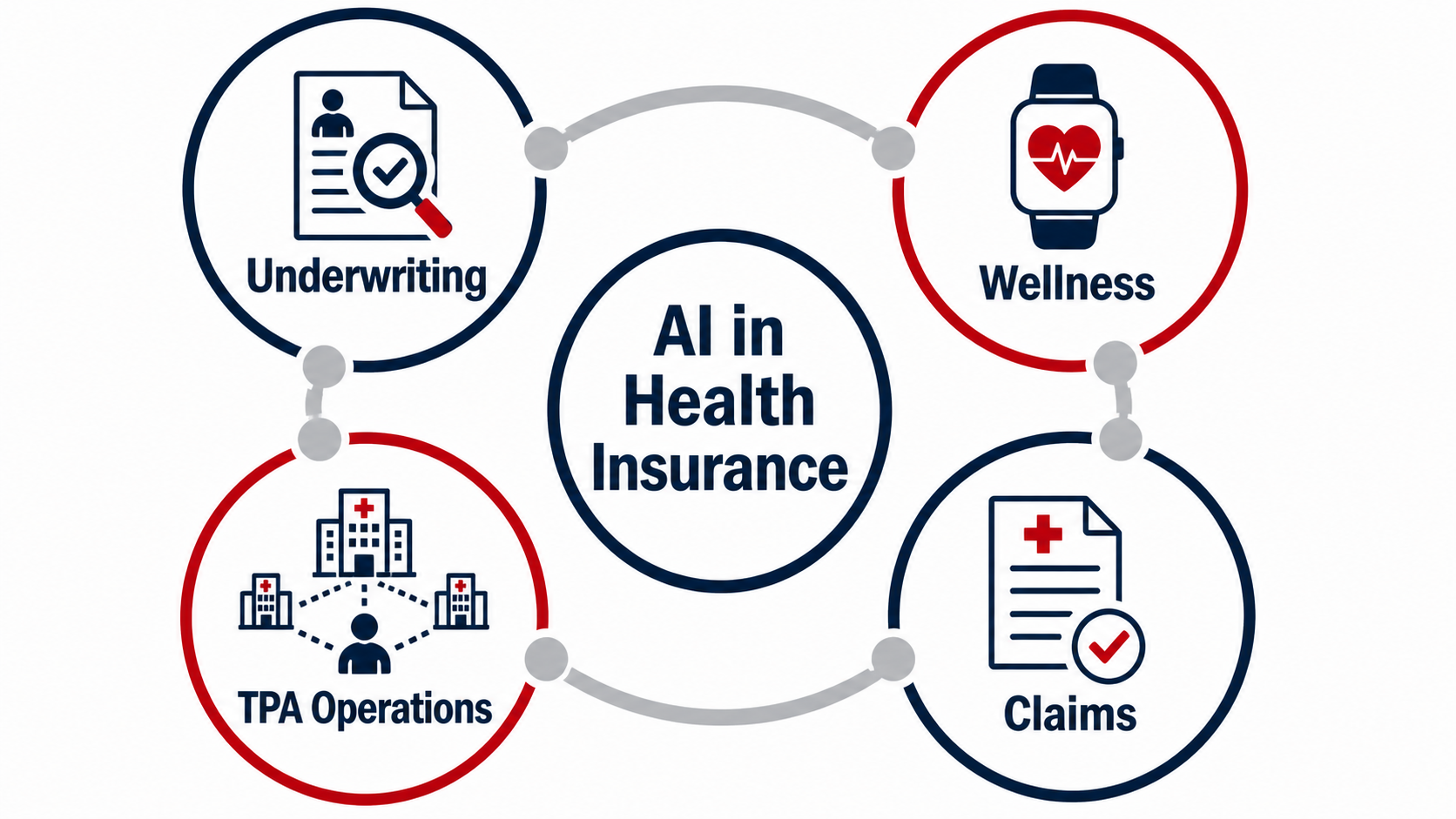
The four-part AI in health insurance framework
The operating chain has four linked parts: underwriting, wellness, claims, and TPA operations. Each uses different data and serves a different decision.
1. Underwriting: supporting a fuller risk assessment
Health underwriting begins with proposal information, declared medical history, product rules, and actuarial assumptions. Machine-learning models can add another layer by identifying relationships across variables that fixed rules may miss.
This does not mean that an algorithm should make an unexplained accept-or-decline decision. Its safer role is to help segment applications, identify cases eligible for simplified processing, and direct uncertain or high-impact cases to qualified underwriters.
Digital health records could make this process more complete when access is lawful, relevant, and based on explicit consent. India’s Ayushman Bharat Digital Mission provides infrastructure for consent-managed sharing of personal health records. Its Health Information Exchange and Consent Manager allows individuals to control which records they share. Insurers therefore need a clear boundary between information that is available and information they are permitted to use.
The practical test is not simply whether a model predicts claims accurately. Underwriting teams should also ask whether it treats applicants consistently, whether its inputs are reliable, whether decisions can be explained, and whether overrides are recorded and reviewed.
2. Wellness data in AI in health insurance
Wearables and wellness platforms can supply activity, sleep, heart-rate, and engagement data over time. These signals may support health programmes, renewal rewards, and timely prompts for policyholders who choose to participate.
The strongest business case is often engagement and retention. Aggressive repricing creates a weaker proposition. Wellness data can be incomplete, device-dependent, and influenced by a person’s job, disability, location, or access to technology. Step counts and missing records carry limited information on their own; neither establishes a diagnosis or unhealthy behaviour.
An insurer considering wellness data should define:
- what data it collects;
- why each field is needed;
- how long it is retained;
- whether participation is genuinely voluntary;
- how consent can be withdrawn; and
- whether a customer can challenge an adverse outcome.
These safeguards protect customers and improve the analytical design. Models trained on selective participation data can otherwise confuse who uses a device with who presents a particular health risk.
3. Claims automation in AI in health insurance
Claims operations combine policy terms, clinical documents, hospital information, bills, and past decisions. AI can help convert this unstructured material into a usable case file.
Optical character recognition and language models can extract fields from pre-authorisation requests, discharge summaries, diagnostic reports, and invoices. A triage model can then route straightforward cases for rapid processing while sending ambiguous, unusually costly, or medically complex cases to experienced reviewers.
This is where workflow design becomes more important than model novelty. A useful claims system should show the reviewer which documents were read, which fields were extracted, what rule or pattern triggered an exception, and what information is still missing. It should never hide uncertainty behind a confident score.
IRDAI’s 2024 health-insurance framework places customer service, cashless treatment, and claims administration within a regulated process. Automation must fit that process. It cannot dilute the insurer’s responsibility to make a fair decision or the customer’s ability to understand and contest it.
The same principle applies to fraud detection, where rules, supervised models, and network analysis can flag unusual relationships among hospitals, procedures, doctors, policyholders, and repeated claims. Such a flag warrants investigation without establishing fraud. Human investigators still need to examine the clinical and contractual context before reaching a conclusion.
4. TPA operations and AI in health insurance
A third-party administrator, or TPA, supports services such as cashless-claim administration, reimbursement processing, hospital-network coordination, and policyholder service on behalf of an insurer. IRDAI regulates this role under the Third Party Administrators (Health Services) framework.
AI can help a TPA classify incoming cases, extract documents, prepare review summaries, monitor turnaround times, and route questions to the right team. The larger opportunity is integration. The insurer, TPA, hospital, and customer should experience one coherent workflow, with the gaps between their systems removed.
That requires common case identifiers, agreed data definitions, visible service-level clocks, and clear ownership for exceptions. Without those basics, automation can make a fragmented process move faster without making it better.
How AI in health insurance links the four parts
The four-part framework is a chain, not a menu.
- Underwriting establishes the initial view of risk and the terms of cover.
- Wellness programmes create optional engagement signals during the policy period.
- Claims test the policy against real clinical events and service needs.
- TPA operations connect hospitals, documents, authorisations, and communications.
Information from one stage may improve another, within stated purposes and permissions. Claims experience can reveal process defects or emerging cost patterns. Using it as a hidden reason to penalise an individual at renewal would cross that boundary.
Wellness data may help tailor engagement. Any new use should be disclosed and covered by valid consent.
This separation of purposes is especially important for health data. The ABDM consent architecture enables individuals to control record sharing; it does not grant every participant unrestricted access. The IRDAI health-insurance guidance likewise states that insurers need specific consent to facilitate an ABHA number and express consent each time medical records or related information are shared.
A practical implementation checklist
Before scaling AI in health insurance, leaders should be able to answer ten questions:
- Which customer or operational problem are we solving?
- Who owns the decision supported by the model?
- What data is necessary, and what is merely convenient?
- How is consent obtained, recorded, and withdrawn?
- Can the user see the evidence behind an exception?
- Which cases always require clinical or senior review?
- How are false positives, overrides, and complaints analysed?
- Are insurer, TPA, and hospital workflows measured end to end?
- How are drift, bias, security, and data quality monitored?
- What happens when the system is unavailable or uncertain?
Teams should measure outcomes at the workflow level. Useful indicators include application turnaround time, pre-authorisation time, extraction accuracy, exception rate, claim rework, complaint rate, investigation yield, and customer satisfaction. Model accuracy belongs on the dashboard, but it is only one measure.
This operating view complements FinTech Central’s broader discussion of AI in insurance underwriting and the role of an accountable financial-services RAG framework when employees need answers grounded in approved documents.
The real transformation is operational
AI in health insurance can help shorten decisions, organise complex evidence, detect unusual patterns, and improve coordination. Its impact depends on how well the four parts work together.
The right design keeps people accountable for consequential decisions, limits data to legitimate purposes, and makes exceptions visible. Insurers that treat underwriting, wellness, claims, and TPA operations as one governed system will gain more than those that deploy a series of impressive but disconnected models.
FINTECH BRIEFING · A FUTURECENTRAL BRIEFING
Get practical financial AI analysis in your inbox.
Useful signals, focused analysis and decision questions on AI in banking, payments, lending, insurance, wealth and risk.
Free to subscribe. Confirm your email after signing up. Unsubscribe at any time.