


Motor claims automation can shorten the path from an accident report to settlement by connecting digital first notice of loss, image assessment, document extraction, and human review. The goal is a faster, clearer claims process, especially for straightforward own-damage cases.
A quick decision still needs reliable evidence. Images may be incomplete, documents may conflict, and unusual damage may require a surveyor’s judgment. Effective automation identifies these cases early and assigns each claim a suitable route.
What motor claims automation changes
The traditional motor-claim journey often moves through separate steps. A policyholder reports the incident, an insurer checks the policy, a surveyor inspects the vehicle, a workshop prepares an estimate, and the claims team reconciles the documents before settlement.
Digital workflows can connect those steps. A mobile claim form captures the initial facts and photographs, after which computer vision estimates the location and severity of visible damage. Document AI extracts details from the registration certificate, driving license, survey report, and repair estimate. Using that combined file, a routing system decides which case needs further review.
That final point is essential. Motor claims automation should determine the next workflow, while authorized professionals remain responsible for consequential decisions.
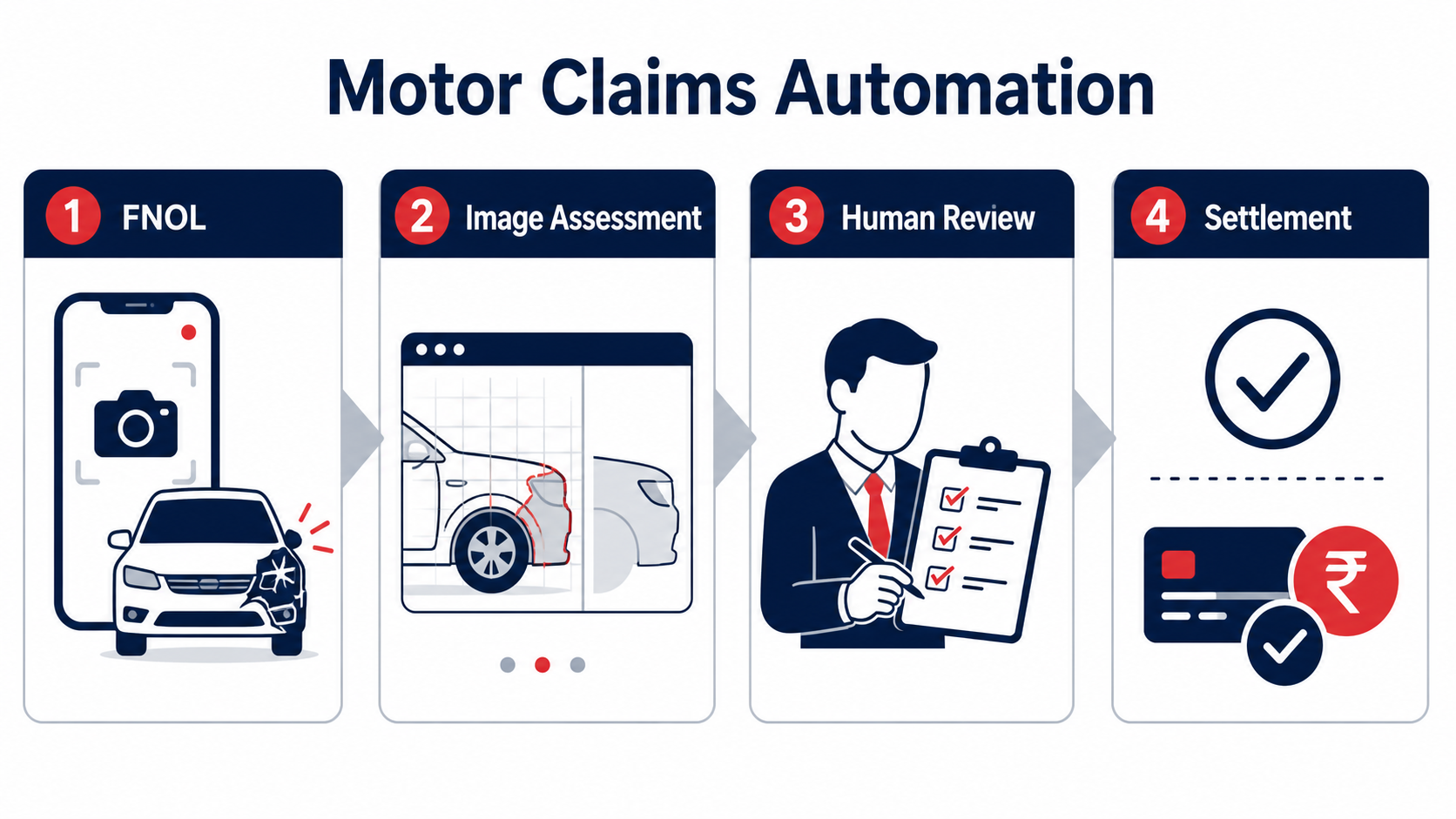
The four-stage motor claims automation workflow
The operating model has four linked stages. Each stage prepares evidence for the next one.
1. Digital FNOL
First notice of loss, usually shortened to FNOL, begins the claim. A digital FNOL flow can collect the policy number, location, time, vehicle details, account of the incident, and images or video of the damage.
Good design guides the customer through the capture process. It can ask for specific angles, check whether an image is blurred, and flag missing documents before submission. As a result, the claim enters the insurer’s system with a more complete case file.
The system should also explain what happens next. Customers need a reference number, an expected response time, and a clear way to supply additional evidence.
2. Image and document assessment
Within motor claims automation, computer-vision models can identify damaged vehicle areas and classify visible severity. They may also compare the images with known repair patterns or workshop estimates. This produces an initial assessment that must be validated before it becomes a finding.
At the same time, optical character recognition and language models can extract structured fields from submitted documents. The workflow can compare names, registration details, dates, policy terms, repair items, and quoted amounts. Any mismatch becomes an exception for review.
Image quality sets a practical limit. Poor lighting, hidden internal damage, prior repairs, and unusual vehicle models can weaken an automated estimate. The workflow should measure that uncertainty and route the case accordingly.
3. Triage and human review
Triage separates claims by complexity, confidence, and potential impact. A low-value claim with consistent documents and clear images may qualify for a streamlined review. A complex collision, uncertain liability, possible total loss, or fraud indicator should move to a qualified surveyor or investigator.
The reviewer needs usable evidence. A good interface displays the original images, extracted fields, policy checks, confidence indicators, and the reason for each exception. It should allow corrections and record why a person accepted or overrode the system’s recommendation.
Human review is therefore part of the architecture. It protects customers while producing feedback that can improve future versions of the model.
4. Approval and settlement
Once the insurer confirms coverage and the repair path, motor claims automation can prepare the approval, communicate with the network workshop, and trigger the appropriate payment workflow. The customer should be able to see the claim status without repeatedly calling the insurer.
This stage also creates operational data. Teams can track turnaround time, rework, workshop response, supplements to the first estimate, complaints, and final settlement outcomes. These measures show whether the workflow is improving the claim journey.
Where motor claims automation can fail
Automation creates new failure modes alongside its benefits. Insurers should test the complete process, including the points where people and systems exchange information.
Weak image evidence
A model may appear confident even when the submitted photographs do not show the full damage. Capture guidance, image-quality checks, and a simple request for additional photographs can reduce this risk.
Hidden or internal damage
Exterior images cannot reliably establish every mechanical or structural issue. Claims involving airbags, chassis damage, electronics, or safety systems may require physical inspection and diagnostic evidence.
Manipulated or reused images
Fraud controls can look for file manipulation, inconsistent metadata, and images reused across claims. A flag should open an investigation; it should not be treated as proof of wrongdoing.
Workshop-estimate mismatch
An automated estimate and a workshop quote may differ because of labor rates, parts availability, tax, prior damage, or hidden problems. The workflow needs an exception route and an audit trail so the claims team can reconcile the figures.
Broken handoffs
A fast assessment produces little value if the case waits in a surveyor, workshop, or payment queue. End-to-end monitoring should follow the claim across every handoff.
Governance for motor claims automation
Motor claims automation processes personal data, vehicle information, images, location details, and sometimes third-party information. Data collection should be limited to the stated claims purpose, protected with appropriate access controls, and retained according to a defined schedule.
IRDAI’s Regulatory Sandbox framework provides a controlled route for testing insurance innovations. Production deployments still need accountable owners, documented controls, complaint handling, and compliance with applicable insurance and data-protection requirements.
Insurers should define which cases can use streamlined handling and which require mandatory review. They should also test performance across vehicle types, damage conditions, languages, devices, regions, and workshops. Average accuracy can conceal weak performance for a smaller group of customers.
The governance model should connect with the wider AI in health insurance framework, where the same principles apply: preserve human accountability, control data use, make exceptions visible, and measure the complete workflow.
A practical motor claims automation checklist
Before scaling the workflow, a motor insurer should be able to answer these questions:
- Which claim types qualify for automated or streamlined handling?
- What evidence must the customer submit at FNOL?
- How does the system detect poor-quality or incomplete images?
- Which uncertainty or risk signals trigger surveyor review?
- Can reviewers see and correct extracted data?
- Are override reasons captured for later analysis?
- How are suspected fraud cases separated from ordinary exceptions?
- Can the customer understand the decision and challenge it?
- Are workshop, surveyor, and payment queues measured end to end?
- How are drift, complaints, rework, and settlement outcomes reviewed?
These controls fit the broader discipline described in FinTech Central’s framework for measuring AI value. Model performance, workflow adoption, economics, and risk should be measured separately before leaders judge the business result.
Why motor claims automation needs better routing
Motor claims automation works best when it gives each case the right path. Clear, low-complexity claims can move quickly. Uncertain or high-impact cases receive the attention they require.
That balance matters more than an impressive demonstration of image recognition. The real test is whether the system reduces waiting and rework while preserving accurate decisions, useful explanations, and human responsibility.
FINTECH BRIEFING · A FUTURECENTRAL BRIEFING
Get practical financial AI analysis in your inbox.
Useful signals, focused analysis and decision questions on AI in banking, payments, lending, insurance, wealth and risk.
Free to subscribe. Confirm your email after signing up. Unsubscribe at any time.