


Agentic banking starts with choosing which workflow to change first. A useful pilot targets work with measurable value, reliable data, and errors the team can catch and contain.
Consider a hypothetical bank with two proposals. One agent would gather records for staff who resolve payment exceptions. Another would handle customer complaints from receipt to closure.
Both proposals aim to speed up the work. However, they involve different access rights, judgment calls, and risks for customers. A good demo cannot settle which deserves funding.
The team needs to compare the whole process, including what happens when the agent fails. The following method helps bank leaders make that choice before buying tools or setting a start date.
Start agentic banking with a defined workflow
An agent can choose steps and use tools to complete a task within its access limits. That makes the scope of those limits part of the business case.
Start by naming the process, its inputs, its users, and its final action. Then mark which actions the agent could take on its own.
For example, gathering payment records is a different task from deciding whether to return money. Drafting a complaint response also differs from sending it or closing the case.
If the team cannot describe those boundaries, the proposal needs more work. Otherwise, different people may approve different versions of the same idea.
Also check whether the task needs an agent at all. A fixed rule or a simpler search tool may solve a stable, well-defined problem and need less upkeep.
The NIST AI Risk Management Framework 1.0 calls for understanding an AI system’s context and impacts before an initial decision to proceed. Its voluntary guidance supports this kind of assessment; it does not prescribe the selection method below.
Estimate the value the bank can actually capture
Time saved is a useful starting measure. Still, a shorter task does not always create a lower cost or a better service.
Ask how much work enters the process, how much effort each case needs, and what share of that effort the new workflow could remove. Then ask how the bank would use the freed time.
For instance, minutes saved across many staff members may remain scattered through the day. By contrast, reducing a queue may let the same team resolve more cases within its service target.
The benefit could also come from better evidence, fewer repeat requests, or more uniform handling. In each case, name a measure that the team can track.
Also subtract the new work. Staff may need to review outputs, correct mistakes, handle exceptions, and keep the tools working.
For agentic banking, the business case should therefore state both the expected benefit and the process change needed to capture it. Give the process owner responsibility for that change.
Check whether the workflow is ready to test
A plan can score well overall while failing one key test. Good software cannot compensate for records that the bank cannot safely access.
Before ranking a pilot, check four conditions separately.
| Condition | Question to resolve |
|---|---|
| Data | Are the needed records available, sound, and approved for this use? |
| Process | Can the team describe the steps, exceptions, and decision boundaries? |
| Integration | Can the tool reach the required systems with clear access controls? |
| Recovery | Can staff stop the workflow, correct an error, and restore a safe state? |
If a key condition fails, name the blocker and the work needed to remove it. Then hold the pilot until that work is done.
For example, a records-gathering agent may need a sound link between case numbers and source documents. A successful search demo does not prove that this link works across the full queue.
Similarly, a test environment may allow access that the live system should restrict. The pilot needs a clear set of access limits before its results can guide live use.
Our AI sourcing guide explains how to map the model, workflow, data access, and controls when outside firms supply the tools.
Ask how serious an error is, who spots it, and who fixes it
One risk score can hide the reason a workflow is unsafe. Instead, record three judgments for each main failure.
First, assess severity. Who could be harmed, and how serious could the harm be?
Next, assess recovery. Can the bank reverse the action, and what effort would that require? Staff may be able to fix a wrong internal record quickly. However, they cannot count on recalling a message after sending it to a customer.
Finally, assess detection. Would someone notice the error before it affects the next step? A clear, fluent summary can still omit a fact that changes the decision.
In the payment example, staff may catch a wrong document by checking the source before acting. However, that depends on the review actually finding the mistake.
Test that assumption with cases containing missing records, conflicting evidence, and plausible errors. Measure what reviewers catch and what they miss.
The human review guide gives a practical way to test whether staff can identify wrong answers. Assigning a reviewer does not show that the check works.
Also set a fallback route. State who takes over when the tool fails and how urgent cases continue through the process.
Rank agentic banking candidates by value and readiness
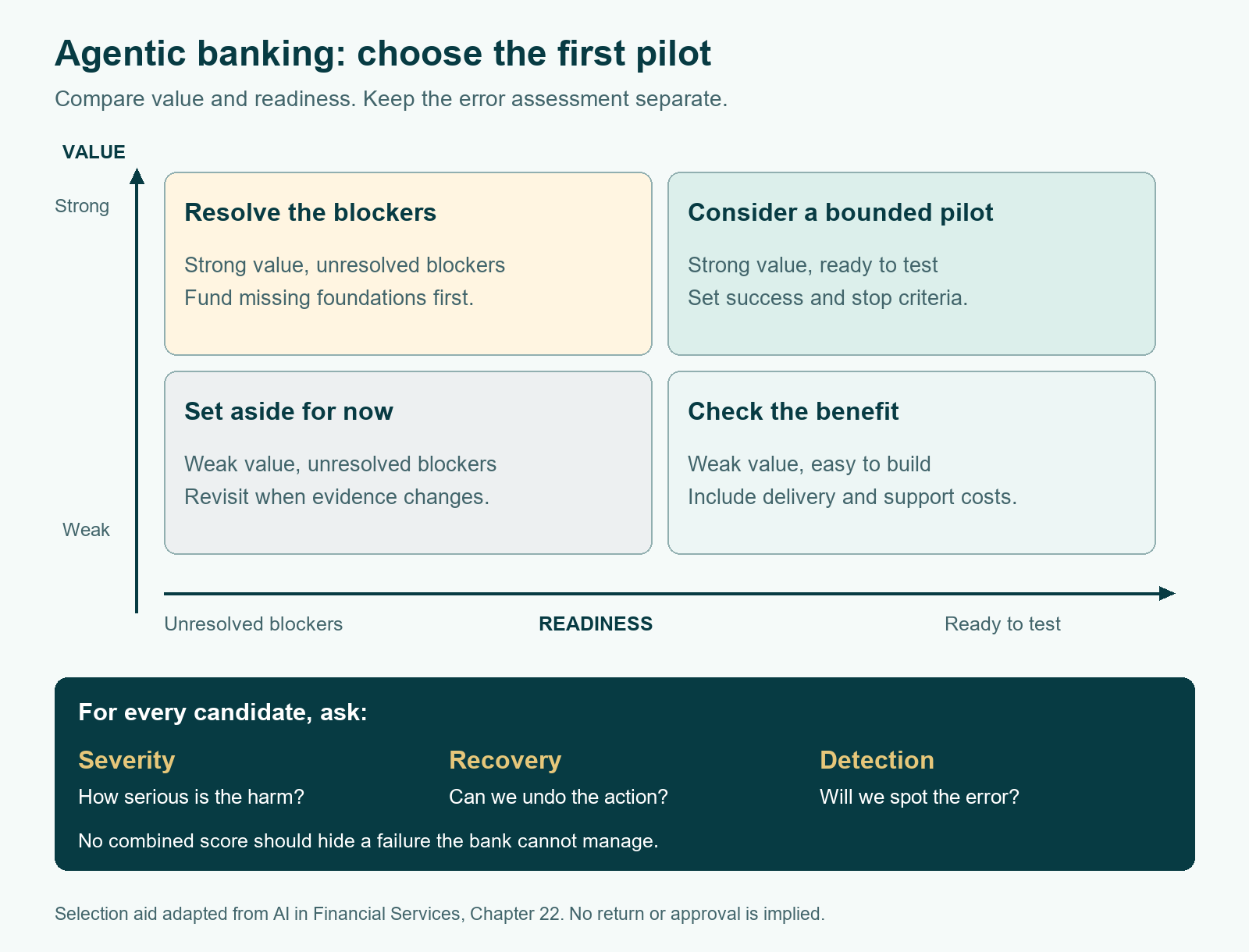
Compare value with readiness, and keep unresolved blockers visible. Keep the error assessment beside the ranking so a strong business case cannot hide a harmful failure.
| Candidate position | Practical decision |
|---|---|
| Strong value, ready to test | Consider a bounded pilot with clear success and stop criteria. |
| Strong value, unresolved blockers | Fund the missing foundations before committing to live use. |
| Weak value, easy to build | Check whether the benefit justifies the delivery and support work. |
| Weak value, unresolved blockers | Set aside unless new evidence changes the case. |
These positions organize discussion. They are not proof of returns or approval to deploy.
For example, the payment-records proposal might be ready if reliable records and source checks already exist. The complaint proposal could need tighter limits on what the agent may send or close.
However, the labels alone cannot decide the result. Each bank must test its own process, evidence, and controls.
Prefer pilots that leave useful capabilities behind
When two candidates have similar value and readiness, ask what each will leave behind. A reusable evidence format or access-control pattern may help later workflows.
Still, reuse needs a clear future use. A vague promise that a platform will serve every team adds little to the decision.
Also ask whether the process owner will change how the team works. If staff must run the old process in full alongside the new tool with no end date, much of the expected benefit may disappear.
For the first agentic banking pilot, write a short selection note. Include the workflow boundary, benefit measure, key conditions, main failure modes, fallback owner, and assets the bank can use again.
Then agree on what evidence would support a wider rollout, a change, or a stop. Start with a workflow whose gains the team can measure and whose failures the bank can manage in practice.
For more practical financial AI analysis, subscribe to FinTech Briefing.
FINTECH BRIEFING · A FUTURECENTRAL BRIEFING
Get practical financial AI analysis in your inbox.
Useful signals, focused analysis and decision questions on AI in banking, payments, lending, insurance, wealth and risk.
Free to subscribe. Confirm your email after signing up. Unsubscribe at any time.