


Human review can give a financial AI decision a stamp of approval without making it more accurate.
Consider this hypothetical credit case. An analyst receives a neat loan summary with a cash-flow table and a clear reason to approve. Yet a key income figure comes from the wrong period.
The analyst clicks approve because the summary looks complete. The system records a human decision, but the error survives.
For banks and fintech teams, each review step needs a clear purpose. What mistake should the person catch, which records make it visible, and what can they do next?
Human review needs its own test
After a rollout, it is easy to count checked cases. It is harder to show that human review led to better decisions.
A 2024 study by Daniela Sele and Marina Chugunova in PLOS ONE shows why adding a person may not improve a decision. People in the experiment used advice from a model or another person to predict students’ test scores. When they could adjust that advice, they were more willing to choose the model. However, their final estimates became less accurate on average.
The study also found that people were less likely to correct larger errors. When they did act, they made smaller changes to those larger errors.
These were controlled tasks, mostly with students. The experiment did not test trained bank staff or modern AI agents. It therefore cannot tell us how often bankers miss AI errors.
Still, a bank needs to test whether its own review process works. Use the tasks, records, and staff that the bank will rely on in daily work.
Our banking AI reliability analysis makes a related point: one success gives an incomplete view of a system. Human review needs repeated tests too.
Watch for advice that confirms a prior belief
Human review may favor advice that supports a stereotype the person already holds. Researchers call this selective adherence.
Saar Alon-Barkat and Madalina Busuioc tested this in Dutch public-sector experiments. They found no general tendency to favor advice from a model over equivalent human advice. In one experiment, however, people were more likely to follow advice that matched ethnic group stereotypes. The effect appeared for both sources of advice. It did not recur in their experiment with civil servants.
That context matters because these were public-sector tasks. The finding does not prove the same effect exists in an Indian credit team.
It does suggest a question to test. Does a person question weak evidence whether the advice supports or challenges their first impression?
For example, imagine a collections officer who thinks a borrower is unwilling to pay. An AI summary echoes that view without good support. Before using it to choose the next step, the officer should check which records back the claim.
Give human review the records it needs
A review screen should help staff check the proposed decision. A fluent explanation can make the task easier, yet also hide a weak link.
First, name the errors that matter. In the credit example, these might include stale income, a missed debt, or a policy exception that needs another person’s approval.
Then place the key records beside the AI output. Show the original statement and its date next to the extracted income figure. Link a policy claim to the relevant clause and version.
The case file should also list missing records and facts that conflict. Otherwise, silence can look like a completed check.
| Review target | Records to show | Action staff need |
|---|---|---|
| Income figure | Original record, period, and extracted value. | Correct the field and rerun affected checks. |
| Policy claim | Relevant clause, version, and case facts. | Challenge the reading or seek approval. |
| Identity match | Matching details and unresolved differences. | Request more records or escalate the case. |
| Proposed action | Intended effect and customer impact. | Hold, revise, reject, or approve within their authority. |
These are examples to adapt. Each team needs checks that fit its actual errors and decision rights.
Test the handoff before adding more AI tasks
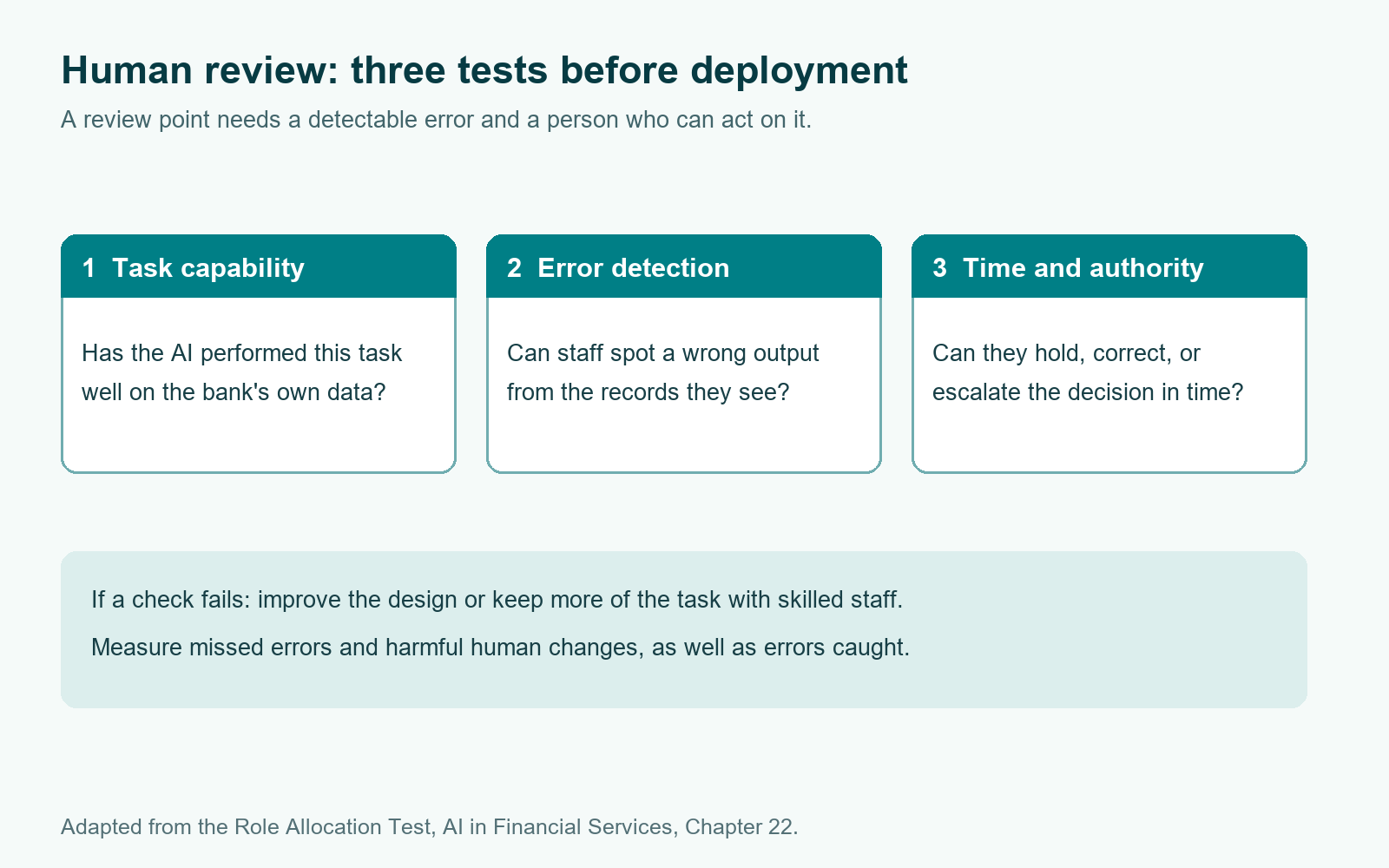
Break the work into stages with a clear output and owner. Next, test the handoff from AI and source systems to human review.
Has the model shown it can do this task well on your bank’s data? If it gets the task wrong, can staff spot the mistake from what they see on screen?
Finally, do they have enough time and the power to act? If the workflow fails any of these checks, change the design before sending more work through it.
An offline test can mix correct cases with flawed outputs. Include obvious mistakes as well as plausible errors in summaries that otherwise look sound.
Before the test, a separate team should establish the correct answers. Staff doing the checks should not know which cases contain planted errors, because daily work offers no such warning.
Count harmful errors they miss as well as errors they catch. Also check when a person changes a correct output into a wrong decision.
Run these tests in a controlled setting. Real customers should not bear the cost of planted mistakes.
Check whether human review improves decisions
A high override rate can mean active review, weak AI output, or poor human changes. A low rate can mean strong output or passive approval.
Either way, the rate needs context. Track whether the final decision improved after a person changed the AI’s advice.
Results should also separate errors by type and harm. A team that catches spelling mistakes while missing wrong balances may look busy and still provide weak control.
The process also needs a backup route. When records are missing or a system is down, give the case to a named owner with a clear deadline.
A growing queue changes the test conditions. If staff must rush, earlier results may no longer describe the live process.
Our agentic KYC guide explains why research, policy checks, and client decisions need clear boundaries. Staff need to know which checks remain open when they receive an AI case file.
Make the review step earn its place
First, choose one workflow and write a short plan for its review point. Name the key error, the records that reveal it, the person who checks, and the action they can take.
Then test that plan with the staff who will use it. If they cannot spot the error, improve the case file or keep more of the task with skilled people.
Human review can preserve judgment while keeping people accountable. It adds practical value when a person can detect a problem and has the means to correct it.
For more practical guidance on responsible financial AI, subscribe to FinTech Briefing.
FINTECH BRIEFING · A FUTURECENTRAL BRIEFING
Get practical financial AI analysis in your inbox.
Useful signals, focused analysis and decision questions on AI in banking, payments, lending, insurance, wealth and risk.
Free to subscribe. Confirm your email after signing up. Unsubscribe at any time.