


An AI banking strategy should help a branch resolve the request in front of it. Consider a hypothetical customer who has returned to ask why a service request remains open. A chatbot can explain the process, but staff still need to find the case and complete the work.
That is a useful starting point for a public sector bank. Ask which delays AI can help remove and which decisions need a person. Then redesign the steps around a clear service goal.
An AI-first bank would use AI where it improves that work, with limits staff can enforce. It would also keep a reliable route for customers who need human help. The test is whether the service works across branches and channels.
Build the AI banking strategy around a service outcome
Choose a problem that the bank can define and measure. For example, a team might aim to resolve routine service requests with fewer repeat visits. It needs a baseline for waiting time and errors before it can judge a new tool.
Language can be part of that problem. The Ministry of Finance’s April 2026 announcement describes Bank of Baroda’s bob SAMVAD, a platform for multilingual conversations between branch staff and customers. It reports a launch in March and a planned first phase across 250 branches.
That is a concrete service use case. The announcement establishes a launch and a rollout plan; measured gains in resolution time would need further evidence. A bank should apply that same distinction to its own AI program.
Choose workflows that staff can supervise
Start where records are available and teams can check the result. A service assistant could find the right form and flag missing details. Staff would still confirm the customer’s request before changing a record.
Credit teams could test support for checking loan files, while fraud teams could test case preparation for review. Collections and compliance teams could also test document summaries. Each use case needs its own limits and a named team to handle exceptions.
Rank these options by likely service value, data readiness, and the cost of mistakes. Also check whether a simpler process change could solve the delay. Our workflow priorities guide sets out questions to ask before choosing a pilot.
Connect the data before expanding the tool
In the opening case, a fluent answer will not help if the assistant cannot find the live request. The bank needs a way to match the customer to the right case. Shared customer and account IDs help systems link the correct records.
Also name the approved source for each answer. A policy search should show the version in force and link to its source. Staff need to know when a scanned document is incomplete or hard to read.
Connect the tool to the core banking system, which holds account and transaction records, through controlled interfaces. Also connect the case records. Define which data it may read and which changes need approval. Test a failed connection as well as a successful one.
Use data for an agreed purpose and check the permissions needed for that use. Record where it came from and how it changed. This record of data history, often called lineage, helps staff trace an answer back to its source.
Build accountability into the AI banking strategy
The RBI’s FREE-AI committee report, published in August 2025, places responsibility on the entities that deploy AI. Its principles include fairness, accountability, and understandable design. The committee’s recommendations provide a reference for this discussion; each bank must also map the rules that apply to it.
For every use case, keep a record of the model and its owner. State who tests it before launch and who can approve a change. Also specify what evidence reviewers must see before they accept its output.
Customers need a clear way to challenge an outcome or seek help. Pass the case history and open questions when a digital channel hands the case to a person. Check whether the process works for customers who need a local language or an assisted service.
Procurement must support those controls. Ask vendors for test access, clear data-use terms, and records the bank can inspect. Set terms for changes, outages, and exit so that a contract can support the service through problems.
Pair a shared platform with accountable workflow owners
A central team can provide common tools for access control, searching approved sources, and logging. This can reduce the need for each department to build those services again. However, a platform team cannot decide every business rule for every workflow.
Give the service owner responsibility for the result from the first request to closure. Bring branch operations, technology, and risk staff into the design. Compliance and procurement staff should join early enough to shape the requirements.
Before launch, agree on who acts when the tool gives an unsupported answer or a vendor service fails. Also test how branch staff continue the work. Our human review guide explains why a review needs both evidence and time to assess it.
Train staff for the work that changes
Training should use the cases staff face each day. Ask a branch employee to spot an outdated policy in an AI answer. Then check whether the employee can find the correct source and route the case safely.
Managers need a different set of skills. They must review error patterns, set sensible targets, and check that staff can report problems. A target based only on speed can encourage people to accept weak output.
The bank may also need specialists in data quality and model testing. Pair them with staff who understand branch work. A useful AI banking strategy makes room for those roles and the time needed to learn them.
Measure results after review and rework
Measure the whole service from the customer’s first request to a checked result. Include repeat visits and cases reopened after an apparent resolution. A quick chatbot reply says little about whether the bank completed the request.
Also track errors and the time staff spend checking or repairing output. Compare results across languages and service channels where the data supports it. Look for groups whose waiting time or error rate has worsened.
For a fraud workflow, measure missed fraud, false alarms, and the time staff spend reviewing cases. For loan support, check file quality and the time to a reviewed decision. These measures help the bank judge value without treating every generated answer as useful work.
Freed staff time creates capacity. A claim of cost savings needs evidence of costs actually removed; a revenue claim needs evidence of business gained. Our AI sourcing guide can help teams assess the costs and dependencies behind the service.
Scale the AI banking strategy in stages
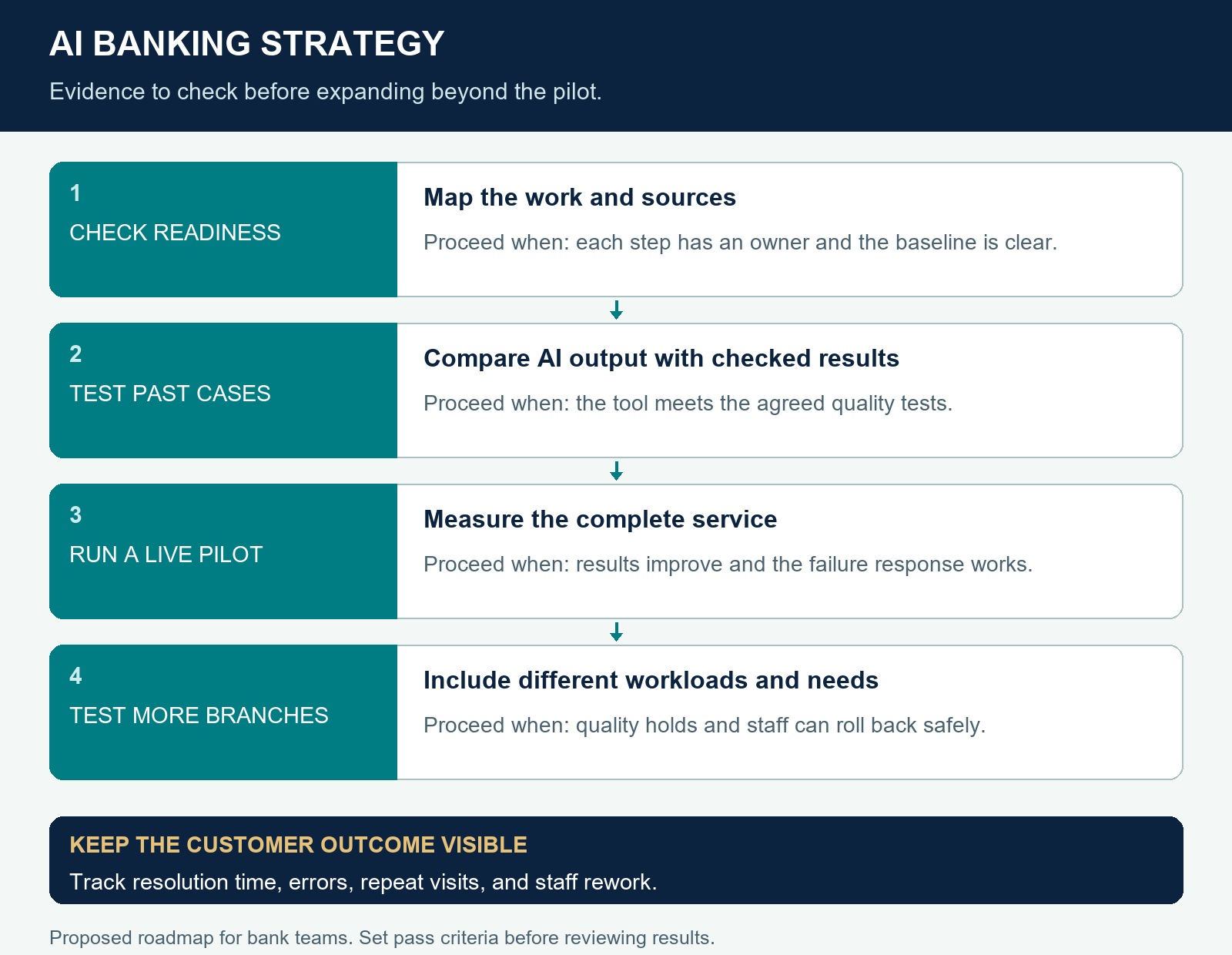
Use a phased roadmap with clear tests at each stage. First, map the workflow and check the source data. Move forward when the bank can trace a sample case and name the people who own each step.
Next, test the tool on past cases and then in a controlled live pilot. Compare it with the baseline, check difficult cases, and rehearse a failure. Set the pass criteria before results arrive.
Then widen use across branches that differ in workload and customer needs. Keep a rollback plan and check whether results hold. Expand shared tools only after the bank has shown that they work beyond the original team.
For the customer asking about an open request, progress has a simple meaning: staff can find the case and finish it correctly. Start the AI banking strategy there. Ask the next project team to show how its proposal changes that customer’s journey.
For more practical analysis of financial AI, subscribe to FinTech Briefing.
FINTECH BRIEFING · A FUTURECENTRAL BRIEFING
Get practical financial AI analysis in your inbox.
Useful signals, focused analysis and decision questions on AI in banking, payments, lending, insurance, wealth and risk.
Free to subscribe. Confirm your email after signing up. Unsubscribe at any time.