


An insurance AI inventory should help a claims manager answer a customer’s question: why did my file enter a slower queue?
Consider a hypothetical motor claim. A tool reads repair estimates and flags invoices that may repeat the same charge. Staff then route the file for extra checks. When the customer asks about the delay, the manager needs to trace the tool’s output and find who reviewed it.
A software list won’t supply that answer. A useful record links each AI use to its effect on customers and the person responsible. It also points to tests, review logs, and a way to keep claims moving when the tool fails.
Why an insurance AI inventory matters now
On November 13, 2026, the California Department of Insurance announced a survey and public workshop on responsible AI use. The survey asks how insurers use and oversee AI, including tools from outside suppliers. A December 15 workshop will gather views on consumer safeguards.
The department says this initiative gathers information; any formal regulatory proposal would need a separate public process. This California announcement creates no Indian requirement. For Indian insurers, the useful lesson is a management question: can you explain where AI affects your customers?
The register below is a suggested starting point. Legal teams should check which rules apply to each business and use. Filling in a spreadsheet cannot prove that a system meets the rules or is safe.
There is also a broader reference point. The US National Institute of Standards and Technology’s AI Risk Management Framework Playbook, GOVERN 1.6 discusses an inventory that tracks systems across their life cycle. The insurance-specific fields here are editorial recommendations.
Map the work, including AI inside vendor products
Start by walking through how staff sell a policy and how a claim reaches payment. Ask each team where software predicts, ranks, generates text, or recommends action. Include pilots and tools that staff use without a formal rollout.
For example, underwriting tools may assess applications, while pricing models help set premiums. Claims teams may use document readers or routing scores. Fraud tools flag cases for investigation; a flag alone cannot establish wrongdoing.
Distribution needs attention too. An assistant may suggest products or draft messages for agents. Servicing tools may answer coverage questions, while employee assistants summarize internal files. Each use needs a clear boundary because a draft can influence what staff tell a customer.
Ask vendors about AI features within existing products. A claims platform upgrade may add a model even when the insurer has bought no separate AI service. Purchase records and staff interviews can reveal gaps that a central technology list misses.
In your insurance AI inventory, use one entry for each distinct business use. If the same model drafts letters and ranks claims, record both uses and link them to the shared component. They affect customers in different ways and need their own checks.
What each insurance AI inventory entry should contain
Keep the main register brief enough to maintain. Then link each entry to detailed evidence in a secure store. These fields form a practical insurance AI inventory:
- Identity and status. First, assign an ID and name the business use. State the product and channel, then mark it as a pilot, live, paused, or retired.
- Purpose and limits. Describe what staff expect the tool to do before they use it. Also record uses that the insurer has ruled out.
- People in charge. Name the business owner, technical contact, and person who approves use. Then explain who reviews the work.
- Model and supplier. Record the provider, system, and model versions before each release. Also link shared parts and keep a record of changes.
- Data and access. List input sources and types of data before staff grant access. Link the rules for permitted use, access, storage, and how long to keep records.
- Affected customers. State which products, customer groups, and languages the tool serves. Also state how many customers the tool could reach.
Record decisions and checks
- Decision authority. Describe the output, then state what it can trigger. Mark the point where a person must approve an action, plus actions the tool cannot take.
- Risk assessment. Give the use a risk tier, or level, because that choice sets the checks it needs. Describe possible harm and the checks that address it.
- Validation. Link the tests that check whether the tool works for its intended task. Then add results, known limits, reviewer, and approval date.
- Oversight and appeals. Set out how staff review outputs before they act and how they can overrule the tool. Explain how a customer can raise a complaint and how staff can trace a case.
- Monitoring and fallback. Define what to measure, when to raise an alert, and who acts. Then record how to pause the tool and switch to a tested backup process.
- Review and change dates. Log the last update and next review. Also track open issues and explain how to close the use when it ends.
Record unknowns explicitly, with an owner and a due date. A blank model-version cell should prompt follow-up before a change slips past testing.
Keep customer files out of the register itself. For example, an entry can describe repair invoices as an input and link to controlled records. The data-access review should explain who can see those files and why. Our article on permissioned data in financial AI explores that boundary further.
Use the register when something goes wrong
A risk tier needs a reason. Consider how much harm an error could cause, how many customers it could reach, and how quickly staff could correct it. Check routing tools closely because delays can harm customers even when a person decides the claim.
For bias testing, use the recorded customer groups to plan comparisons. Where lawful and appropriate, check error rates across languages or other relevant groups. Account for sample size and claim differences before treating a gap as evidence of unfair treatment. Link the results so reviewers can judge the evidence.
During an appeal, the insurance AI inventory should point staff to the model version used at that time. Preserve relevant inputs, outputs, review actions, and reasons under approved rules on how long to keep records. Then an appeals reviewer can trace what happened and assess the claim afresh.
Vendor review should cover testing evidence and notice of major changes. Also ask who handles failures and how the insurer can pause the feature. Record limits in supplier access or documentation because those gaps affect the controls available.
For board reports, show where risk remains: high-risk uses without current tests, overdue controls, customer complaints, and shared supplier failures. Counts of AI tools alone say little about harm. The related article on SEBI AI readiness examines similar ownership questions in securities businesses.
Worked example: a motor-claims triage tool
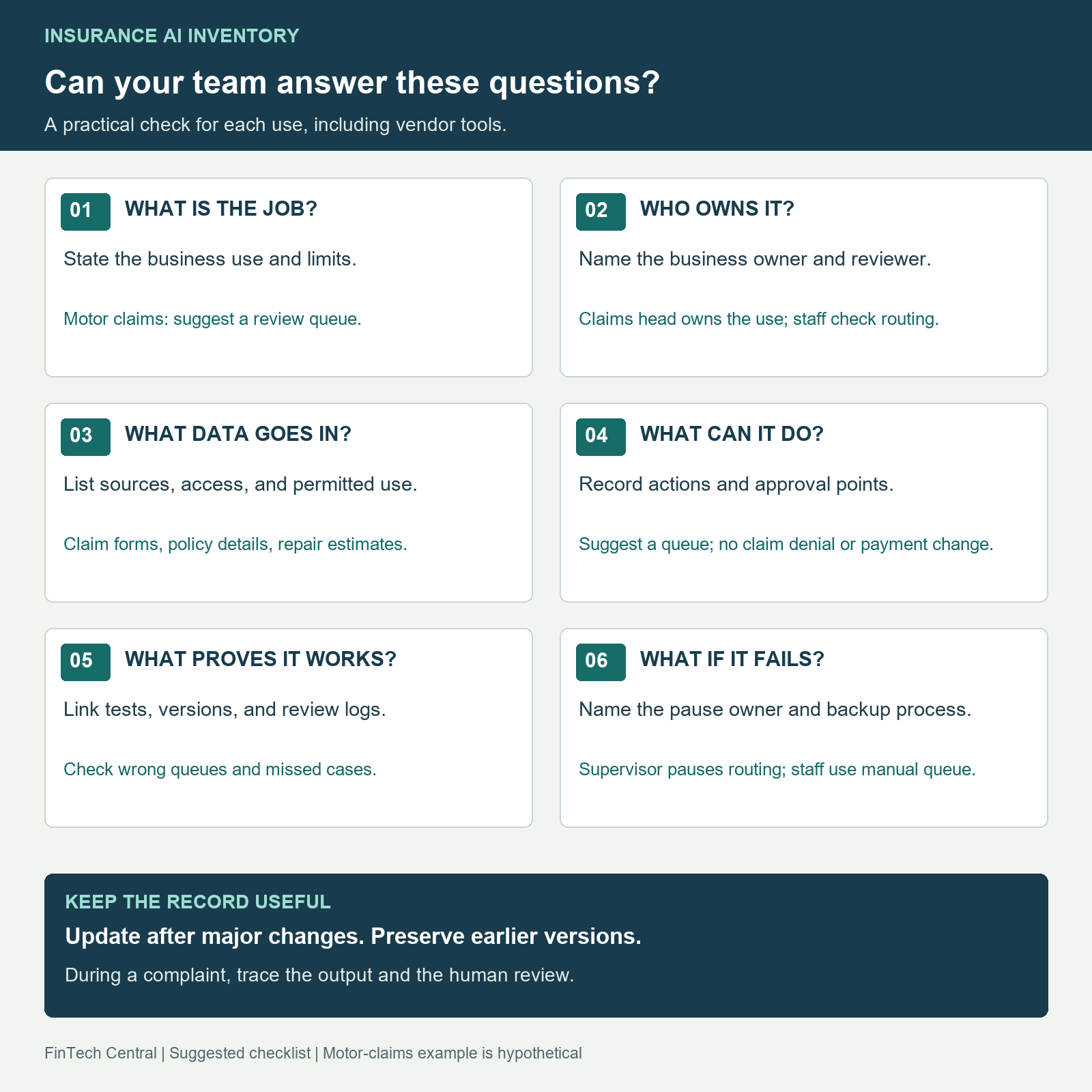
Suppose an insurer tests a tool that reads repair estimates and suggests a review queue. This is a hypothetical design, with no claimed production results. Its entry might contain the following:
- Purpose and owner: Sort incoming motor claims for review; the head of motor claims owns the use.
- Inputs and supplier: Claim forms, repair estimates, and permitted policy details; record the document reader, routing model, vendor, and versions.
- Authority: Recommend a queue. Staff approve routing before a file moves; the tool cannot deny coverage, change payment, or send a customer message.
- Tests: Check routing errors on files kept separate from training, including estimates in local languages and faint scans. Review both needless extra checks and cases the tool missed.
- Monitoring: Track review delays, wrong queues, overrides, and complaints. Sample apparently routine files too, since checking flagged files alone can miss errors.
- Fallback and review: Let the claims supervisor pause automated routing and use the manual queue. Test staff capacity and record the next review date.
Before launch, define when an error or delay requires action. Set thresholds against the insurer’s own service standards and approved risk tolerance. A human approval step helps only if reviewers have the time and evidence to challenge the recommendation.
After a major vendor update, reopen the tests and approval record. Keep the earlier entry so an old claim remains traceable. If the tool later gains power to send messages, review that wider power before staff switch it on.
Put the register to work
Start your insurance AI inventory with the uses that affect claims and coverage. Assign an owner to each gap, then test whether staff can find the right record during a complaint. That exercise will show what the register still needs.
Download the starter register, which includes an illustrative row and blank space for your own use. Replace all placeholders and complete the review before launch.
For more practical financial AI explainers, read the FinTech Briefing.
FINTECH BRIEFING · A FUTURECENTRAL BRIEFING
Get practical financial AI analysis in your inbox.
Useful signals, focused analysis and decision questions on AI in banking, payments, lending, insurance, wealth and risk.
Free to subscribe. Confirm your email after signing up. Unsubscribe at any time.