

Permissioned data can change a lending conversation before an AI model writes its first answer.
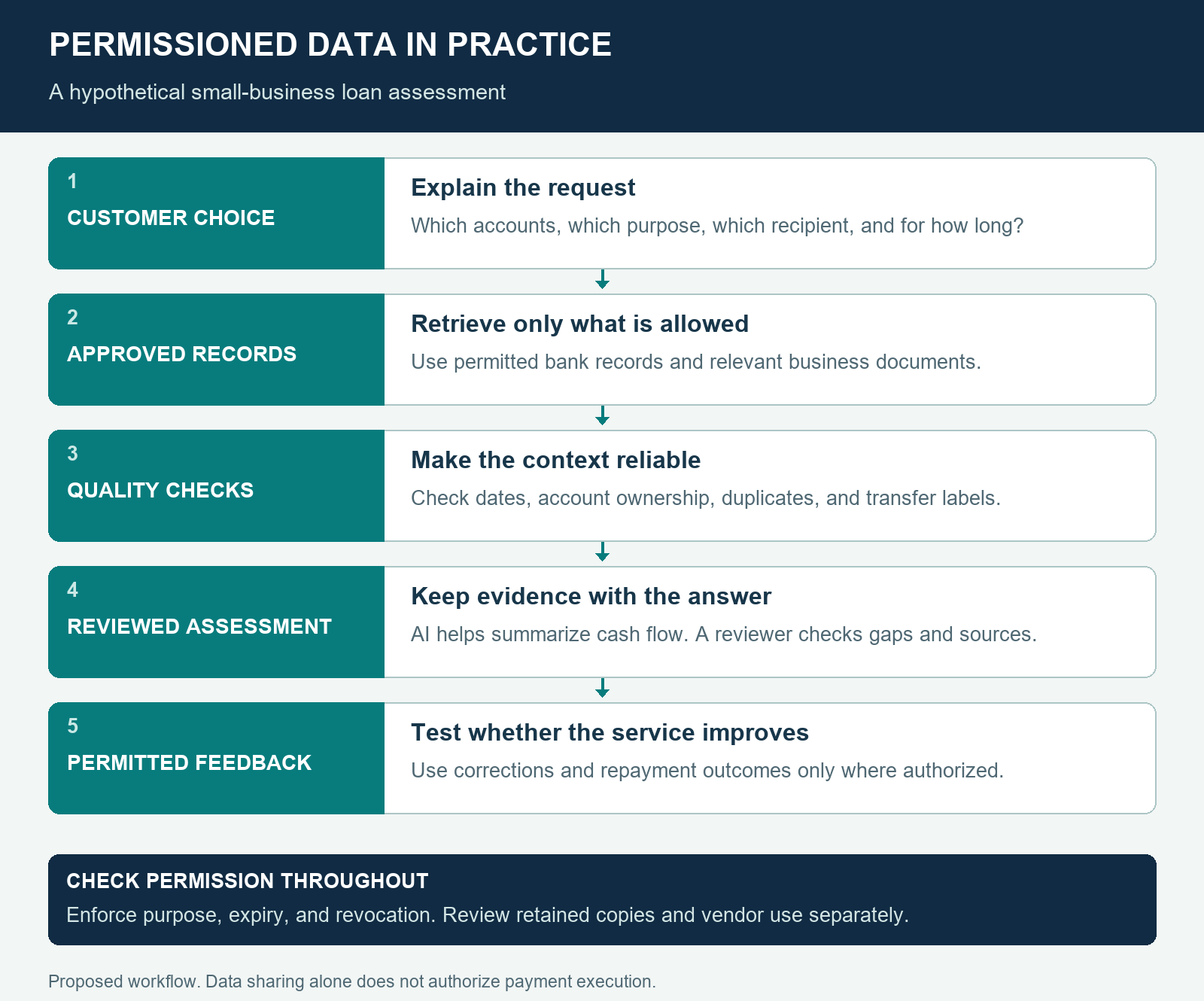
Consider a hypothetical stationery wholesaler seeking money to buy stock before schools reopen. Her last tax return shows the prior year’s trade. Recent account records could reveal whether schools are paying on time and whether supplier bills have risen.
With her consent, a lender could use those facts to assess the request. A model with no access to the records would have far less to work with.
Yet access leaves questions open. Are the records up to date? What may the lender do with them? Can the customer fix an error?
Banks and fintechs can build an edge by answering those questions and improving a real service. That is the case for treating trusted data access as a source of lasting advantage, or a moat.
A capable model is only part of the product
Financial firms can choose among several suppliers of foundation models, the general-purpose AI models behind many business tools. They can also use licensed data in more than one AI tool. LSEG, for example, describes a service that brings market data into AI tools while checking clients’ access rights. Its product guide says access depends on license terms and a phased rollout.
This shows where firms can compete. Two lenders might buy the same model, but use it with different client records and lending steps. Their results could differ because one can fill gaps in the records and act on the answer.
Model choice still matters. Test how well each model works, what it costs, and how fast it responds. However, a strong model cannot supply a missing repayment record or decide whether your contract allows a new use.
The build, buy, or partner decision therefore needs to cover the whole service. Model fees cover only part of that service.
What permissioned data actually includes
Permissioned data is data a firm has a valid right to use for a stated task. That right might rest on consent, a license, or other grounds in law. Consent does not set aside other duties or make every new use lawful.
The useful context can include account transactions, products held, past service requests, risk signals, and documents. Checked outside sources, such as licensed market data, can fill gaps. For each source, record which uses the terms allow.
For the wholesaler, sales receipts mean more when the lender can match them to the right firm and dates. A transfer between her own accounts could otherwise look like new sales. A note from a past service call might explain a disputed debit. Yet staff need a valid purpose to use that note too.
Collect only what the task requires. A broader profile adds work: staff must check access and keep more records correct. It may add little to the decision.
Test four qualities of permissioned data
Start with freshness. A cash-flow review needs a clear end date for the records it uses. If a feed stops, the product should flag the gap before staff rely on it.
Next, check that the records are right. Match account owners, remove duplicates, and distinguish sales from loans or transfers. Keep a path back to the source so staff can check a disputed figure.
The third test is the right to use the data. The right to fetch a statement does not grant the right to use it for every task. Your team needs to link each use to the customer, purpose, recipient, and time limits.
The fourth test is a link to a real result. In the wholesaler’s case, that could mean less time spent chasing files without more errors. Also track staff time, how many applicants quit, and whether borrowers repay. Compare similar loan requests with the old process before claiming a gain.
These tests work together. Fresh records with wrong labels can mislead. Clean records add little if staff cannot use them in the loan review.
India’s Account Aggregator rails change access
India’s Account Aggregator, or AA, framework provides a route for consent-based financial data sharing. Under the RBI’s 2025 AA directions, the consent record identifies the requested information, purpose, recipients, and relevant dates. Customers must also have a way to revoke consent, and electronic consent records must support audit and verification.
The framework separates data sharing from moving money. An AA must not support customer transactions or retain the financial information it accesses. Information users are entities regulated by a financial-sector regulator; a fintech cannot assume that any app may receive data directly.
Adoption gives this route practical weight. Sahamati’s ecosystem dashboard reports 352.19 million linked accounts and 595.11 million fulfilled consents cumulatively through September 2026. One person can link several accounts or give consent more than once. The totals do not measure unique users or better loans.
Before designing around AA, check the providers and account types your target customers can actually use. Then test whether the data arrives and whether it covers the period you need. A large network count cannot tell you whether one borrower’s required history will arrive.
Shared rails also allow rivals to seek access with the customer’s consent. The lender still has to earn trust and deliver a service worth using.
Make permissions part of the customer experience
For permissioned data to support a useful product, people must understand the request. Explain which records the service needs and what it will do with them. A loan review and an ongoing budgeting service may need access for different lengths of time.
Then enforce those limits in the software. Check authority before fetching records and again before giving a tool access to them. Limit staff access by role.
Treat instructions inside uploaded files as untrusted. They must not change who can access the system or its records.
Model training needs a separate check. A vendor may have the right to read a statement to answer a question. That does not settle whether it may keep it or train on it. Check contracts and system settings for reuse, storage, and access by the vendor’s own suppliers.
When consent ends or the customer withdraws it, stop access that no longer has authority. Separately, check which records the firm must keep and which it should delete under the rules that apply. Include saved copies, search indexes, and logs in that review. A stop button does not remove every copy by itself.
Keep enough secure proof to show which source and permission supported an answer. Our guide to financial RAG source checks explores how to keep retrieved evidence connected to the response.
Earn the return through the service
In the hypothetical loan case, the lender could earn interest on loans while using better context to spend less time chasing files. An AI summary would help only if staff could check it and fill gaps. Later loan results could test whether the review improved. The firm still needs valid rights to use those results.
The same test applies elsewhere. A money guidance service needs current balances and the client’s goals before suggesting a plan. An insurer could use policy terms and past claims to explain which files a customer still needs. Both services must earn repeat use by giving useful, correct answers.
Fraud prevention may draw on different legal grounds and controls from an optional advice service. Even within one firm, teams should check the authority for each use. A shared database does not erase those boundaries.
Build a feedback loop around corrections and outcomes. If staff find a transfer wrongly labeled as sales, record the fix where the rules allow. Then test whether the fix cuts similar errors without exposing another client’s records. Over time, these tested fixes can be hard for rivals to copy.
Own the customer promise; choose partners carefully
Name a person in the firm to own the purpose, access rules, and service results. Teams can buy models, license outside information, or partner to connect data sources. They still need to explain and enforce the service’s limits.
Before signing, test whether a new model supplier could use the same approved sources and access rules. Check whether you can move consent records, source links, and test results when changing vendors. Budget for connecting systems, support, and control work alongside model fees.
Finally, ask what a rival could copy. If it can get the same records on the same terms, access offers a weak defense. The firm must show that its service and tested data checks add value.
Start with one workflow and show what permissioned data changes: fewer missing records, faster resolution, or more accurate decisions. Expand only after checking the cost of controls and the risk of harm to customers.
For more analysis of these operating choices, subscribe to the FinTech Briefing.
FINTECH BRIEFING · A FUTURECENTRAL BRIEFING
Get practical financial AI analysis in your inbox.
Useful signals, focused analysis and decision questions on AI in banking, payments, lending, insurance, wealth and risk.
Free to subscribe. Confirm your email after signing up. Unsubscribe at any time.