


Insurance AI vendor due diligence starts when a claims manager asks to try the tool on a file the sales team has never seen.
Imagine a hypothetical product demo. A vendor’s tool drafts a useful claim summary from a clean repair estimate and policy details. Then the buyer supplies a faint scan with a missing page. Can the tool flag what it cannot read, and can staff check where each figure came from?
That second file should shape the buying decision. A good demo shows what a product can do under selected conditions. The insurer still needs evidence that it can use the tool safely, at a workable cost, on its own mix of claims.
Our insurance AI inventory guide explains how to record each use and its owner. The next step is to turn that entry into a brief for the vendor. Start with the task, the data it needs, and the actions the insurer will permit.
Start insurance AI vendor due diligence with the job
A tool that drafts a summary has different powers from one that changes a claim’s queue. Either could affect a customer, so describe the whole path from input to staff action. Also state whether the system can send messages or change a payment.
For the motor-claims example, the buyer might allow draft summaries for staff review. It could rule out coverage decisions and customer messages. Put those limits in the test plan and proposed contract before the pilot starts.
Name the business owner who can accept the use. Then involve claims staff and the teams responsible for technology, security, privacy, legal review, and purchasing. The vendor should know who decides whether the evidence is good enough.
Overseas guidance offers useful reference points. The US National Association of Insurance Commissioners’ model bulletin on AI systems, adopted in December 2023, addresses third-party due diligence. It also discusses audit rights or audit reports and cooperation with regulators, where appropriate and available.
New York’s Circular Letter No. 7 of 2024 addresses AI in insurance underwriting and pricing. It expects oversight of vendors and says insurers retain responsibility for their use. These are US reference points. The questions below are suggested buyer practices; Indian legal teams should map the rules that apply to the actual arrangement.
Check insurance AI vendor data flows
Ask the vendor to map how a claim file moves through its service after upload. Which systems receive the document? Where do they process and store it, and who can see it? Also include the other firms that help provide the service.
Separate data use for the agreed task from use to train or improve models. Check prompts, outputs, logs, and backup copies as well as uploaded files. A promise about the main document may leave other records outside its scope.
For each type of record, seek written terms on permitted use and how long the provider keeps it. Also check staff access, deletion, and support access from other locations. Our permissioned-data article explains why access rights need a defined purpose.
List the parts that the supplier depends on. A claims application may call an outside model, a document reader, and a cloud service. Ask which parts the vendor can change without notice, because those changes may alter quality or data handling.
Security reports can help assess the service. However, check their date, scope, and open findings before relying on them. A report on one hosted product may say little about the proposed claims setup or the tool’s accuracy.
Test the tool on the insurer’s own files
Use a test set that reflects the work you expect, with files kept separate from those used to train or adjust the model. Include routine claims as well as hard cases. Use lawful, controlled data, and agree on access before anyone sends customer records to the provider.
In the motor-claims example, include estimates in local languages, faint scans, and conflicting repair totals. Add a file with a missing page. Check whether the tool flags uncertainty and links figures to the source, while staff review what the file supports.
Choose measures before the vendor sees the test results. For a summary tool, check wrong amounts, missed facts, and statements the source does not support. Then measure the staff time needed to correct and approve each output.
Count every test file. If the system cannot process a case, record that outcome and its handling cost. Report results by document type or language where the sample permits a useful comparison. A single average can hide a group of files that staff must redo.
Also test misleading instructions inside a document. For example, a note in an uploaded estimate might tell the model to ignore its review rules. The system should treat the file as evidence to read and keep its permitted actions within the agreed limits.
Ask for the model and system versions used in each run. Keep the inputs, outputs, and reviewer decisions under approved record rules. Without that record, a later software update can make a disputed result hard to reproduce.
Put the working controls into the agreement
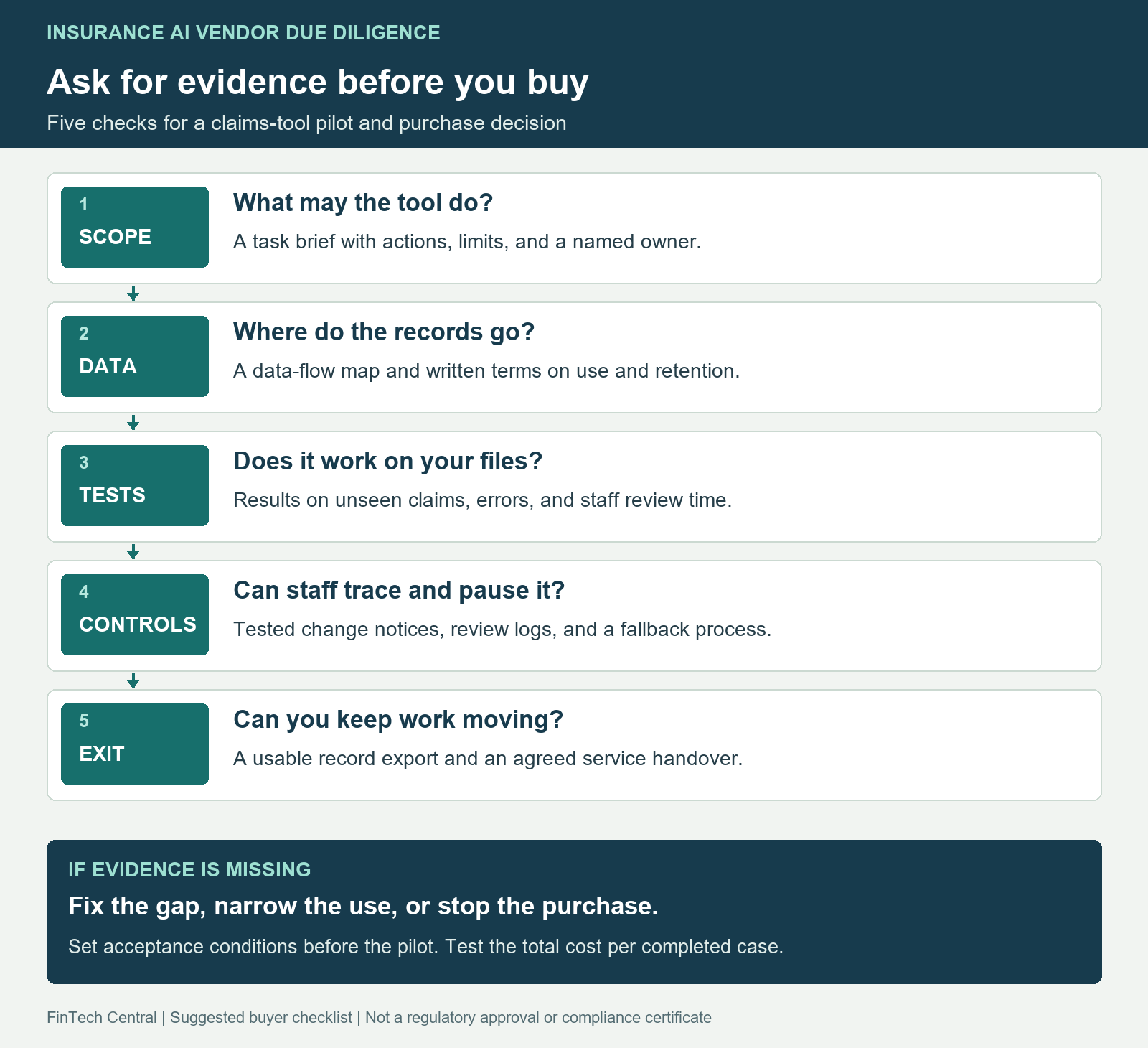
Insurance AI vendor due diligence should produce terms that staff can use when the service fails. Link test findings to named controls and owners. If evidence is missing, record the gap and decide whether to narrow the pilot or defer it.
Ask for a process to notify the insurer of major changes. Define which updates need new tests or approval before use. Where practical, agree how to delay an update or return to a tested version if results worsen.
Set out how each side handles failures and preserves evidence. Who takes the first call, what must the vendor report, and how will staff trace affected claims? Match response targets to the harm a failure could cause, then test the contact route.
Audit access needs detail too. Ask what records the insurer can inspect and what independent reports it can obtain. Check how the vendor will support a complaint or regulatory inquiry when a component comes from another supplier.
Contract terms also need a legal and commercial review. Examine liability limits and any exclusions for model errors. Fee credits for downtime may leave the insurer with the cost of reviewing wrong summaries or handling delayed claims.
Finally, test how staff stop the tool’s actions. A pause button should prevent further automated work while preserving the records needed for review. Customer-facing tasks still need an alternative process and enough people to run it.
Use pilot results to choose an insurance AI vendor
Begin with a defined task and a named reviewer for every output. Where useful, run the tool alongside the existing process without allowing it to change customer outcomes. Then compare quality and total handling time on similar work.
Agree on the conditions for wider use before the pilot starts. For example, the claims owner might require acceptable error levels on each key file type and a tested manual fallback. The insurer should set those levels for its own risk and service needs.
Include the full cost. Count license charges and usage fees, integration, staff review, repeat runs, monitoring, and vendor support. Compare cost per correctly completed case with the existing process. A cheaper draft may still leave more work for the claims team.
Check the exit before signing
Ask for an export of the records needed to continue work elsewhere. Check formats and the cost of moving, then test whether another team can use the export. Agree what the provider will delete, what it must retain, and when it will confirm completion.
Keep a short evidence record for the buying decision:
- Scope: The named owner approves the task, permitted actions, and limits.
- Data: Written terms cover the records and suppliers involved.
- Tests: Results show errors and staff effort on the intended files.
- Controls: Teams have tried the change, pause, and failure-response procedures.
- Exit: The insurer has tested record export and planned the service handover.
A weak result should lead to a specific choice: fix the gap, narrow the use, or stop the purchase. Extra strengths elsewhere cannot make an unresolved data-access or control gap disappear.
Bring the vendor back to that faint repair estimate. Ask the claims team to find the source figures, correct the draft, and finish the case. Insurance AI vendor due diligence is useful when it makes that work easier to judge before the insurer commits.
Read the FinTech Briefing for more practical analysis of AI in financial services.
FINTECH BRIEFING · A FUTURECENTRAL BRIEFING
Get practical financial AI analysis in your inbox.
Useful signals, focused analysis and decision questions on AI in banking, payments, lending, insurance, wealth and risk.
Free to subscribe. Confirm your email after signing up. Unsubscribe at any time.