

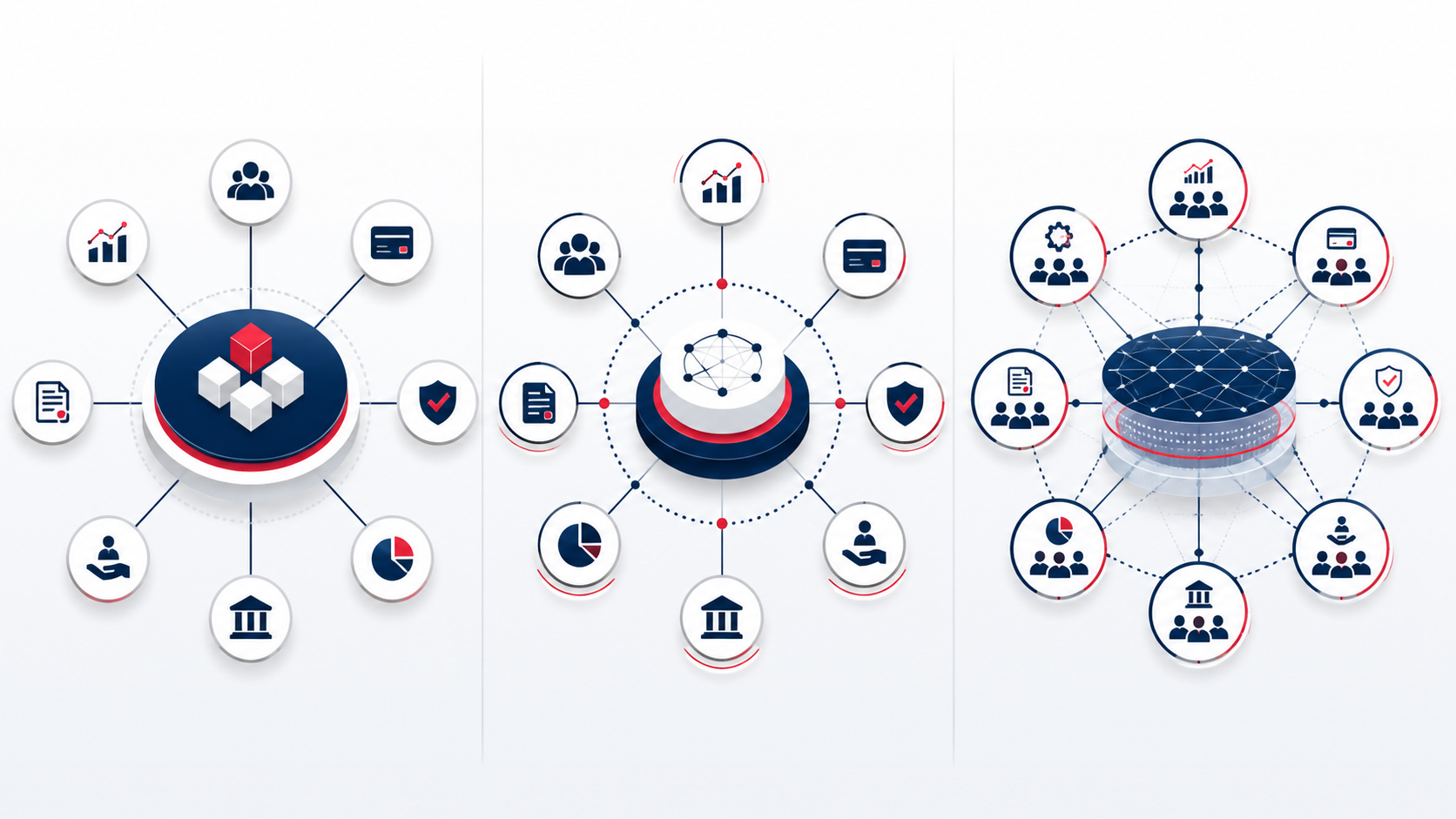
A bank AI operating model determines who builds AI, who controls it, and how successful ideas reach the wider institution. Without that design, banks often collect pilots but struggle to create repeatable value. Choosing among the available structures requires trade-offs involving speed, consistency, accountability, and proximity to customers.
Three patterns dominate: a centralized platform, a hybrid hub-and-spoke model, and an AI-native model. Each can work. However, each fits a different level of maturity and organizational complexity.
Why a bank AI operating model matters
AI work crosses normal organizational boundaries. A lending model may require product knowledge, data engineering, credit policy, legal review, model validation, cybersecurity, and frontline adoption. If nobody coordinates those groups, handoffs multiply and ownership becomes vague.
A clear bank AI operating model answers practical questions. It identifies who approves data access, which tools teams can use, who monitors a model after launch, and who owns customer harm or a weak business result. It also shows how another business unit can reuse a proven capability.
Model 1: A centralized bank AI operating model
In a centralized model, one enterprise team controls the main AI platform, technical standards, specialist talent, and often the project portfolio. This structure can establish strong discipline quickly.
It works well when a bank is early in its journey or must repair fragmented data and controls. Scarce specialists can work together, while the institution avoids buying overlapping tools. Central governance also makes audit and security more consistent.
However, distance from the business can become a problem. A central team may receive a long queue of requests and lack detailed process knowledge. Business units may then treat AI as a service ordered from technology. They may fail to own the change themselves.
Model 2: A hybrid bank AI operating model
The hybrid model combines an enterprise hub with AI teams embedded in business units. The hub provides platforms, reusable components, risk standards, and specialist support. Meanwhile, the spokes identify problems, redesign workflows, and manage adoption.
For many established banks, this is the most practical choice. It balances control with local knowledge. It also lets the bank vary governance by risk. A marketing recommendation and a credit decision should not face identical review.
Still, the hybrid design needs explicit decision rights. Otherwise, the hub and spokes may both assume the other owns data quality, monitoring, or benefits. A simple responsibility map should cover use-case selection, model ownership, validation, deployment, incident response, and retirement.
Model 3: The AI-native institution
An AI-native institution goes further. Shared data and AI capabilities are part of normal product delivery, while multidisciplinary teams own outcomes from design through operation. The institution retains central standards and makes approved controls and tools easy to use in everyday work.
This model can support rapid learning, but it requires mature foundations. Teams need reliable data, automated monitoring, strong product management, and employees who understand both AI’s potential and its limits. Banks should not declare themselves AI-native while basic ownership remains unclear.
Bank AI operating model examples from current strategies
JPMorganChase illustrates the value of a strong enterprise platform. The bank says its LLM Suite provides controlled access to generative AI and shared capabilities for building use cases. That platform approach can reduce duplication across a large institution. Its 2025 annual report also shows how shared tools can support employee workflows at scale.
Goldman Sachs shows why operating-model change must extend beyond technology. In its 2025 annual report, the firm describes One Goldman Sachs 3.0 as a new operating model propelled by AI. Its first workstreams cover end-to-end processes such as KYC, lending, regulatory reporting, and enterprise risk.
Digital banks begin with fewer organizational layers. Yet they still need clear governance as products and markets expand. FinTech Central’s profiles of Nubank and N26 show how a digital-first base can support faster product change.
How to choose the right bank AI operating model
Leaders should assess five conditions.
Data and platform maturity
If business units cannot access governed data or deploy models safely, centralization may be necessary first. A hybrid structure becomes useful when shared foundations are stable.
Strength of business ownership
Embedded teams work only when business leaders own outcomes. If AI remains “the technology team’s project,” more spokes will not solve the problem.
Risk profile
High-impact decisions need independent challenge, documentation, and monitoring. The operating model must preserve those controls even when delivery becomes faster.
Talent distribution
Central teams help concentrate scarce expertise. Later, rotations, common career paths, and communities of practice can spread capability without isolating specialists.
Need for reuse
Banks should reward teams for building reusable components as well as strong local solutions. Otherwise, every spoke creates its own version of identity checks, document extraction, or model monitoring.
How a bank AI operating model changes over time
The right structure can change over time. A bank may start centrally, introduce business spokes, and later make AI capabilities part of every product team. Therefore, leaders should review the design as maturity grows.
The strongest bank AI operating model gives teams a clear path from problem to production. It also keeps accountability visible after launch. Explore more related analysis in FinTech Central’s AI in Banking section.
A quick choice guide
Use a central model when the bank is new to AI. It is also a good fit when data is split, tools vary, or key skills are scarce. One team can set the base and stop teams from doing the same work twice.
Use a hub-and-spoke model when the base is sound. The hub can own shared tools and rules. Each spoke can stay close to the client, product, and daily work.
Move toward an AI-native model only when teams can act with care at speed. They need clear rights, good data, live checks, and a way to stop harm. If those parts are weak, a loosely governed model can raise risk.
The best test is simple. Can a team ship a safe tool, show that people use it, and prove that it helps? If yes, the model works. If no, the chart on the org page means very little.
Leaders should also watch the pace of work. A team should know where to go for data, testing, and a risk review. It should not wait for months to learn who has approval authority.
At the same time, speed is one aim, and sound control matters just as much. The bank must keep a clear log of each key choice. Staff must know when to ask for help. A client must have a fair path to request a correction or appeal.
Thus, the model must work on a normal day and survive beyond the slide deck. Clear roles, shared tools, and sound checks make that real.
FINTECH BRIEFING · A FUTURECENTRAL BRIEFING
Get practical financial AI analysis in your inbox.
Useful signals, focused analysis and decision questions on AI in banking, payments, lending, insurance, wealth and risk.
Free to subscribe. Confirm your email after signing up. Unsubscribe at any time.