


Bank AI value should show up in business results, customer outcomes, or stronger risk control. Model accuracy provides technical evidence; economic value depends on what changes after deployment. Banks therefore need a measurement system that connects performance to adoption, operating change, and financial impact.
This measurement is difficult because gains in one part of a process can create costs elsewhere. An AI tool may save time on one task and add review work for another team. Fraud models can prevent losses while blocking legitimate customers, and service assistants can answer quickly while weakening trust. Leaders need a balanced scorecard built around a credible comparison point.
Bank AI value begins with a clear baseline
Before launch, the bank should record how the process performs today. Useful baseline measures include cost per case, cycle time, error rate, loss rate, conversion, customer effort, and employee time.
The team should then state how AI is expected to change those measures. For example, a document model may reduce handling time, while a decision model may improve approval quality. This creates a testable value hypothesis grounded in operational change and measurable results.
Measure four layers of bank AI value
A strong framework tracks four linked layers.
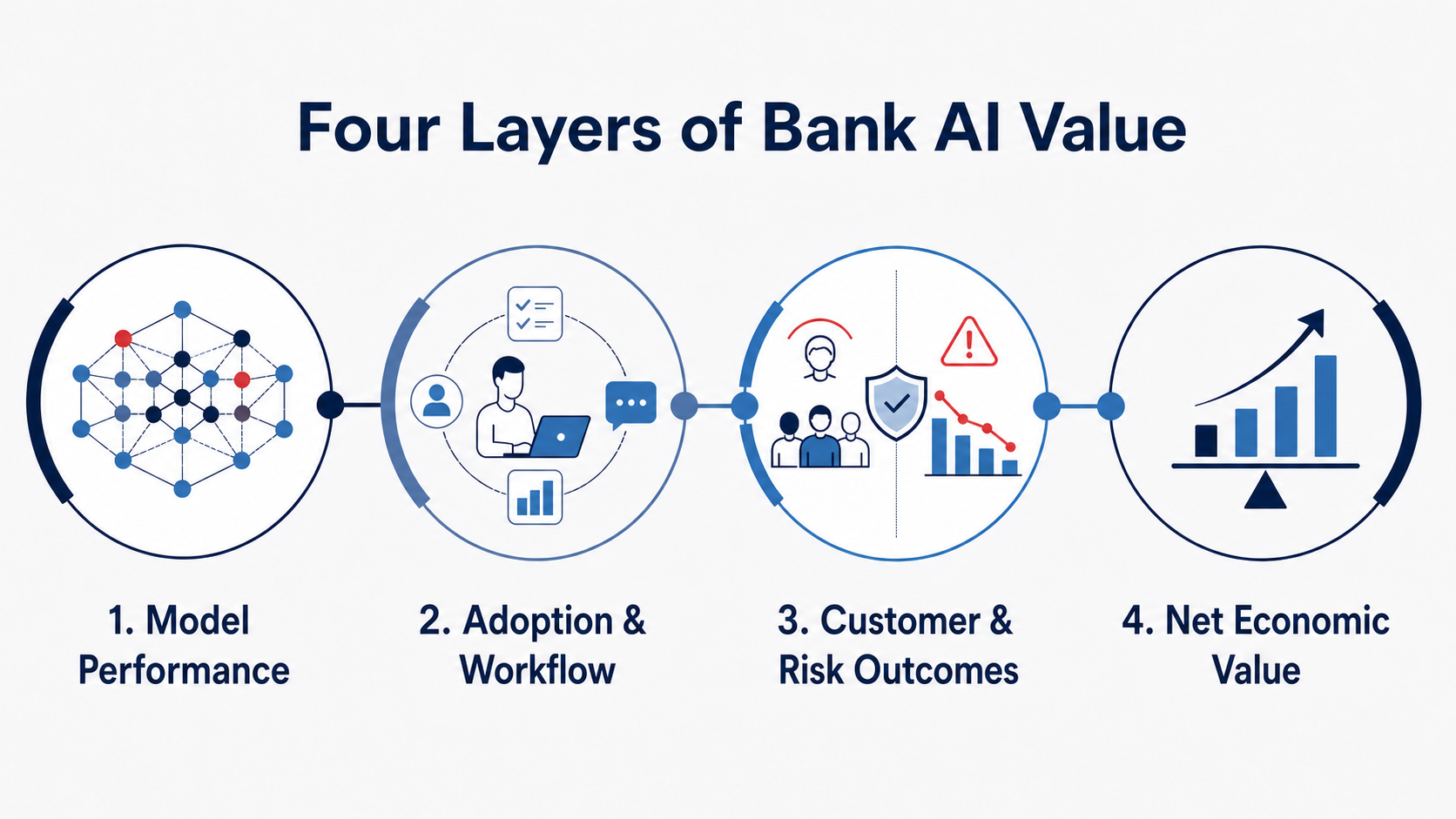
1. Model performance and bank AI value
Technical measures depend on the use case. They may include precision, recall, false-positive rates, calibration, stability, or response quality. Teams should also test performance across relevant customer groups and operating conditions.
These measures show whether the system works as designed. However, they do not prove that employees use it or that the bank benefits.
2. Adoption turns bank AI value into workflow change
The bank should measure active users, recommendation acceptance, override rates, time in the new workflow, and exception volumes. Low adoption may signal weak training, poor integration, or a system that does not help with the real job.
Override data is especially useful. A high rate may reveal a weak model, unclear guidance, or justified frontline caution. Forced adoption can hide the underlying problem.
3. Customer and risk outcomes reveal bank AI value
Customer measures may include resolution time, complaint rates, approval speed, abandonment, and satisfaction. Risk measures may include prevented fraud, credit losses, operational errors, control failures, and harmful false positives.
These outcomes need guardrails. For instance, a lender should not celebrate faster approvals if later losses rise sharply. Likewise, a fraud team should not reduce losses by creating unacceptable payment declines.
4. Economic measures complete the bank AI value case
Economic value can come from revenue growth, avoided losses, lower operating cost, reduced capital use, or improved employee capacity. The calculation should subtract the full cost of data, technology, vendors, controls, training, monitoring, and change management.
Capacity is not automatically cash. Saving ten minutes per case creates value only if the bank handles more work, improves service, reduces overtime, or redeploys time to higher-value activity.
Strengthen bank AI value estimates with control groups
The strongest test compares outcomes with a credible counterfactual. A bank can introduce a tool to a selected group, branch set, product segment, or workflow while maintaining a comparable control group. It can then measure the difference over a suitable period.
Randomized tests are not always practical, particularly for high-risk decisions. Still, phased launches, matched cohorts, and before-and-after comparisons with adjustment can improve confidence. Finance and risk teams should agree on the method before results appear.
DBS provides a useful public example of enterprise-level measurement. Its 2025 annual report says more than 2,000 models and over 430 use cases generated about SGD 1 billion in economic value during the year. The headline matters less than the discipline behind it: DBS aggregates value from deployed use cases across the bank.
Avoid common measurement traps
Counting pilots as progress
A pilot count says little about adoption or value. Banks should track the share of validated use cases that reach production and remain useful after launch.
Treating gross savings as net value
Claims often omit data work, integration, human review, licences, and ongoing controls. Net value is more credible.
Ignoring displaced work
An automated step may push complexity to another team. End-to-end process measures prevent local gains from hiding wider costs.
Measuring only the average
Average performance can hide poor results for smaller customer groups. Banks should review distributional effects, complaints, and overrides.
Ending measurement at launch
Models drift, customer behavior changes, and employees develop workarounds. Value and risk should be monitored throughout the system’s life.
A practical bank AI value scorecard
Each use case should have a short scorecard with:
- the business owner and accountable risk owner;
- baseline and target measures;
- model-quality and fairness indicators;
- adoption and override measures;
- customer and control outcomes;
- gross benefit, full cost, and net value;
- review dates and stop conditions.
Portfolio leaders can then compare use cases on a common basis. They can scale proven work, repair weak adoption, and stop projects that do not justify their cost or risk.
Value is a management discipline
Banks do not need perfect attribution before measuring. They need transparent assumptions, agreed methods, and consistent follow-up. Over time, the evidence will improve investment choices and make ambitious AI claims easier to test.
Ultimately, bank AI value is created when a deployed system changes a real outcome without weakening trust or control. For related context, see FinTech Central’s AI in Finance coverage, its guide to fraud detection, and its overview of LendTech.
Six questions for each review
The review can stay short. First, ask six plain questions.
Start with actual use: did employees adopt the tool in their daily work? Then examine whether the task became faster or better and whether clients benefited. The remaining questions cover risk, total spending, and the resulting net gain.
If staff did not use the tool, find out why. The cause may be poor fit, weak trust, or too many extra steps. If clients did not benefit, examine the full journey and the effects beyond the individual task.
If risk rose, slow down because speed cannot justify customer or institutional harm. If costs grew, count every fee and each hour of staff work.
Finally, record what the team learned. That note can help the next team set a sound goal and avoid the same flaw.
FINTECH BRIEFING · A FUTURECENTRAL BRIEFING
Get practical financial AI analysis in your inbox.
Useful signals, focused analysis and decision questions on AI in banking, payments, lending, insurance, wealth and risk.
Free to subscribe. Confirm your email after signing up. Unsubscribe at any time.