


Agentic insurance could give each buyer an AI tool that checks cover, scans plans, and helps with renewal. You would set the goal and the limits. The tool would do the search and bring key choices back to you.
This could save time. A good review takes work. You must check new needs, read terms, compare prices, and find gaps. Many people skip that task and renew the same plan each year.
An AI agent could help with the hard parts. Yet a bad choice may leave a home, car, or family at risk. The tool needs firm rules, clear consent, a full log, and a person who owns the result.
What agentic insurance means
Agentic insurance goes past a chat tool. A chat tool waits for a question. An AI agent can take an agreed goal, work through a set of steps, and come back when it needs your choice.
Think of a health plan that will soon renew. The agent could read the old plan, ask what has changed at home, and find plans that fit. It could explain room-rent caps, wait times, and copay terms in plain words. You would then pick the plan and approve the sale.
This idea can work for motor, term life, travel, and small-firm cover. Each type has its own risk. A missed travel clause and a gap in life cover can cause very different harm. The depth of the check must match that risk.
The agentic insurance shopping loop
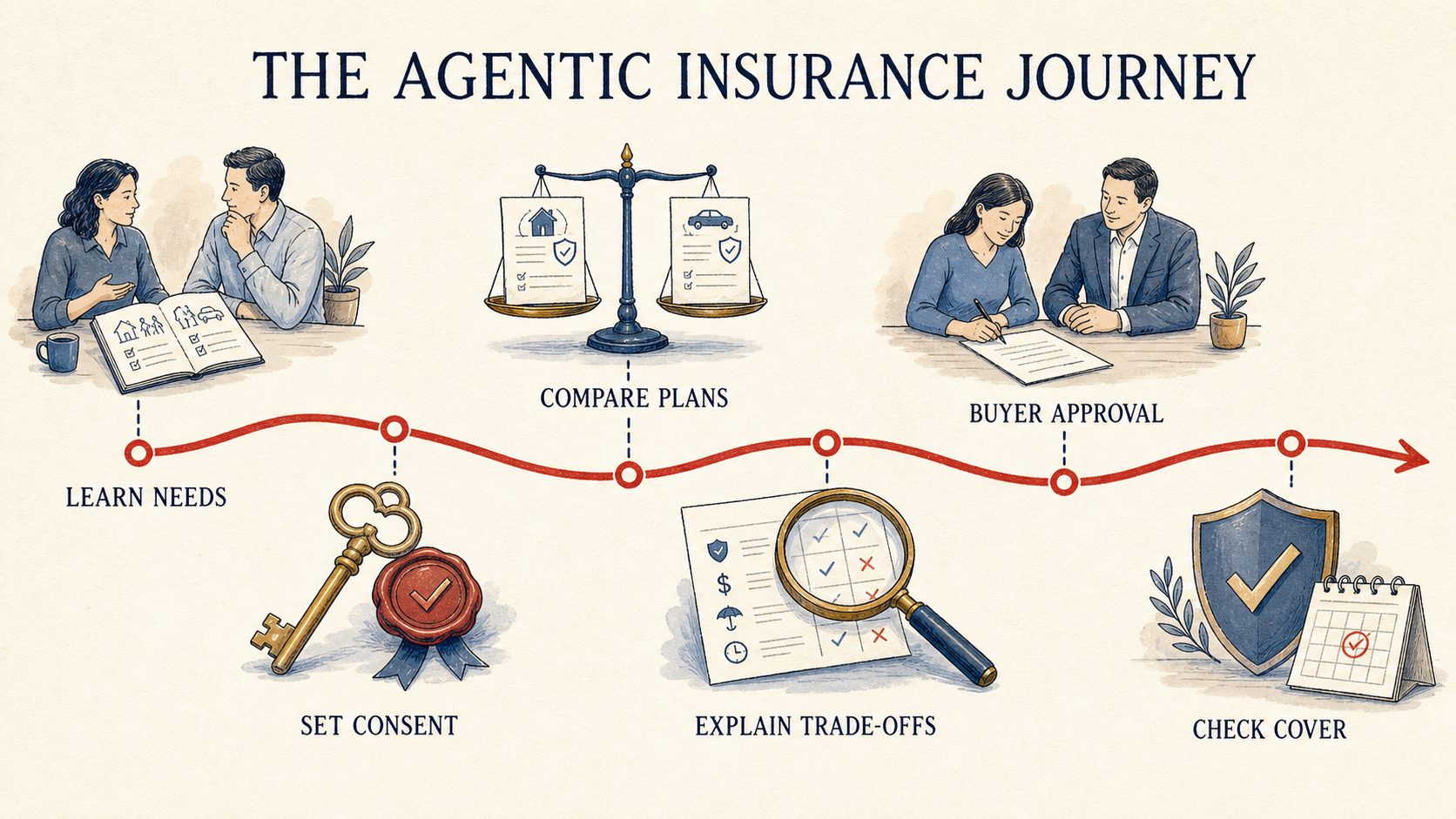
A safe design has six stages. Each stage should leave proof that you or a trained staff member can check.
1. Learn what the buyer needs
First, the agent asks about goals, old plans, people at home, key assets, budget, and main risks. It should seek only the data that it needs for this task.
The agent must also spot gaps in the facts. If a key fact is absent, it should ask for it or state that its advice may be weak.
2. Set consent and limits
Next, the buyer sets what the agent may see and do. Reading an old plan is one step. Searching public plan data is another. Sending a form is a much bigger step.
Consent should be clear and easy to end. A buyer may let the agent track renewal dates while keeping each sale under direct control.
3. Compare agentic insurance plans
The agent can screen plans against the buyer’s needs. It may check what is covered, what is left out, the excess, wait times, claim terms, service, and price.
The data must be fresh and sound. An old file or a weak fact table can lead to a neat answer that is wrong.
4. Explain each trade-off
There may be no single best plan. A low price may come with a high excess. Wide cover may cost more. A larger sum may strain the home budget.
The agent should show these trade-offs in plain words. It should say why a plan fits, which needs stay open, and what facts shaped the advice.
5. Ask the buyer to approve
The buyer should approve the plan and all form data. A trained and licensed person should check cases with high risk, weak data, or hard terms.
The firm must keep the proof. That file should show the plans checked, the rules used, the facts given, the advice shown, and the buyer’s final choice.
6. Check the cover over time
After the sale, the agent can track due dates and ask if life has changed. A new home, child, car, or firm may point to a gap in cover.
This watch must stay within set bounds. The buyer needs full control of which data the agent sees and how often it runs a check.
Why Bima Sugam could help
An AI shopping agent needs clean and trusted market data. It is hard to scan many insurer sites because each one uses its own page style and plan format.
India’s Bima Sugam rules set out an online insurance market. A shared market could give future agents a sound base for search, plan service, and sale logs. Common data can also make each match easier to check.
This is a future use case. Bima Sugam does not now claim to give open links to AI shopping agents. The rules and tech rights would need to be clear before an agent could act on the site.
Five safety tests for agentic insurance advice
The main issue is who owns the advice. An agent may compare plans, explain fit, and help fill a form. That is close to work done by a licensed seller or broker.
Firms should pass five tests before they launch such a tool:
- Name the owner. A known and licensed firm must own the advice and the full flow.
- Set the agent’s rights. Search and alerts pose less risk than sending a form or changing cover.
- Mark the hand-off point. High risk, weak data, odd terms, or large sums should lead to staff review.
- Give a clear appeal path. A person must be able to read the log, fix an error, and help the buyer.
- Keep proof of consent. The log must show the scope, time, buyer’s act, and any later end to consent.
These tests belong in the design from day one. Fine print at the end cannot fix a flow with no clear owner.
The control model behind agentic insurance
The shopping loop needs a control layer that works at each step. First, identity controls must verify the buyer and the policyholder. This prevents a person or bot from using another customer’s records.
Authorization must then match the task. For example, permission to read a policy should not permit a purchase. Permission to prepare a form should not permit the agent to send it.
The firm also needs a suitability policy. This policy should define the facts needed for each type of cover. It should also state which facts rule out an automated path. Therefore, the agent cannot treat every buyer as a routine case.
Product data needs formal control as well. Before each comparison, the system should confirm the source, version, and date of the terms. It should retain the exact document used in the review. As a result, staff can recreate the recommendation even after a product changes.
The explanation layer needs its own checks. A plain-language summary must preserve the legal meaning of the policy. For instance, the agent should not turn a conditional benefit into a promise. It must cite the clause behind each major point so the buyer can inspect it.
Suitability and explanation should then meet in one decision record. In practice, that record should list the buyer’s needs, the products screened, the options removed, and the reason for the final shortlist. It should also show any data that the agent could not confirm.
Oversight, security, and model controls
Human review needs a risk-based trigger. Complex ownership, large sums, medical disclosures, business use, or conflicting records may require specialist judgment. Since these cases can cause severe harm, the system should block the sale until a qualified person completes the review.
Security controls protect the same flow. The agent may handle identity data, financial details, health facts, and policy files. Therefore, access should follow the least-privilege rule. The firm should encrypt stored and transmitted data, set a retention period, and record each access.
Model controls matter because the agent can change over time. After each update, the firm should test the system against a fixed set of cases. It should compare the new results with the approved baseline. Meanwhile, live monitoring should track drift, errors, overrides, and unfair outcomes across customer groups.
Commercial governance must remain separate from product ranking. A commission may affect the firm’s revenue, while the buyer needs a suitable plan. Consequently, the ranking logic should exclude hidden sales weights. Any paid placement should be clear and should never appear as independent advice.
Finally, the firm needs an incident plan. If the agent sends wrong advice, exposes data, or acts outside its rights, staff must be able to stop it at once. The response should preserve logs, alert affected buyers, correct the record, and report the event when law or regulation requires it.
These controls turn a promising demo into an accountable service. They also give auditors, compliance teams, and the regulator a clear way to test how the agent reached a result.
Metrics for an accountable service
Good oversight depends on more than one accuracy score. For example, the firm should measure whether the agent gathered enough information for a sound review. A high rate of missing data may show weak questions or poor user experience.
Recommendation quality also needs several measures. First, specialists can review a sample and rate the fit between needs and cover. Next, the team can record how often staff change the shortlist or the final advice. Since each correction reveals a defect, teams should group the causes and remove repeated errors.
Customer comprehension deserves a separate measure. After the explanation, a short check can ask the buyer about key exclusions, cost sharing, and claim duties. If many buyers answer poorly, the explanation needs revision even when the recommendation is technically valid.
Operational metrics show whether the service works at scale. Therefore, leaders should track completion time, abandoned reviews, hand-off volume, staff wait time, and failed transactions. These measures reveal where automation has moved work into a new queue.
Data lineage and technical assurance
The technical team should maintain documented data lineage for every recommendation. Data lineage records where information originated, how it was transformed, and which component used it. Therefore, an investigation can distinguish a source-data error from a reasoning or interface error.
Version control is equally important. Each record should identify the product file, rule set, model release, prompt template, and software configuration used at that moment. Without this information, later reproduction becomes unreliable.
Automated validation can test these dependencies before the service starts. For example, schema checks can reject incomplete product feeds, while consistency rules can detect mismatched dates or definitions. The service should quarantine suspect data and notify the responsible team.
The architecture also needs separation between retrieval, recommendation, and transaction components. This separation limits unauthorized action and makes technical testing more precise. In addition, each component can carry its own access rights, monitoring thresholds, and fallback procedure.
Adversarial testing should examine how the agent responds to manipulated documents, misleading instructions, identity fraud, and abnormal purchase requests. Since attackers adapt, the test library should expand after every confirmed incident. Regular penetration testing should also cover APIs, data stores, user sessions, and third-party connections.
Finally, business continuity needs an alternate process. If the AI service fails, customers should still be able to reach qualified staff and complete urgent work. The fallback should preserve context so the customer does not need to restart the whole review.
Fairness, audit, and customer harm
Fairness analysis should compare outcomes across relevant customer groups. For instance, the firm can examine recommendation changes, failed identity checks, escalation rates, and complaint rates. A difference does not prove unfair treatment, although it does require investigation and a documented response.
The firm should also monitor commercial influence. Consequently, compliance teams can compare the rank before and after commission data is removed. A large change may show that revenue has affected the advice.
Audit quality provides another test. An independent reviewer should be able to rebuild a past recommendation from the stored records. If the reviewer cannot find the source terms, consent, model version, or explanation, the decision is not fully auditable.
Finally, customer harm must remain the main outcome. The firm should track complaints, canceled sales, claim disputes linked to advice, and confirmed gaps in cover. These events may be rare, so each one deserves a detailed review. Over time, the combined set of quality, service, fairness, audit, and harm measures gives management a realistic view of performance.
Where agentic insurance can fail
The agent may miss an exclusion or compare terms that do not mean the same thing. It may treat a rough quote as a firm price. It may also infer private facts that the buyer did not wish to share.
People may trust a sure tone too much. The screen should show doubt, source text, and any fact that still needs a check.
Sales pay can skew the rank as well. A seller may earn more from one plan than from another. The AI must not hide this clash. The firm should show the link and test if the rank shifts when sales pay is removed.
An emergency shutdown control is also necessary. If data is lost, a source is down, or the result is hard to explain, the agent should pause and call for help.
How to run an agentic insurance pilot
Start with one task that is easy to undo. A renewal check is a good choice because the buyer has an old plan for use as a base.
Keep the test to one type of plan and one group of users. Make the buyer approve each sale. Send all odd cases to licensed staff. Track bad facts, changed advice, hand-offs, complaints, and gaps found.
FinTech Central’s AI in health insurance guide gives a broad set of controls. Use only the data you need, keep people in charge, show each odd case, and track the full flow.
Motor cover gives two more test cases. Vehicle telematics can add opt-in drive data to a plan check. Motor claims automation shows why clear routes and staff review still matter after a crash.
Agentic insurance should give buyers more control
Agentic insurance can make plan checks less hard. It may also find gaps that a buyer would miss.
The safe model gives the agent a small, clear job. The buyer stays in charge of each key act, and a named firm owns the result. With those rules in place, artificial intelligence can simplify policy shopping and keep cover up to date.
—
FINTECH BRIEFING · A FUTURECENTRAL BRIEFING
Get practical financial AI analysis in your inbox.
Useful signals, focused analysis and decision questions on AI in banking, payments, lending, insurance, wealth and risk.
Free to subscribe. Confirm your email after signing up. Unsubscribe at any time.