

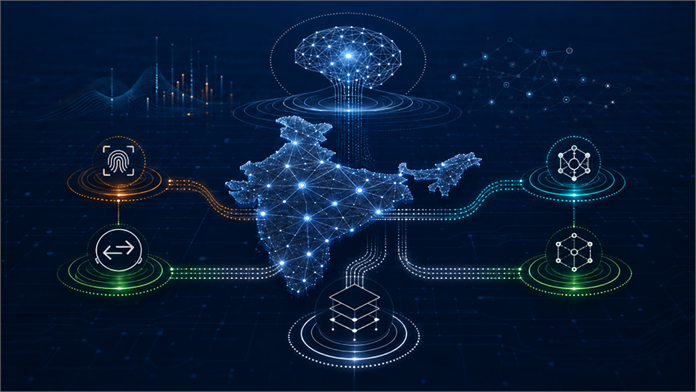
India Stack AI can combine digital public infrastructure with intelligent financial products. The phrase refers to AI-enabled services built on identity, payments, consent-based data sharing, and open digital networks. This usage differs from a single government AI system.
Effective AI services depend on more than a model. They need trusted ways to identify a user, receive permission, exchange data, move money, and record an action. India’s digital public infrastructure can provide many of those rails. Financial institutions can then focus on service design, risk decisions, and customer outcomes.
India Stack AI starts with digital rails
Four layers are especially relevant to financial services.
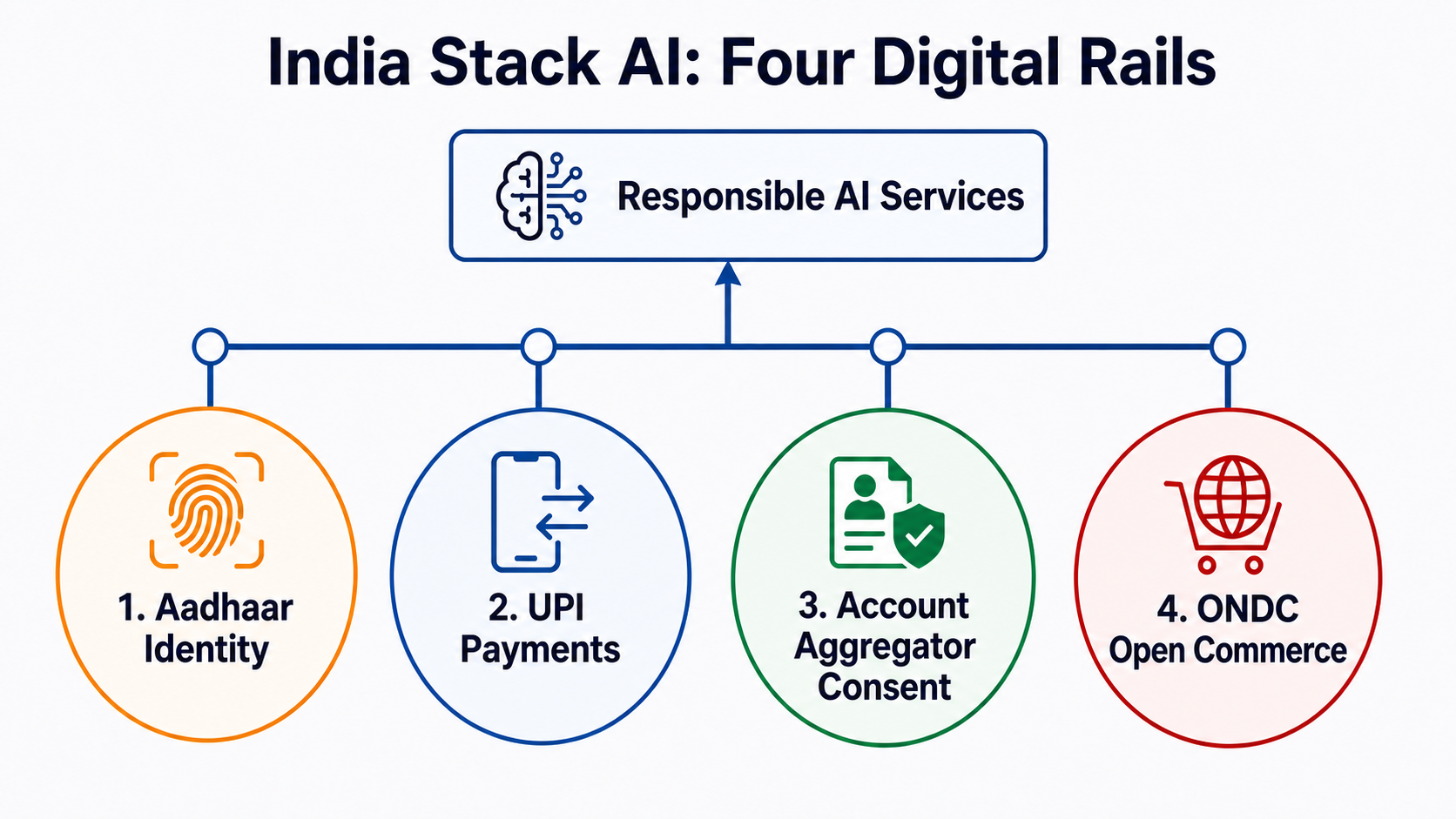
Aadhaar supports digital identity
Aadhaar provides a population-scale identity layer. Regulated firms can use approved identity and authentication services within the rules that apply to them. This can reduce friction in onboarding, although firms must still protect privacy and avoid treating identity as proof of creditworthiness.
UPI moves money in real time
The Unified Payments Interface connects bank accounts and payment applications through interoperable rails. According to NPCI’s official UPI statistics, UPI processed more than 22 billion transactions in June 2026. That scale creates a rich operating environment for fraud controls, service automation, and cash-flow-based products.
However, payment data must be used lawfully and for a clear purpose. A large data trail does not give every firm the right to train or deploy a model on it.
Account Aggregator enables consent-based data sharing
The Account Aggregator framework lets customers share financial information between regulated entities through explicit, purpose-linked consent. Account Aggregators do not become owners of the data. Instead, they help transmit it securely between information providers and users.
The ecosystem is now substantial. Sahamati’s public dashboard reported 326.3 million linked accounts and 538.32 million fulfilled consents by July 2026. Those rails can support lending, personal finance, insurance, and wealth services without relying on informal document collection.
ONDC creates an open commerce layer
The Open Network for Digital Commerce separates the network from any single marketplace. For finance, this creates opportunities around seller cash flow, embedded payments, insurance, and working capital. Yet access to network activity should not become unchecked financial surveillance.
Where India Stack AI can create value
The strongest use cases join several rails around a specific customer need.
Faster small-business lending
A small business may consent to share bank or tax-related financial information through the Account Aggregator framework. A lender can then assess cash-flow patterns with an explainable model. If approved, funds can move digitally, while repayments may use established payment rails.
This process can reduce paperwork and improve speed. Lenders must still test for bias, data gaps, and unstable income patterns. Faster decisions advance inclusion only when the underlying assessment is fair and reliable.
Personal financial guidance
With permission, an application can bring together accounts, investments, insurance, and liabilities. AI can help categorize cash flows, identify gaps, and explain options. The customer should still control what is shared and be able to correct errors.
Fraud detection and customer protection
Real-time payment systems require real-time risk controls. AI can detect unusual device, behavioral, or transaction patterns. It can also prioritize alerts for review. FinTech Central’s guide to the future of fraud detection explains the main techniques and trade-offs.
Embedded finance for open commerce
Network participants can add payments, credit, or insurance to a commerce journey. For example, a seller may receive a working-capital offer based on consented records alongside conventional evidence such as collateral. This resembles broader Banking-as-a-Service models, but India’s public rails can reduce dependence on one closed platform.
Risks within India Stack AI services
India Stack AI can widen access, but it can also scale mistakes. Institutions should address five risks.
Consent must be understandable and revocable, and models should use only the data needed for the stated purpose. High-impact decisions also require explanations and a route for human appeal. Firms must monitor fraud, cyber risk, and model drift throughout operation. Commercial incentives cannot weaken customer control.
The Account Aggregator architecture provides an important design principle: data sharing should be permissioned and purpose-linked. AI systems built on top should preserve that principle and prevent one consent from becoming permanent access.
A practical India Stack AI design pattern
Financial institutions can use a five-step pattern:
- Define the customer problem and the regulated decision.
- Identify the minimum data and the lawful source.
- Capture clear consent and record its purpose.
- Apply AI with suitable human oversight and monitoring.
- Give the customer an explanation, correction path, and exit.
This approach turns digital infrastructure into a trusted service with clear accountability.
From India Stack AI infrastructure to better finance
India’s advantage comes from combining AI with interoperable identity, payments, and consent-based data exchange. The result can be faster and more inclusive finance, provided institutions design for accountability from the start.
For wider context, read FinTech Central’s AI in Finance coverage and its analysis of how technology companies are reshaping financial services.
What a trustworthy India Stack AI service should feel like
For a user, the best flow should feel short and clear. The app should say what data it needs and why. It should ask for consent in plain words. It should not hide a broad right inside a long form.
The user should see what will happen next. If an AI tool gives a score or tip, the app should show the main facts behind it. If the data is wrong, the user needs a way to fix it.
The firm should request only the data required for the task and retain it only as long as necessary. When consent ends, new use must stop.
These steps may seem basic. Yet they turn trust into part of the product. They also help the firm spot bad design before it can harm many people at once.
There is one more test. A service should still work for a person with a low-cost phone, a slow connection, or limited experience with apps. It should use plain language and a short set of steps.
Also, the firm should plan for a failed check or a lost phone. A user needs a safe way back in. A help team needs the facts to solve the case.
Good technology should make the task easier without shifting the full risk to the user. This is how open rails can help more people and earn their trust.
FutureCentral pathways
Turn India Stack AI insight into action
Continue with teaching resources, institutional capability and India-relevant research from FutureCentral.
FINTECH BRIEFING · A FUTURECENTRAL BRIEFING
Get practical financial AI analysis in your inbox.
Useful signals, focused analysis and decision questions on AI in banking, payments, lending, insurance, wealth and risk.
Free to subscribe. Confirm your email after signing up. Unsubscribe at any time.