


Financial AI implementation often breaks down after a successful pilot. The model may work well in a test. Yet daily operations bring messy data, unusual cases, old systems, and changing rules.
Financial firms have tested AI in lending, fraud, service, risk, and operations. During a pilot, teams prepare the data and define the use case. They also watch the process closely. Production removes many of those safeguards.
Why financial AI implementation changes after deployment
A pilot usually has clear limits. The team knows which data it will use and who will review each result. It can also investigate any unusual output.
After deployment, those conditions change. For example, a credit application may combine records from several sources. An address may conflict with an older record. The applicant may have changed jobs or have an unusual income pattern.
These cases are common in finance. However, their impact grows when a system handles them at scale. The system must decide whether to predict, stop, or send the case for review.
As a result, a strong score on clean test data can create false confidence. Teams must examine both accuracy and behavior under real conditions.
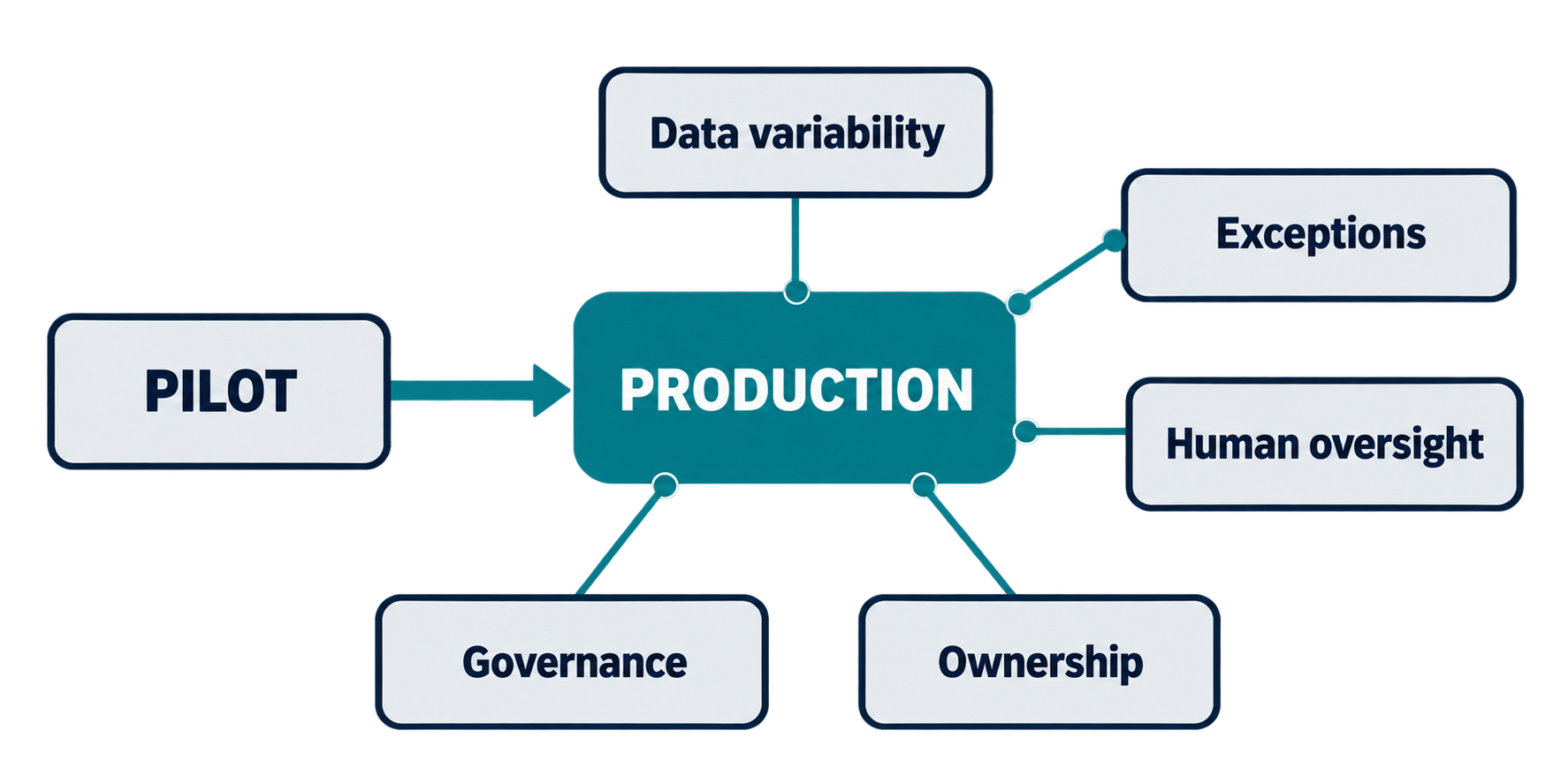
Financial AI implementation must include difficult cases
Financial processes contain many exceptions. A fraud model may flag a valid purchase made while a customer is traveling. A lending model may struggle with income from self-employment. An insurance model may flag a valid claim with an unusual fact pattern.
A pilot shows how the model handles expected cases. Production reveals how often unexpected cases occur. In practice, these exceptions can become a large part of the workload.
The answer isn’t always to rebuild the model. Instead, the firm can define its limits more clearly. For instance, an application with missing data can go straight to a specialist. A fraud alert can enter a review queue when the model cannot give a reliable score.
Therefore, the firm needs a clear process for exceptions. It cannot assume they will disappear.
Accuracy can still produce a worse process
Model accuracy matters, but it covers only part of the result. A more accurate model can still make the wider process slower or harder.
Too many alerts may create extra work for investigators. A sound recommendation may arrive too late to help. Employees may also accept an output they don’t understand, even when other facts point to a problem.
This issue matters in finance because one prediction often starts a longer process. Someone must investigate a fraud alert. The firm must explain and record a credit decision. A risk signal may also require action from another team.
The AI system supports that process; it doesn’t replace it. Therefore, teams should track what happens after each output. Useful measures include decision time, override rates, extra work, and the point where cases leave automation.
These measures often say more about a financial AI implementation than the pilot score does. A model may improve prediction while sending too many cases to manual review.
Human oversight in financial AI implementation
Many firms say their AI has a “human in the loop.” The phrase sounds safe. However, it doesn’t explain what that person must do.
Human review works only when the reviewer has enough time, information, and authority. A risk score without context gives an employee little reason to challenge the result. Hundreds of alerts each day can also turn review into a routine click.
The process should state when an employee may disagree with the model. Some evidence may allow an override. Other cases may require a specialist. In either case, the firm should record the reason.
Those records create useful feedback. Repeated overrides may reveal a weak model, an unclear rule, or a gap between the model and the firm’s priorities. Thus, the reviewer protects the customer and helps improve the system.
Governance after financial AI implementation approval
AI governance is often treated as a step before launch. A team reviews, approves, and documents the model. Yet the model’s environment soon begins to change.
Customers, products, credit rules, fraud patterns, and data sources all evolve. These shifts can change model behavior even when no one changes the code. Ongoing monitoring is therefore essential.
Overall accuracy cannot show every problem. For example, a fraud model may weaken for one type of payment. A lending model may start sending more applications from one group to review. An average score can hide both changes.
The firm must also decide who can intervene. Someone needs the authority to pause the model. The same process should cover new thresholds, added review, retraining, and rollback.
Ownership in financial AI implementation
Responsibility may sit across several teams. Technology may manage the model, while the business owns the process. Risk may own controls, and compliance may watch regulatory duties. A vendor may also run part of the system.
Each role can make sense. Problems begin when no one owns the final outcome. A firm should not spend weeks deciding who must investigate a sudden rise in manual reviews.
A production system needs one clear point of accountability. That owner should understand the business goal and the cost of failure. A defined bank AI operating model makes these decision rights visible.
External tools do not remove this duty. The financial firm remains responsible for the decision it gives a customer.
Test uncomfortable cases during the pilot
Teams should look for operating problems before they call a pilot successful. A useful test includes cases that are hard to classify. It should cover missing data, conflicting records, unusual behavior, borderline decisions, system failures, and human disagreement.
The team should also watch what happens when the model is wrong. Who sees the error? How does the firm correct it? Does the correction reach the customer? The team should record the decision and stop the problem from repeating.
These tests may appear less impressive than a high accuracy score. Still, they reflect the problems that production will expose.
Start with a smaller deployment
A realistic pilot tests the operating process as carefully as the model. That may lead to a smaller first release.
For example, a firm might automate recommendations before final decisions. It might limit the model to one product or customer group. It may also require human review until the team gains enough live experience.
These choices do not hold back the technology. Instead, they show where automation works and where human judgment still matters. The same foundations support a later move toward AI-native banking.
What production teaches about financial AI implementation
One technical fault rarely explains the gap between a good pilot and a good production system. Small operating details usually reveal the real weakness.
An employee may start overriding one recommendation. A type of application may keep going to manual review. A fraud team may spot a new pattern. Meanwhile, a policy may change without an update to the model’s assumptions.
Each issue may look minor on its own. Together, they show whether the AI system belongs in the workflow.
A useful prediction is only the starting point. The firm must build a process that can handle uncertainty, exceptions, changing conditions, human judgment, and accountability.
A pilot can prove that the technology has promise. Production teaches the firm how to use that promise safely, repeatedly, and at scale.
About the Author

Chetan Saundankar is the Founder and CEO of Coditation Systems and Plant360.ai. He has more than two decades of experience in software engineering, data systems, modernization, and AI, working with enterprises on complex technology transformation and AI adoption.