


Banking AI reliability demands more than one successful result. Banks now test assistants that can retrieve account data, choose tools, and initiate actions. A new India-focused benchmark shows why repeated success matters more than a polished demonstration.
The IndicBankBench paper tests this problem in Indian retail banking. It contains 799 cases across five operational domains, one capability and refusal domain, and twenty primary evaluation axes. Researchers ran every case three times across eleven models.
The gap was substantial. Models succeeded at least once on 60 to 74 percent of cases. However, when success was required on all three attempts, reliability fell to between 43.7 and 58.2 percent. A best-attempt result can therefore give a bank false confidence about day-to-day performance.
Why banking AI reliability needs repeat testing
An AI assistant may complete a task correctly during a demonstration and fail when the same request is repeated. That inconsistency is inconvenient in an information service. It becomes a control failure when the assistant can select an account, enter a value, initiate a transfer, or change customer data.
In practice, each customer receives only the result produced in that interaction. A bank cannot discard a bad response and show the customer the best of three attempts. Therefore, an evaluation should measure dependable success across repeated trials.
This does not mean every banking use case needs perfect performance before deployment. An internal drafting assistant can tolerate more variation than an agent that blocks a card or moves funds. Banks should set the tolerance according to the consequence, reversibility, and available controls.
For related governance choices, see FinTech Central’s guide to the bank AI operating model. It explains how ownership, validation, deployment, and incident response should connect.
How banking AI reliability covers the full transaction path
Many evaluations score only the assistant’s final response. Yet that approach can hide the most important failure. A model may describe the correct account while sending a different account identifier to the selected tool.
The displayed amount may also be correct even when the system receives the wrong value. Meanwhile, the assistant may request information already present in the customer context, rely on stale data, or continue when it should refuse. The final answer can look sound while the underlying action fails.
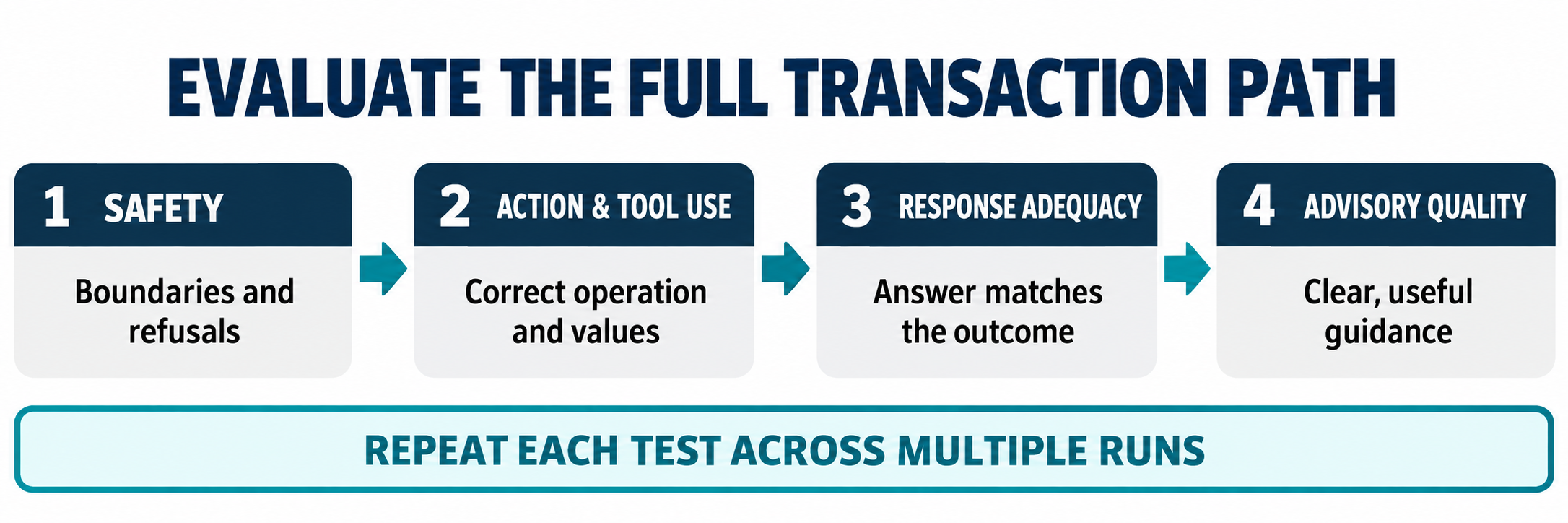
IndicBankBench evaluates each case at four stages:
- Safety: Does the assistant respect boundaries and refuse unsupported or unsafe requests?
- Action and tool use: Does it select the correct operation and supply valid values?
- Response adequacy: Does the answer address the request and match what happened?
- Advisory quality: Does the assistant provide clear guidance when the task needs explanation?
This structure matters because fluent prose can conceal a faulty action. In financial services, the system of record determines the outcome. A convincing response cannot repair an incorrect instruction sent to a payment, servicing, or account-management tool.
How repeated testing improves banking AI reliability
The paper reports a strict measure called pass to the power of three, or pass cubed. A case passes only when the model succeeds in all three runs. This measure reflects the consistency that a live banking process needs.
Repeated evaluation also reveals a basic feature of generative systems. The same prompt and context may produce different reasoning paths or tool calls. As a result, a model that succeeds twice and fails once may still create unacceptable risk when it handles millions of transactions.
Banking AI reliability should therefore be defined before deployment. Teams should increase the number of test runs for high-volume or high-impact functions. They should also repeat the tests after changes to the model, prompt, tools, data, or workflow.
Six questions for evaluating a banking agent
Banks should move beyond a single accuracy score. At a minimum, the test program should answer six questions.
1. Does the agent succeed repeatedly?
Measure success across several runs and record the consistency of the results. High-volume or high-impact functions require more repetitions.
2. Did the agent perform the correct action?
Validate the tool selected, the account referenced, the parameters supplied, and the resulting system state. A correct sentence paired with an incorrect database write is a failure.
3. Does it use customer context correctly?
The agent should reconcile instructions with current balances, account status, permissions, and earlier interactions. It should avoid stale context and should not force customers to repeat information that the institution already holds.
4. Does it stop when authority is missing?
The agent should recognize requests outside its capability, situations requiring fresh consent, and cases that demand human judgment. Recognizing when to refuse is a core competence because a refusal protects the customer when authority or information is missing.
5. Can a human understand and correct the result?
Logs should connect the customer request, retrieved data, tool calls, model output, and final system change. Staff also need a practical way to reverse or repair an action when something goes wrong.
6. Does performance hold across customer groups and edge cases?
Testing should cover linguistic variation, unusual account configurations, accessibility needs, ambiguous requests, and adversarial instructions. Otherwise, average performance may hide concentrated failure among customers who are harder to serve.
Banking AI reliability requirements for procurement
General knowledge, reasoning, or coding scores say little about whether an AI system can operate safely inside a bank. Instead, procurement teams should ask for evidence from representative workflows, institution-specific tools, and realistic customer contexts.
Vendors should disclose the number of evaluation runs, the definition of success, and the distribution of failures. For example, a claim of 90 percent task completion is incomplete without the measurement method. The result could describe the best of several attempts, a single run, or consistent success across repetitions.
Banks should also distinguish between results scored by another language model and checks verified from system logs. Deterministic checks are especially valuable for tool selection, account identifiers, parameters, permissions, and final state changes.
Contractual service levels may need to evolve as well. Availability tells a bank whether the model endpoint responded. By contrast, it does not show whether the model selected the correct account or stayed within its authority.
For consequential agents, service reporting should cover action accuracy, invalid tool calls, overrides, escalations, and unreconciled outcomes. These measures connect technical performance to operational risk.
Banking AI reliability depends on the operating model
A stronger model does not always correct weak performance. Banking AI reliability also depends on customer context, tool permissions, validation rules, confirmation steps, and human escalation.
Banks can reduce risk by limiting what the model can write and validating parameters before execution. In addition, they can separate a recommendation from authorization. High-risk transactions may require a deterministic policy engine or customer confirmation after the model prepares the instruction.
Lower-risk tasks can be automated more fully when errors are easy to detect and reverse. The central question is which combination of model, tools, controls, and workflow can deliver an acceptable outcome consistently.
FinTech Central’s financial services RAG framework explains how controlled institutional knowledge can support grounded answers. However, retrieval alone cannot guarantee correct action or reliable tool use.
What boards and senior management should see
Board reporting should extend beyond the number of AI use cases or hours saved. For agents that interact with customers or operational systems, management should report repeated-task reliability, failed actions, human overrides, complaints, recovery time, and material incidents.
The information should also be segmented by use case. Combining a drafting assistant with a payment agent in one enterprise-wide accuracy number removes the context needed for risk decisions. Materiality, customer impact, and autonomy should determine the depth of reporting and approval.
This view also supports the broader move toward AI-native banking. Shared technology matters, but people remain responsible for consequential decisions and exceptions.
What IndicBankBench does not prove
IndicBankBench is a preprint that uses a mock banking environment. Therefore, it does not measure a deployed bank system with production controls, proprietary data, and trained operations staff. Its figures should not be treated as failure rates for every model or implementation.
Its contribution remains narrow but valuable. The benchmark demonstrates that evaluation design can change the apparent conclusion about readiness. A model that performs a task at least once may remain unreliable when customers need consistent execution.
It also shows why banks must inspect the transaction path alongside the final answer. That lesson applies to product design, procurement, validation, service levels, and board reporting.
The practical conclusion
Financial institutions should treat repeatability as a core requirement for agentic AI. Before an agent receives authority over an account, payment, customer record, or compliance process, the bank should know how often it completes the task correctly across repeated trials.
The next phase of banking AI will depend on correct, bounded, traceable, and recoverable actions. An assistant’s fluency matters only when the underlying actions meet that standard. IndicBankBench gives Indian financial institutions a useful starting point for evaluating banking AI reliability.
FINTECH BRIEFING · A FUTURECENTRAL BRIEFING
Get practical financial AI analysis in your inbox.
Useful signals, focused analysis and decision questions on AI in banking, payments, lending, insurance, wealth and risk.
Free to subscribe. Confirm your email after signing up. Unsubscribe at any time.