

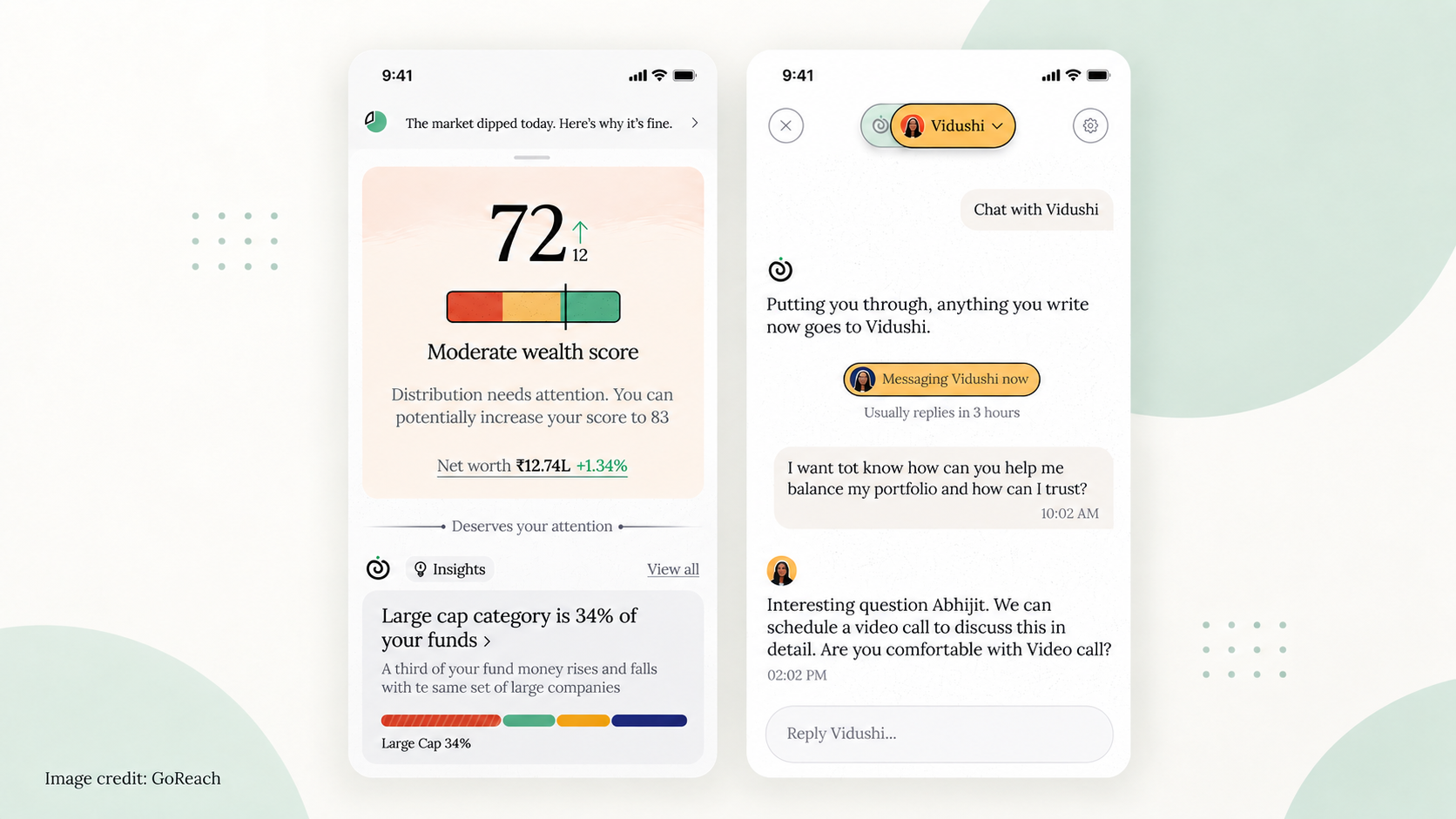
GoReach is bringing an AI companion and named human experts together in a service for mutual-fund investors. The company describes a service where users move from an AI chat to a person who knows their financial situation.
The Bengaluru startup announced an October 1, 2026 launch, The Bengaluru Live reported. Co-founder Prashant Kumar Tiwari puts its pre-seed funding at US$500,000, from Mukesh Bansal.
The service starts with mutual funds. For financial-services firms, this raises a practical question. How much routine work can AI handle, and when should a person step in?
How GoReach moves from AI to an expert
The service pairs Reacher, an AI companion, with human professionals called Reach Experts. Reacher draws on the user’s inputs and portfolio details, according to GoReach. It also uses other information available to the system.
Reacher can flag overlap between fund holdings and a portfolio’s concentration in particular assets. It also explains the firm’s Wealth Score and answers routine questions. When users want a fuller discussion, they can chat or have a video call with a Reach Expert. The handoff carries their financial context across.
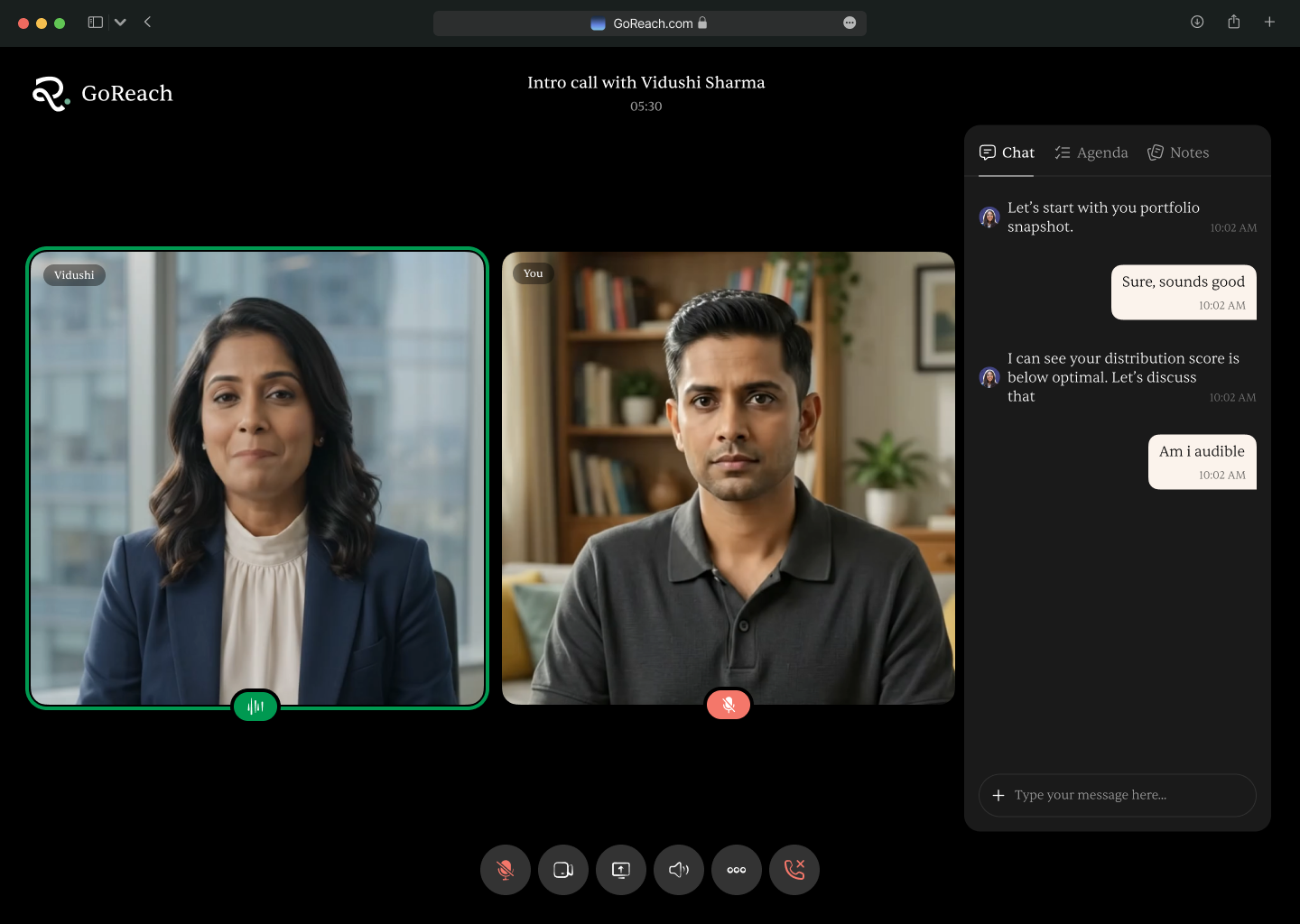
That handoff matters because a useful observation may still leave a user unsure what to do. Two funds may hold many of the same stocks, for example. Before changing those holdings, the expert also needs to understand the user’s goals. When might they need the money?
In this model, AI handles preparation, summaries, reminders, and follow-ups, while experts handle complex planning and judgment. Reducing that routine work could give experts more time to discuss decisions with customers.
The expert also needs a way to check the AI’s work. Access to the underlying facts would help them spot errors before a customer acts. See our broader coverage of AI wealth management for context.
GoReach funding and its commission model
GoReach plans to use the funds to build its consumer product and develop tools for Reach Experts. The money will also fund initial distribution.
The company identifies co-founder Karthik Viswanathan as a former Groww executive and former CEO of GrowwPay. Tiwari’s biography lists a previous role at Nurix. He also co-founded Evallo and served as its chief business officer.
The launch business model centers on trail commissions. These are ongoing payments from asset management companies. They relate to regular-plan mutual-fund assets distributed through Rytstep Invest Tech.
The firm models annual trail rates of about 0.40%–0.70%. However, rates vary by fund type and asset management company. These figures are assumptions used in its business model. They do not establish a fixed rate for each fund or a fee charged directly to users.
Because revenue comes from distribution, users need to understand how commissions affect product selection. GoReach’s stated approach gives priority to the customer’s plan. Clear commission disclosures would help users assess that claim. So would an explanation of why each fund was selected.
Where information ends and decisions begin
GoReach operates as a brand of Kytrunner Ventures. Mutual-fund distribution runs through its subsidiary, Rytstep Invest Tech. The company website lists Rytstep as an AMFI-registered distributor, with ARN 362132 valid until June 3, 2029.
GoReach describes the launch offering as a distribution service. It does not present it as a SEBI-registered Investment Adviser service.
The company sets limits on Reacher’s role. It cannot independently decide on investments or place transactions. Each transaction requires an explicit user instruction.
The firm’s terms describe the chatbot as informational. They also warn that its output may be wrong or out of date. Users therefore need to know whether an output explains their holdings or proposes an action.
Because users may treat a portfolio-specific suggestion as a recommendation, the review process needs to be clear. Users should know when an expert has checked a proposal and what they must review before deciding.
What to watch after the GoReach launch
The Wealth Score needs a clear explanation of what it measures. Users should understand why it changes and how its components relate to their goals. A higher score alone would not prove better returns.
An ongoing financial conversation can also contain sensitive personal details. GoReach’s privacy policy includes AI training and development among its purposes for using personal information. Users need a clear account of the data involved and the consent controls available.
As GoReach develops the service, the practical test will be how it handles difficult cases. Can an expert correct an AI error, explain a proposed investment, and resolve a customer’s concern? Those everyday interactions will determine whether the combined service earns users’ trust.
Follow our Responsible AI and Regulation coverage for more analysis of these questions.
FINTECH BRIEFING · A FUTURECENTRAL BRIEFING
Get practical financial AI analysis in your inbox.
Useful signals, focused analysis and decision questions on AI in banking, payments, lending, insurance, wealth and risk.
Free to subscribe. Confirm your email after signing up. Unsubscribe at any time.