


Valuation reliability starts with a simple question: does the evidence support the answer? A trustworthy investment model should sometimes decline to publish a fair-value estimate.
A precise answer can rest on weak evidence
Imagine two companies in the same investment app. The first has fifteen years of public results, positive earnings, steady cash flow, and a stable business model. Several valuation methods also point in a similar direction.
The second company became public three years ago. It has negative earnings, volatile cash flow, heavy stock-based compensation, and a changing business model. Yet the app gives both companies a fair-value range precise to the dollar.
The outputs look equally authoritative. However, the underlying evidence is very different.
Financial products often reward completion. Every field should contain data, every stock should have a rating, and every valuation card should show a number. As a result, teams may fill gaps with assumptions until the system can produce an answer.
A polished interface cannot make weak evidence reliable. When the data is thin, inconsistent, or unsuitable, the responsible result may be no estimate at all.
Why valuation reliability differs from precision
Precision describes how specifically a result is expressed. Valuation reliability asks whether the evidence, assumptions, and method support that result.
For example, a model can calculate $87.42 with perfect arithmetic. However, the calculation may depend on a fragile denominator, a short history, or assumptions that cannot be tested. The decimal places describe the calculation alone. They say nothing about the evidence behind it.
This distinction is familiar in professional valuation. The International Valuation Standards Council explains that reasonable methods, data, and assumptions can produce a range of credible outcomes. It also separates unavoidable value uncertainty from errors, omissions, and weak process.
Likewise, IFRS 13 asks entities to consider current market conditions, market-participant assumptions, and risk. Its purpose differs from estimating the intrinsic value of a listed company. Still, the underlying lesson applies: input quality matters.
A single number can hide these limits. A range can also create false comfort when both endpoints rely on the same weak assumptions. Therefore, the system should test reliability before it displays a result.
Companies are not equally measurable
Some businesses offer rich valuation evidence. They have long operating histories, recurring economics, positive earnings, free cash flow, and stable accounting relationships. In addition, analysts can compare several methods and investigate any differences.
Other companies resist standard measurement. A young business may have only a few public reporting periods. Meanwhile, a cyclical producer may sit near a temporary earnings peak or trough.
Restructuring and large acquisitions can also disrupt comparisons. Negative earnings can make a price-to-earnings ratio useless. Heavy capital spending may create a gap between earnings and free cash flow. Similarly, debt, cash, and stock-based compensation can make equity and enterprise measures tell different stories.
Business type matters as well. Banks, insurers, real estate investment trusts, and holding companies often need sector-specific methods. Applying an industrial-company template may produce a number with little insight.
The broader principle is fitness for purpose. The Federal Reserve, OCC, and FDIC’s 2026 model-risk guidance applies mainly to banking organizations. Even so, it offers a useful lesson for investment software. Model risk depends on data, assumptions, constraints, and intended use.
Using a model outside its intended domain increases uncertainty. Therefore, a product should define where its methods work and where they do not. The same discipline helps financial firms move from an AI pilot to production.
How valuation reliability uses an evidence gate
An evidence gate checks whether a system has enough suitable information to publish a specific output. It runs before the valuation appears.
First, the gate checks for usable methods. One valid measure may provide context. However, it may offer too little support for a fair-value range. More than one independent method reduces dependence on a single accounting relationship.
Second, the gate reviews relevant history. Ten observations from a stable period may be more useful than twenty observations across a major structural break. Therefore, the system must judge comparability as well as quantity.
Third, the gate compares the methods. Agreement cannot prove that a valuation is correct. Still, a wide gap may show that the methods capture different economic realities.
Finally, the gate checks for unresolved distortions. These may include one-time charges, acquisition accounting, unusual tax effects, sharp dilution, exceptional capital spending, or stale data.
The system can then choose one of four outputs:
- A full valuation range supported by several methods and enough history
- A wider indicative range with clear limitations
- A directional view, such as relatively demanding or relatively inexpensive
- No valuation because the evidence is insufficient or contradictory
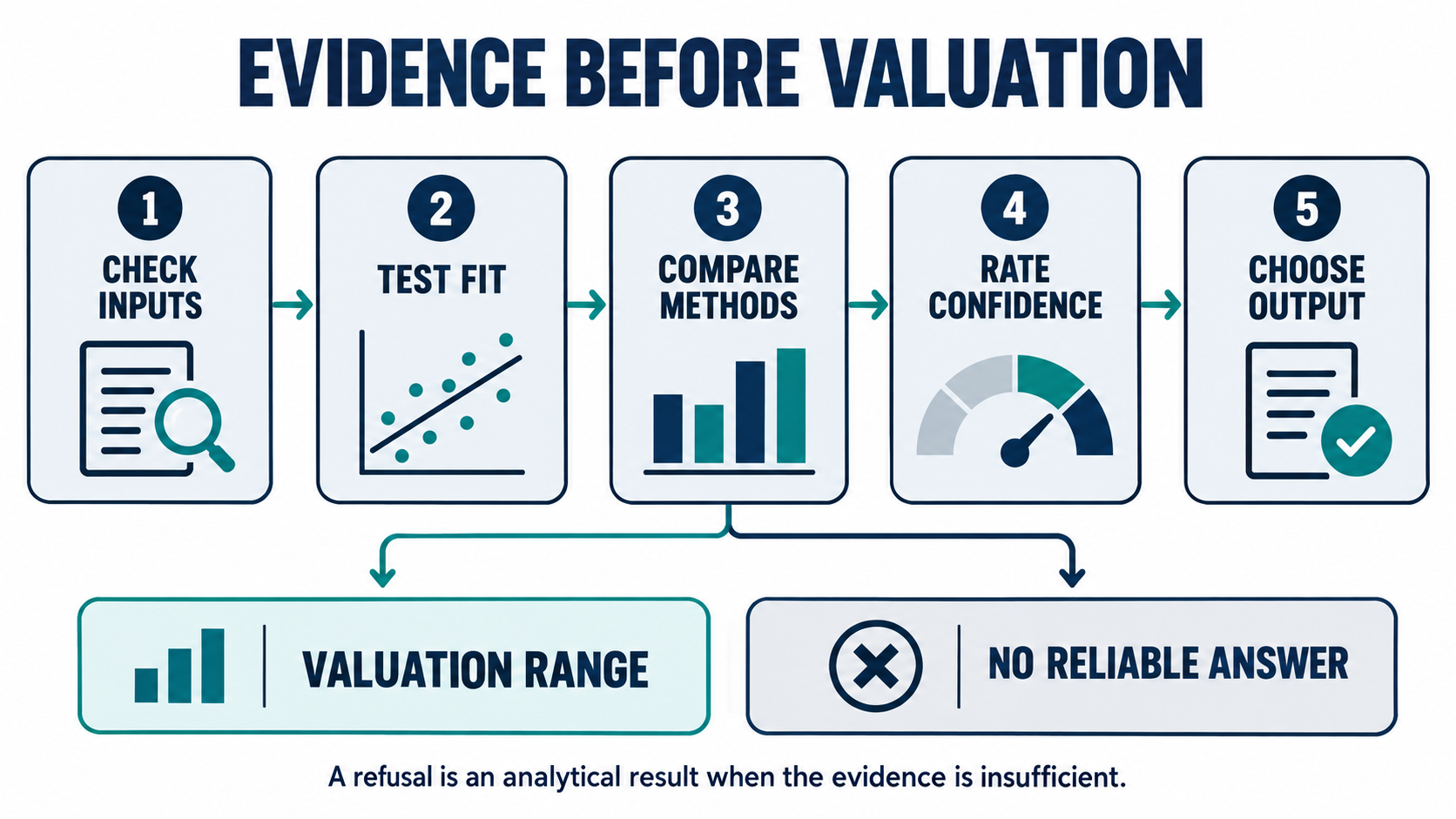
A trustworthy model checks its evidence before choosing between a valuation range and no reliable answer.
This structure separates confidence from opinion. A company may appear expensive while still lacking enough support for a defensible dollar range.
Metric disagreement contains useful information
Suppose a price-to-earnings comparison suggests that a stock is inexpensive. At the same time, an enterprise-value-to-free-cash-flow comparison suggests that it is expensive. A simple system may average the two and produce a moderate valuation.
However, that average may hide the most useful finding. The disagreement could reflect capital spending, working-capital movements, debt, excess cash, acquisition effects, or weak cash conversion. It may also show that the business is changing faster than its historical relationships can capture.
Therefore, the next step should be investigation. When methods disagree, the system should expose the conflict, lower its confidence, and explain the possible drivers. Averaging incompatible signals can destroy useful information.
Silence can be an analytical output
“No reliable fair value is available” may sound unsatisfying. Yet it communicates a real conclusion about the evidence.
The statement does not judge whether the company is attractive. It says the selected method cannot support a reliable estimate with the available information.
For that reason, a refusal should explain itself. The interface can point to thin history, missing earnings, conflicting methods, accounting distortions, or a business outside the model’s intended scope. It can also explain what new evidence may support a stronger conclusion later.
Valuation reliability should change the presentation
Many products calculate confidence internally but present every result in the same way. Consequently, a weak estimate can look as authoritative as one supported by several consistent methods.
Presentation should reveal evidence strength before users read the fine print. A strongly supported valuation can receive a clear range, while an indicative estimate should display its limits. A directional view should avoid the appearance of a price target. Similarly, a withheld result should explain the reason.
Confidence describes evidential support within a defined method. It cannot guarantee accuracy because every valuation remains sensitive to future events and assumptions. A sound AI value scorecard should therefore show confidence and outcomes together.
Coverage and trust require balance
Universal coverage is commercially attractive. It creates larger screeners, fewer blank states, and simpler marketing claims. However, covering every company may force a model beyond the situations its methods can handle.
Limited coverage can be more trustworthy when the boundaries are clear. At the same time, teams must test whether a gate rejects too many useful cases or treats sectors inconsistently.
Teams should monitor both false confidence and unnecessary refusal. They should record why results were withheld and whether later data resolved the uncertainty. A product earns trust when it clearly states what its evidence can support.
Human judgment still matters
Evidence gates cannot solve every valuation problem. Hypergrowth companies may require assumptions that overwhelm their short histories. Banks and insurers rely on accounting and regulatory structures that general corporate metrics may miss. REITs may need property-specific measures, while holding companies may require asset-by-asset analysis.
A model can recognize some of these conditions and route them to a specialist. However, it cannot eliminate judgment.
Human decisions should also be documented. If an analyst overrides a refusal or removes a distorted period, users should understand the reason. Otherwise, the override simply moves the uncertainty out of view.
The refusal mechanism has a practical purpose. It stops the model from presenting its limitations as precision.
Valuation reliability requires clear uncertainty
Financial technology has made sophisticated calculations cheap and immediate. Yet it has not made every company equally measurable.
A trustworthy system first asks whether the evidence supports the answer it is about to display. It separates stable history from thin history, usable metrics from broken denominators, and agreement from conflict.
Sometimes the process supports a valuation range. In other cases, it supports only a directional view. Occasionally, the evidence supports no conclusion.
That final result still carries information. It tells the investor where the data and method reach their limits. Responsible financial technology should communicate those limits clearly and stop when the evidence runs out.
About the Author
External Sources
- International Valuation Standards Council, Managing and Communicating Value Uncertainty
- IFRS Foundation, IFRS 13 Fair Value Measurement
- IFRS Foundation, IFRS 13 supporting and educational material
- Federal Reserve, OCC, and FDIC, 2026 Revised Guidance on Model Risk Management
FINTECH BRIEFING · A FUTURECENTRAL BRIEFING
Get practical financial AI analysis in your inbox.
Useful signals, focused analysis and decision questions on AI in banking, payments, lending, insurance, wealth and risk.
Free to subscribe. Confirm your email after signing up. Unsubscribe at any time.