


Alternative credit data can help a lender assess someone with little borrowing history. However, adding more signals does not prove that the loan decision is fair or useful.
Consider a hypothetical shop owner who has never taken a business loan. Her bank records show steady sales, seasonal stock purchases, and enough cash to meet daily costs. A credit file alone may reveal little of that picture.
A lender could use those records to assess her ability to repay. It could also use phone or shopping data whose link to that capacity is much harder to explain.
Lending teams need to decide which evidence helps them assess risk. They must also check who might lose out and how staff will handle missing or wrong data.
Start alternative credit data with a lending question
Alternative credit data covers information beyond the usual credit file. It can include bank cash flows, rent payments, or utility bills.
Before adding a source, state the question it should help answer. For example, do the shop’s cash inflows cover its costs and a proposed loan payment through a slow season?
Next, define the measure. Total deposits, for instance, may include transfers between the owner’s accounts or a one-time asset sale. Treating every deposit as sales income would overstate what the business earns.
The lender therefore needs to check where the money came from. It also needs a clear rule for gaps, duplicate records, and unusual events.
A useful source should reveal something about the loan. The fact that a field is available does not make it worth collecting.
Test the added value against a simple baseline
A complex model may find useful patterns, but its benefit depends on the borrowers and records it sees.
A BIS working paper published in 2019 studied a Chinese fintech firm’s data from 2017. The model using machine learning and non-traditional data predicted losses and defaults better than traditional models during a credit-supply shock. The model’s advantage was also smaller for borrowers with longer credit histories.
That is evidence from a given setting. It does not establish that every new data source improves lending in India.
For your own test, compare the new model with the current approach on the same held-out cases. Those are cases kept out of model training.
Also compare a simpler cash-flow model. If it gives similar results, the extra data and support work may add little value.
Test the model over time, including slow trading periods. A model that works during strong sales may struggle when the local market weakens.
Check who alternative credit data leaves out
A data source can improve access for some borrowers while making others harder to assess. For example, digital payment records may describe one merchant well and miss another merchant’s cash sales.
Separate missing evidence from signs that a borrower may struggle to repay. If a customer lacks the chosen data trail, the model should not quietly treat that gap as proof of high risk.
Also check whether the source acts as a proxy: a signal that stands in for a personal trait the team should not use. Removing a named personal field does not settle that question.
A sound fairness check tests the inputs, decisions, and later outcomes. Our human review guide shows why a person checking the output needs usable evidence and authority to challenge it.
For a pilot, compare approval rates, prices, and repayment outcomes across key borrower groups. Investigate gaps before deciding whether the model, data, or lending policy needs to change.
These checks support a review; they do not supply a single fairness score that settles every trade-off.
Make correction and explanation part of the process
Suppose the shop owner’s account contains a large payment to a supplier that the system labels as personal spending. The applicant needs a way to challenge that label before it shapes the loan decision.
Design this route alongside the model. State who receives a challenge, what evidence they can inspect, and how the team updates a wrong record.
Also test the explanation a customer receives. A list of model variables may mean little to someone trying to understand a refusal or a smaller loan offer.
The explanation should also reflect the actual decision and use terms the borrower can understand. Staff should be able to trace it back to the records and rules involved.
Before collecting data, the team must establish the relevant access rights and permitted uses. This article’s selection method does not determine whether a given source is lawful for a given lender.
Decide whether the new source earns its place
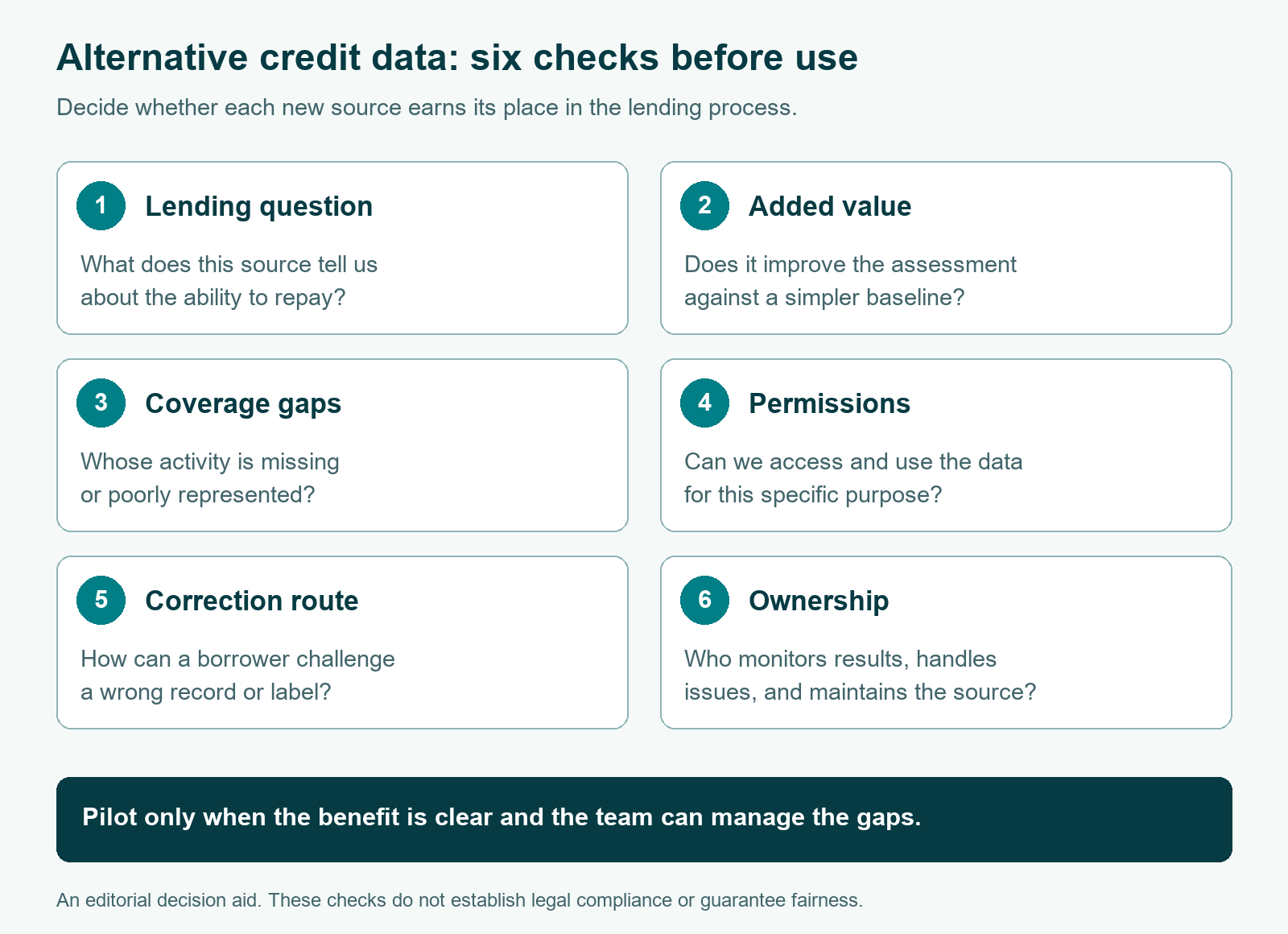
For each proposed source of alternative credit data, write a short decision note. Name the lending question, the added value in the test, the groups with gaps in coverage, and the route to fix errors.
Then record the running cost. Data cleaning, access checks, model testing, and customer disputes all require staff time after launch.
Our AI sourcing guide helps map those duties when a vendor supplies the data or model.
If the evidence shows a real benefit, run a bounded pilot with clear limits and a named owner. If the source adds little value or creates gaps the team cannot manage, leave it out.
The shop owner needs a sound review of her ability to repay. Each new source should help the lender assess the loan and explain the result.
For more practical financial AI analysis, subscribe to FinTech Briefing.
FINTECH BRIEFING · A FUTURECENTRAL BRIEFING
Get practical financial AI analysis in your inbox.
Useful signals, focused analysis and decision questions on AI in banking, payments, lending, insurance, wealth and risk.
Free to subscribe. Confirm your email after signing up. Unsubscribe at any time.