


Agentic KYC can speed up private-bank checks. An AI agent can find company records, map owners, and build a case file. Yet a person should still decide whether the bank accepts the client.
That line matters in the case of Deutsche Bank and Google Cloud. Google Cloud launched Gemini Enterprise for Financial Services on August 25, 2026. The platform supports know-your-customer (KYC) and company research. For example, it can map company groups and find ultimate beneficial owners.
Deutsche Bank helped design the platform’s Financial Research agent. However, its first confirmed use is with Corporate Bank teams that serve German mid-sized firms. The bank has not announced a private-bank KYC agent that can approve clients on its own.
The facts point to a sound starting point. Banks can automate research and case work while named staff keep control of key choices.
What Google Cloud’s financial agent can do
Gemini Enterprise for Financial Services is built for finance teams. Google Cloud says it links a managed research agent to finance skills, paid data, and a bank’s own systems.
For KYC work, the platform can map complex company groups. It can also find owners and review risk profiles. In addition, it can link each finding to a source. Its outputs may include citations, confidence scores, methods, and saved data views.
These tools can ease a real private-bank problem. A new client may use trusts, family offices, holding firms, and companies in several nations. As a result, staff must match names, ownership stakes, directors, source files, sanctions alerts, and news reports.
Much of the work is search and record keeping. An agent can maintain a source-linked map, flag missing files, and prepare a clear case for review.
What Deutsche Bank has confirmed
Deutsche Bank helped shape the agent’s security and control design. Its work also covered audit trails, data location, and the daily needs of bank teams.
The bank says it will first use the agent in its Corporate Bank. The users will serve German MidCorp clients. Deutsche Bank wants to cut manual research and make the results easier to check. It also wants bankers to spend more time with clients.
Google Cloud says the bank is exploring other uses, including financial-crime risk work. That exploration remains separate from a live private-bank KYC launch. Public statements do not show that an agent accepts clients or sets final risk grades.
The two claims must stay apart. Google Cloud explains what the wider platform can support. Deutsche Bank describes a staged rollout that starts with research in the Corporate Bank.
Where agentic KYC can create value
The best early uses sit in the research stage. An agent can collect company records, standardize names, find ownership links, and build a timeline. It can then compare client claims with approved outside sources.
Next, the agent can draft a client profile and flag records that do not agree. It can also prepare questions for the relationship manager. After the bank accepts a client, the same system can watch approved sources for changes.
This approach can improve speed and control. A well-set agent follows the same research steps for each case. It keeps the evidence behind key claims and shows when the record is weak.
Therefore, experts can spend less time copying and sorting files. They can focus on cases that need tax, legal, sanctions, or crime-risk skills.
FinTech Central’s guide to financial-services RAG explains why approved sources and cited proof matter. The same rules should guide agentic KYC.
What agentic KYC should not decide alone
KYC involves more than finding facts. A bank must decide if it knows the client and trusts the ownership story. It must also judge the source of wealth and the fit with its risk rules.
An agent should not approve or reject a high-risk client by itself. It should not clear an unclear sanctions match or set the final risk grade. Likewise, it should not decide whether staff file a suspicious-activity report.
These choices depend on law, bank policy, judgment, and context. A poor choice can harm the client and expose the bank to legal and public risk.
Human review must be real. A compliance officer needs both the source files and the AI summary. The officer must be able to question the ownership map, ask for more proof, change the proposed view, and record a reason.
A control architecture for agentic KYC
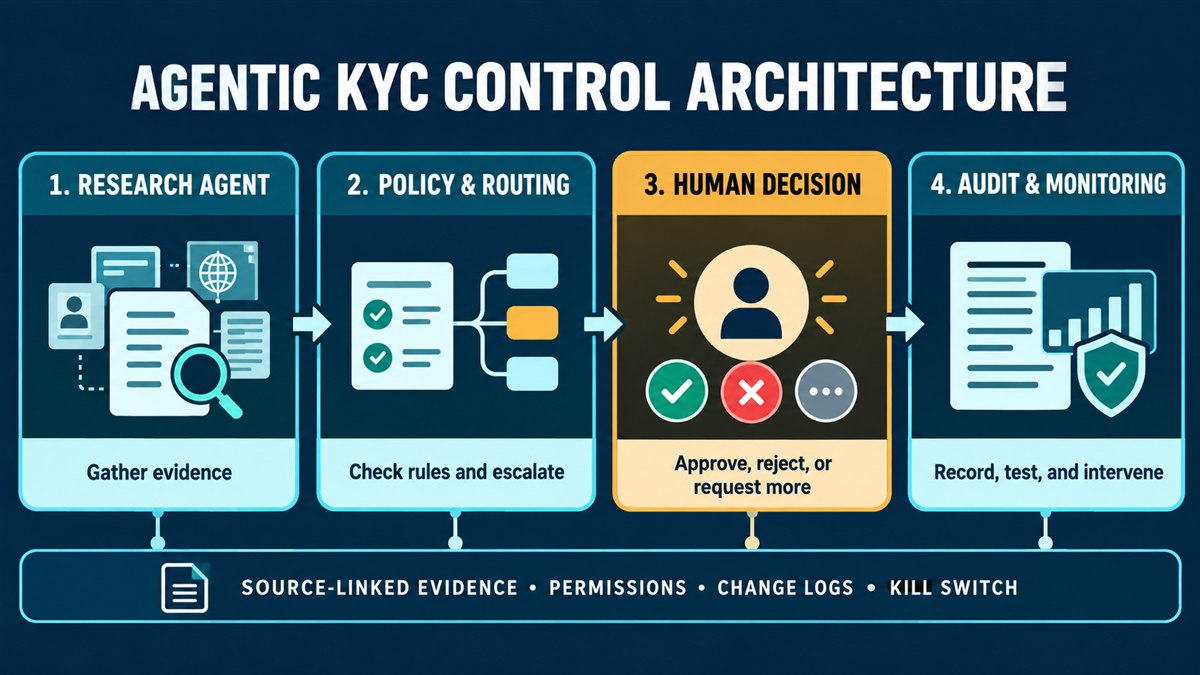
A safe design splits research, rule checks, decisions, and review.
1. Research agent
The agent gathers approved proof, maps firms, records sources, and flags gaps. It should keep possible name matches and show confidence levels. A weak match must never become a fact without review.
2. Policy and routing layer
A rules layer checks required steps and sends hard cases to experts. For example, it can flag a case for deeper checks, sanctions review, legal advice, or senior approval.
3. Human decision
A trained employee confirms the client identity, risk grade, escalation, and final result. That employee stays responsible and can see the full proof trail.
4. Audit and monitoring
The system records what the agent found and which sources it used. It also records what the reviewer changed and why. Finally, the bank tracks changes to models, prompts, data links, access rights, and rules.
This design fits a wider bank AI operating model. A central team can set common controls. Meanwhile, business and compliance leaders remain responsible for client outcomes.
Data and model controls for agentic KYC
Source control is central to agentic KYC. A bank should approve each data link for a clear purpose. It should also record when staff accessed the source, where the data came from, and whether the bank can use it.
Private-client data needs strict access and time limits, backed by strong contract terms. Google Cloud says client data, prompts, files, and outputs stay in the client’s private cloud area. According to the company, this data does not train its base models. Each bank must still test its own setup and confirm that the controls work as planned.
Changes to the agent need the same care. A new prompt, model, or data link can alter a case file. This can happen even when the screen looks the same. Therefore, banks need controlled releases, test cases, live checks, and a way to rebuild old results.
They also need a stop control. A bank must be able to pause the agent when a source fails or access rights break. FinTech Central’s guide to financial AI implementation explains why live checks must continue after launch.
Why agentic KYC matters in India
Indian banks and wealth firms face the same work, often with more varied records and names. A private client may use a family firm, trust, partnership, or overseas company. Some clients may also be politically exposed persons.
Agentic research could cut wait times and improve later reviews. However, the bank must fit the tool to its risk rules and legal duties.
The Reserve Bank of India’s IT outsourcing rules are clear on responsibility. Outsourcing does not reduce a regulated firm’s duties. Its board and senior leaders remain responsible. The firm must also keep full oversight and allow RBI review.
Thus, an Indian bank should control client data, access rights, key choices, and client appeals. It should also test the agent on Indian names, languages, company records, and file types.
There is room here for Indian fintech firms. They can build name-matching tools, owner maps, local-language file readers, case systems, and proof packs. The strongest offer is a clear research layer that helps skilled staff work faster.
Agentic KYC questions before deployment
- Which steps involve research, advice, or a regulated decision?
- Can staff trace each key claim to an approved source and time?
- How does the agent show doubt, record conflicts, and list open matches?
- What sends a case for deeper checks or required human review?
- Who may close a case or change the agent’s advice?
- Can the bank rebuild the proof, setup, and review steps behind an old decision?
- Do vendor contracts give the bank audit, data, change, and pause rights?
Start with disciplined scope
The Deutsche Bank and Google Cloud work matters because it creates a governed research layer. The agent can search many sources, complete several steps, and keep an audit trail.
KYC is one task the wider platform can support. Yet Deutsche Bank’s public rollout starts elsewhere. Banks should keep that distinction clear when they plan their own programs.
First, automate evidence search and case setup. Then measure accuracy, speed, missed issues, and staff actions. A bank should expand the agent’s rights only after it can show that the controls work.
Agentic KYC will earn trust when it makes responsibility clear.