


Payment API security faces a hard test when a stolen access key arrives with a request that looks valid. The system accepts the key, and the request passes its checks. Yet the account owner never chose to send the money.
An application programming interface, or API, lets one system ask another to act. In finance, it might show a balance or start a payment. Each link needs clear limits on who can act and which actions they may take.
AI can help attackers plan and carry out parts of an intrusion. For banks and payment firms, the question is practical: can their controls stop harm before funds leave?
How an AI-assisted payment attack could unfold
Consider a hypothetical payment firm that lets a business partner use its payout service. An attacker finds the link and steals an access key through a fake message or a data leak. The next step is to try to send payouts through that partner’s account.
If the key grants broad rights, the attacker may reach funds held for several clients. Meanwhile, weak checks on new payees, the people or firms receiving funds, could let money reach accounts the attacker controls. A slow response could leave time to move it again.
This is a made-up case to test controls. AI might help with research, fake messages, or attack code. The case does not assume that one AI agent can complete the whole attack on its own.
In May 2025, the UK’s National Cyber Security Centre assessed that attackers were already using AI to improve known attack methods. Its November 2026 report explores plausible threats through 2028. Those scenarios guide planning. Proof of a specific payment attack would need a separate source.
Where payment API security breaks down
A firewall can filter traffic, but an allowed link can still carry a harmful request. Authentication checks who the caller is. Authorization checks what that caller may do. Both checks matter after login.
For example, a partner with the right to view payment status should have no right to create a payout. A key for one merchant should never grant access to another merchant’s funds.
The OWASP API Security Top 10 lists flaws in both types of checks. It also covers abuse of sensitive business flows. Payment teams should therefore test what a caller can do across a whole task, from start to finish.
Teams with separate logs can miss the link between events. The access team may see a valid token, a digital pass, while the fraud team sees an unusual payment. If they keep those views apart, neither may see enough to act.
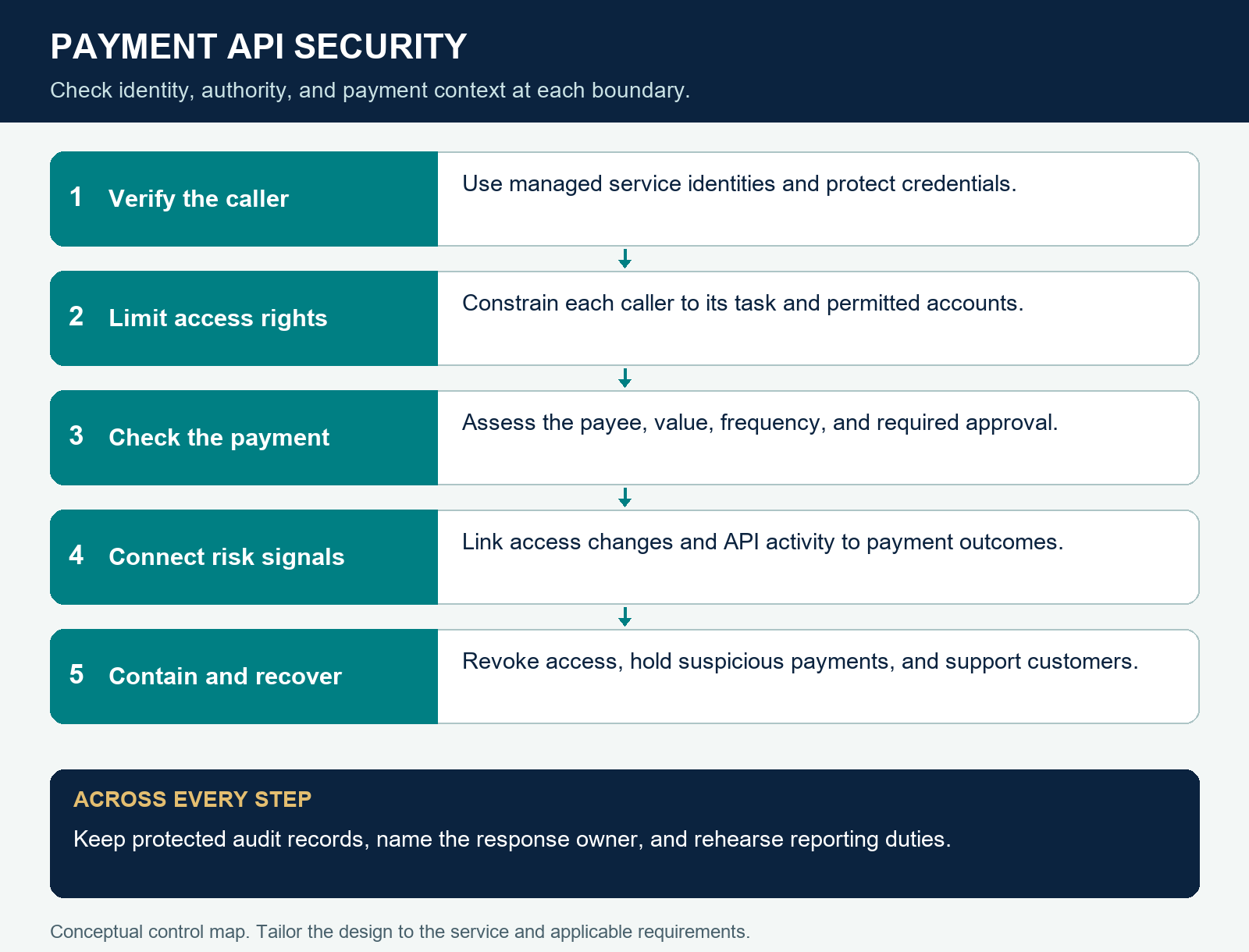
Limit what a stolen access key can do
Start with a list of live APIs and the systems that call them. Give each link an owner. Also record which keys can read data, change payees, or move funds.
For software callers, use a workload identity: a managed identity for a service or app. Where the system supports it, use keys or tokens that expire quickly. Grant only the rights each task needs, and keep test access apart from live access.
Store secrets in a controlled vault and keep them out of code and logs. Then test revocation, which means taking away access. Check that it stops new requests and ends active access as intended.
For mobile channels, device binding links an app to a known device. It adds a useful signal, although the firm still needs checks on the proposed action. For partner systems, check whether a stolen key would work from a different service or caller.
Ask the same questions before buying a tool. Our AI sourcing guide explains why firms need to check the rights and third-party systems behind the software they buy.
Check the payment as well as the caller
Set controls around the risk of the action. A new payee followed by a large payout deserves more scrutiny than a routine status check. Where needed, ask for fresh proof of approval before a sensitive change takes effect.
Also set limits on payment value and frequency across linked events. Counting requests from one network address gives only a partial view. A useful check can link those requests to the client or partner making them.
For business payouts, a maker-checker process means one person prepares an instruction and another approves it. The reviewer needs enough context to judge the payment. Our human review guide explains how access to evidence helps people check automated work.
Consider a cooling period before selected high-risk changes permit funds to move, where the product and rules allow it. Explain the wait and give clients a safe route to seek help. A hold on every payment can also block people who need to pay.
Connect the signals before the money moves
Link account access to payment outcomes. A change in device followed by a new payee may matter more than either event alone. A burst of failed calls may also change how the firm should assess the next successful request.
AI can help staff sort events, but payment API security needs clear rules for action. Define which signals trigger a hold, who reviews it, and how the client gets help. Test false alarms as well as missed fraud.
In India, the RBI’s November 5, 2026 directions for non-bank payment system operators cover API controls and fraud monitoring. They also address access rights, incident response, and board oversight. They take effect for large and medium operators on publication. For small operators, the start date is April 1, 2028.
The scope matters. Banks and other firms must map the rules that apply to them. Assess the controls proposed here against the product and its risks; a compliance review must also cover the firm’s legal duties.
Rehearse containment before an incident
Run a tabletop exercise: a team discussion that tests a response to a simulated incident. Start with signs that someone has misused a partner’s access key. Ask who can revoke it, restrict the affected API, and hold suspect payments.
Also plan how to serve clients while the team checks what went wrong. Save the records needed to trace events. Record who asked for each action and which checks allowed it, while keeping reusable secrets out of logs.
Assign reporting duties before the exercise. Covered non-bank operators must report specified unusual incidents to the RBI within six hours of detection. The directions also require operators to report cyber incidents to CERT-In.
CERT-In’s official FAQs explain its six-hour reporting rule and the relevant incident criteria. Firms can send the facts they have, then add details later. Map both duties in advance so that an unfinished inquiry does not delay a report.
Give the board evidence that controls work
Track the time from a suspected breach to the point when access is actually cut off. Then test whether it stays blocked. Also report how many privileged service accounts have an owner and reviewed rights. These software accounts have elevated access.
For payment checks, show which suspect transfers the firm stopped and how many valid payments it delayed. Include client losses and the time needed to restore service. Alert counts alone leave too much unexplained.
Start with one live payout flow. Trace each right from the partner link to the final transfer, then rehearse its failure. That test will show where payment API security rests on an unchecked assumption.
For more practical analysis of AI in financial services, subscribe to FinTech Briefing.
FINTECH BRIEFING · A FUTURECENTRAL BRIEFING
Get practical financial AI analysis in your inbox.
Useful signals, focused analysis and decision questions on AI in banking, payments, lending, insurance, wealth and risk.
Free to subscribe. Confirm your email after signing up. Unsubscribe at any time.