

AI wealth advisory needs a clear route to a person when a client’s needs exceed the tool’s scope. The service must decide when that happens and what the advisor receives.
Consider a hypothetical client who uses a digital platform for routine investment tasks. After losing a job, he asks whether to sell investments to cover living costs.
The platform still has the income and goals he entered while employed. A fluent answer based on that old profile could miss why he now needs help.
For wealth firms, the key design question is how to spot a changed situation and move the case to someone equipped to assess it. However, account size alone cannot answer that question.
Define the scope of AI wealth advisory
First, separate the tasks within the service. Searching approved research, drafting meeting notes, and recommending a client action have different risks.
For each task, state what the tool may produce and who can approve the next step. Also tell the client what kind of help the channel offers.
For example, a client seeking general information may need a clear explanation of a product. Someone seeking a personal recommendation brings questions about their goals, finances, and ability to bear losses.
Our AI sourcing guide can help map the software and data behind that service. The firm also needs an owner for the advice process across the tools it buys.
Use changes in the client’s situation as triggers
A handoff rule should respond to complexity and uncertainty. It should not wait for the client to use a given phrase such as “speak to an advisor.”
For example, a job loss, a major inheritance, or a new need for cash may make the stored profile unreliable. Conflicting answers about goals or risk can also require follow-up.
In the hypothetical case, the service should flag that income has changed. It should gather enough context to route the question and check whether the old plan still fits.
Also offer a direct way to request human help. A client may know that a question is unusual even when the system fails to detect it.
The firm should also define which cases need an advisor, a complaints team, or a specialist. A single general queue may delay the very cases the trigger was meant to protect.
Design the handoff before choosing the chatbot
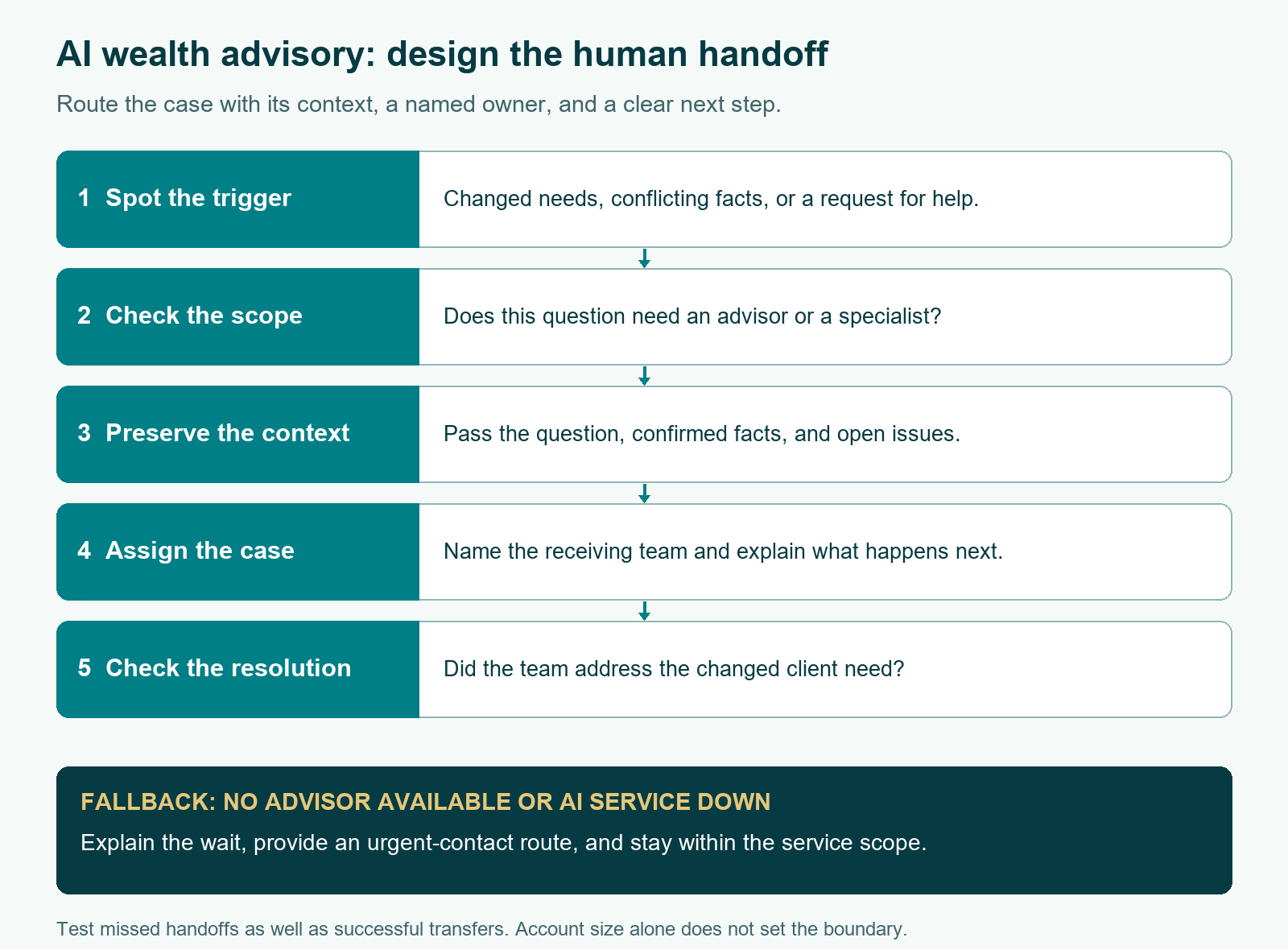
A handoff fails if the client must repeat the whole conversation. The advisor receiving the case needs an accurate account of the question and why it crossed the service boundary.
Include the key profile changes, source records, and any draft the tool produced. Mark facts that the client has confirmed separately from points the system inferred.
For example, the tool may infer that the client wants to sell all investments. The client may only have asked how to fund a short period without income.
Also give the advisor access to that original question. A confident summary should not replace the evidence needed to understand it.
Then tell the client what happens next, who will respond, and what to do if the need is urgent. The fallback should work when the AI service is down.
Keep responsibility visible across digital and human channels
In its May 2024 statement on AI in investment services, the European Securities and Markets Authority (ESMA) highlights poor data, bias, and overreliance on AI. The statement addresses EU investment firms and their duties under the EU investment-services rules known as MiFID II. Indian firms must assess their own rules.
The design lesson is to keep responsibility clear when AI contributes to the service. A handoff should not become a gap in which the digital team and advisor each assume the other checked the recommendation.
Then state who checks the client’s current facts, who assesses the proposed action, and who records the decision. The relevant rules depend on the firm’s role and jurisdiction.
Our human review guide explains how to test whether a reviewer can spot a wrong answer. Use that approach to check whether advisors challenge an unsuitable AI draft.
Test AI wealth advisory with awkward cases
Routine cases may show that the service works when every input is complete. They reveal less about what happens when a client is distressed or the profile is out of date.
For example, build tests around missing information, goals that conflict, and changed cash needs. Ask whether the tool recognizes the limit, preserves context, and routes the case correctly.
Also test delays. If no advisor is available, the system needs a clear response that stays within its scope. It should not offer a personal recommendation merely to avoid an unanswered question.
Measure more than transfer speed. Check whether the receiving team understands the case, asks the missing questions, and resolves it without needless repetition.
Finally, review cases where no handoff occurred as well. A low transfer rate can reflect simple client needs or missed triggers; the number alone cannot distinguish them.
Match human access to the service promise
AI wealth advisory can reduce preparation work and support a wider service. Still, the cost model must include the people needed when a case becomes complex.
Estimate demand for those cases before launch, and check the waiting time after launch. If the service promises access to an advisor, make sure the team can deliver it during busy periods.
For the client who lost his job, a useful handoff preserves the question and prompts a fresh review. Check that the service responds to the changed need.
For more practical financial AI analysis, subscribe to FinTech Briefing.
FINTECH BRIEFING · A FUTURECENTRAL BRIEFING
Get practical financial AI analysis in your inbox.
Useful signals, focused analysis and decision questions on AI in banking, payments, lending, insurance, wealth and risk.
Free to subscribe. Confirm your email after signing up. Unsubscribe at any time.