


AI agents in finance can prepare a credit file without having the right to approve the loan. That gap matters when a vendor offers to automate a bank’s work. A system may do several steps on its own while a person still controls the action that affects the client.
Consider a hypothetical demo. A tool reads company accounts, checks them against a policy, and drafts a credit memo. The screen looks impressive. Before buying it, the bank needs to know what happens when a source is missing or the client asks for an exception.
Start with the rights the bank would grant. Which tasks can the tool choose? Which records can it change? And where must it stop for a person?
Three ways to assess AI agents in finance
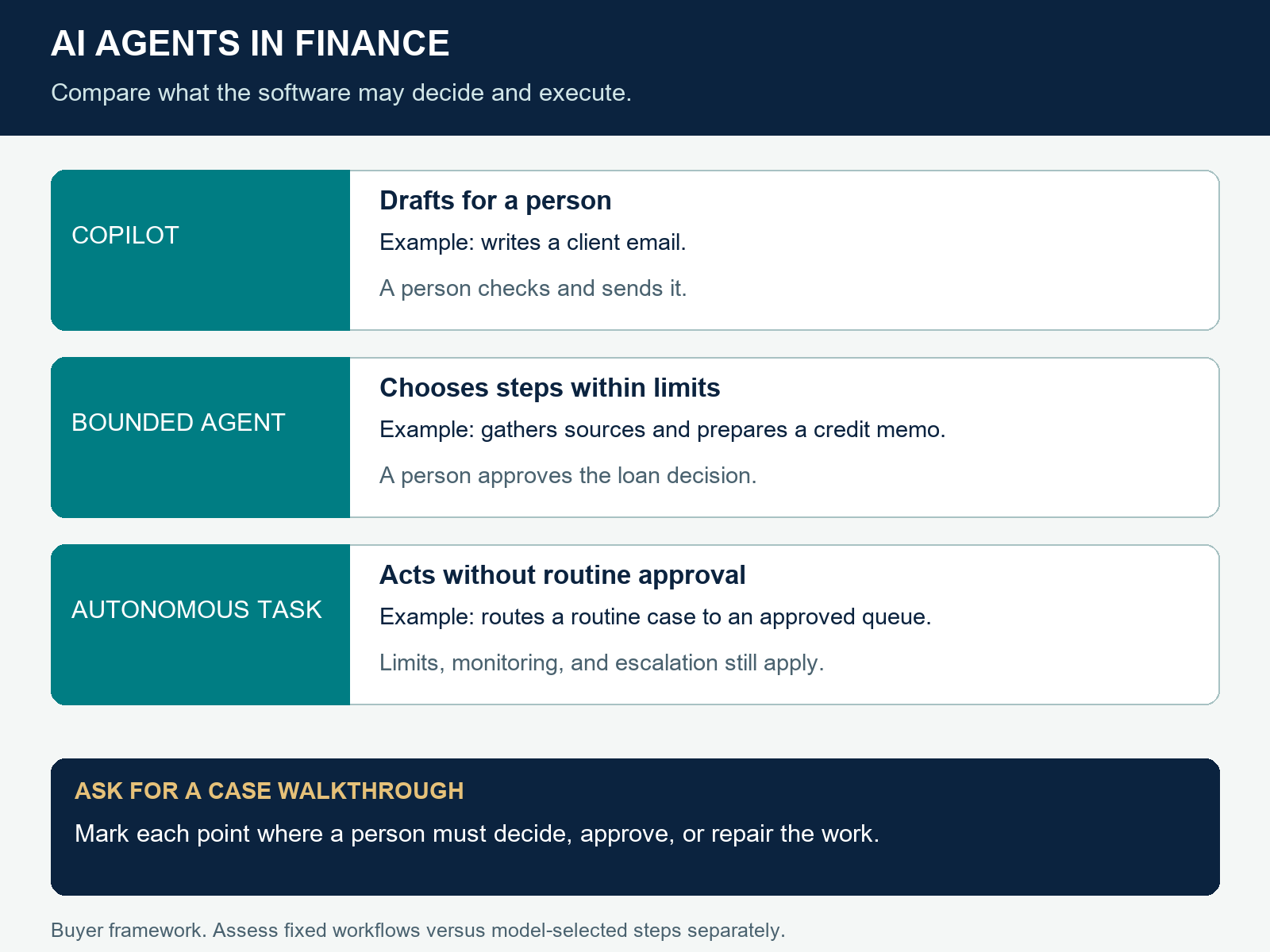
A copilot helps a person complete a task. For example, it may draft a client email that a banker checks and sends. The person directs the work and controls the final action.
A bounded agent can choose and carry out steps within a defined scope. It might find approved source files, compare figures, and prepare a memo. The bank can still require a person to approve the credit decision.
An agent with autonomous authority can complete a defined task without routine approval for each case. Its scope still needs limits and a way to stop it. Autonomy over one task says little about its rights elsewhere in the bank.
These categories help buyers compare products. Check how a vendor defines each term.
Also ask how the software works. In its engineering guide, Anthropic distinguishes fixed workflows from agents that choose their own steps and tools. A fixed sequence with several AI calls may offer less freedom than its sales pitch suggests.
Why broad autonomy needs a high bar
Financial actions can have lasting effects. A wrong summary can be revised; an executed trade or rejected claim may be harder to put right. Approval rights should reflect the harm an error could cause.
Data gaps add to the problem. A tool may read an old policy or miss a change in a client’s finances. Meanwhile, links to older bank systems may fail halfway through a task.
Rules and liability also depend on the activity and jurisdiction. Before launch, a firm needs to establish who may make the decision and who answers for the result. Calling the product an agent does not settle either question.
The Bank of England and FCA’s 2024 survey offers a useful historical baseline. Respondents said that 55% of their AI use cases involved some automated decision-making, while 2% involved fully autonomous decisions. The survey covered AI broadly across 118 responding firms. It does not measure the global share of autonomous agents today.
Useful work can sit before the approval step
Credit preparation provides a concrete example. In August 2026, DBS announced that its agentic AI system prepared a first draft of corporate credit memos. Bankers and credit risk managers then refined the work using their own knowledge and judgment.
DBS said it had expanded the capability to about 1,500 employees after a pilot with 150 users. Those are the bank’s reported rollout figures. The announcement describes credit preparation. A claim about better credit quality or automated loan approval would need further evidence.
The same design logic can guide other tasks. A servicing agent could gather the facts behind a disputed fee before staff decide on a refund. In insurance, it could check whether a claim file contains the required documents and route gaps to a person.
For wealth teams, an agent could prepare meeting notes from approved records while an advisor reviews the client’s changed needs. Treat these examples as designs to test on the firm’s own cases. Our workflow priorities guide helps teams choose where to begin.
Put the limits outside the prompt
A prompt that tells AI agents in finance to be careful offers little assurance on its own. Use access controls that restrict what the software can read and change. Give each task only the rights it needs.
Also restrict the tools it may call. A tool allowlist is a list of approved functions, such as searching a policy library or updating a case note. A drafting task should have no access to a payment-release function.
For actions with financial effects, set value limits and approval checkpoints where appropriate. Then test whether the system can bypass those limits through another tool. Our human review guide explains why reviewers need the source evidence behind an AI proposal.
Memory needs boundaries too. Decide which facts the agent may retain and when they expire. Also keep one client’s data apart from another’s, and prevent an unverified inference from becoming a stored fact.
Finally, record the steps and give an owner the power to halt new actions. A stop control must halt queued actions as well as the current task. Check what happens to tasks already in progress and how staff resume service safely.
Test the vendor’s claim on ordinary and awkward cases
Ask the vendor to show a full case on your test data. Include an outdated policy and a source that conflicts with the client’s record. Then remove access to one system while the task is underway.
Watch whether the agent stops, asks for help, or invents a way forward. Also ask who sees the failure and how the case reaches a person. A polished demo of a complete file leaves these questions open.
For production claims, request the period covered and the number of cases attempted. Ask how many reached a correct result without intervention, how many failed, and how the firm checked quality. A rate based only on easy cases can hide the work staff still handle.
Review model changes as well. A vendor may update the model behind the service after your first test. Agree on notice, retesting, and the right to roll back when results worsen.
Measure the cost of AI agents in finance
Measure the whole task from request to a checked result. Include staff review and the time spent fixing errors. Also count the effort needed to run controls and support the system.
For example, suppose a pilot cuts drafting time but creates extra checks for unsupported statements. The bank needs to measure the net time saved. It should also check whether errors or client delays have risen.
Freed staff time creates value when the firm puts that capacity to use. It may allow staff to serve more clients or clear a backlog. A claim of lower costs needs evidence of costs actually removed.
Compare the pilot with a defined baseline and a similar mix of cases. Then track outcomes after launch. Our AI sourcing guide can help frame which parts of the service to build or buy.
What would show that autonomy is increasing?
Look for evidence that the system handles a wider range of cases with fewer routine approvals. Check whether quality holds as those rights expand. Broader access without reliable results is a larger exposure.
Ask for proof that it deals with exceptions, stops when it should, and leaves a record staff can review. Also check that contracts assign responsibility for errors and outages. Those terms should match the rights the software receives.
Before signing, trace one client case from the first request to the final action. Mark every point where a person must decide or repair the work. That map will tell you how much freedom the agent has and where the bank still needs people.
For more practical financial AI analysis, subscribe to FinTech Briefing.
FINTECH BRIEFING · A FUTURECENTRAL BRIEFING
Get practical financial AI analysis in your inbox.
Useful signals, focused analysis and decision questions on AI in banking, payments, lending, insurance, wealth and risk.
Free to subscribe. Confirm your email after signing up. Unsubscribe at any time.