

Financial AI risk can spread beyond the bank that first spots a problem.
Consider a hypothetical small manufacturer whose bank cuts its credit limit after a sharp fall in sales. The owner turns to another lender. That firm uses a similar risk model and also cuts credit, just as suppliers start asking for faster payment.
Each lender may see a sound reason to protect itself. Together, their actions could leave the business short of cash and make repayment harder. If many firms face the same response, the harm could spread across a market.
This hypothetical case shows a risk teams can test. It does not describe an observed AI-driven credit crisis. It shows why checking each model cannot answer every question about the safety of the whole system.
Model risk and system risk ask different questions
Model risk concerns harm from a model’s errors or misuse. A credit tool might misread income, perform poorly on new borrowers, or keep working after the data changes. Testing and monitoring help a firm find those faults.
System risk adds a wider question: what happens when many firms use the same services or react in similar ways? The danger can arise even when each model works as planned. Actions that protect one bank may worsen conditions for others.
The Financial Stability Board’s 2024 report identifies shared suppliers, market correlations, cyber risks, and model governance as channels that could increase systemic risk. Here, systemic means capable of disrupting financial services across the wider economy.
Scale matters. A system-wide concern arises when the shock threatens key financial services or spreads losses across firms.
The task for risk teams therefore grows wider. Keep testing each model, while also mapping the services firms share and the effects of their joint choices.
How financial AI risk can become shared
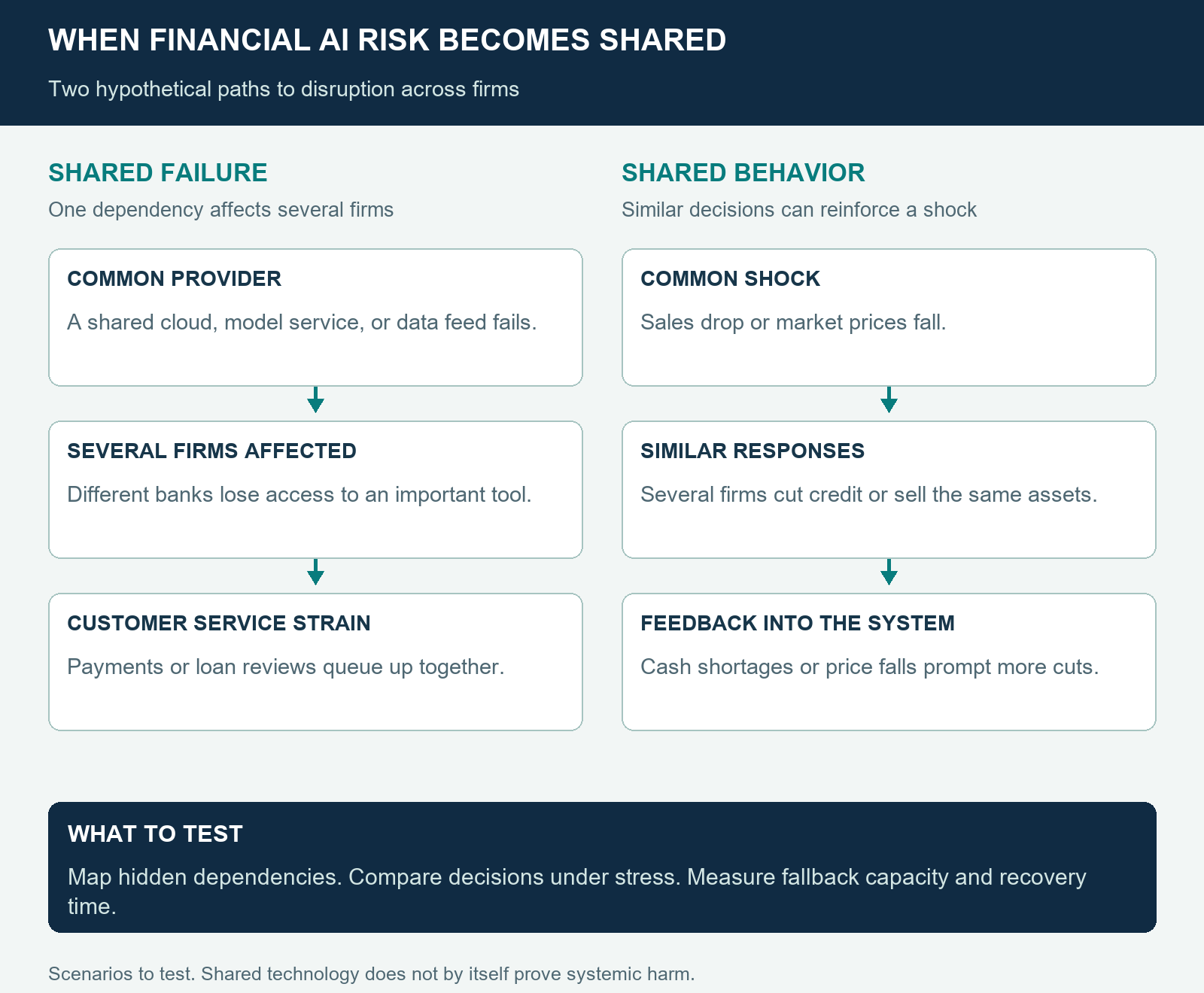
Two routes need separate tests: shared failures and shared behavior.
An outage at a shared cloud host could stop several firms from using their AI tools. A faulty data feed could supply the same wrong prices to different systems. Two vendors may sell their own software yet use the same model supplier underneath.
Shared behavior can develop without an outage. Models trained on the same kinds of records may rank risks alike. Firms may also give different tools the same goals, such as cutting exposure quickly when prices fall. Fraud teams may use the same patterns to flag suspected scams.
Similar models do not always produce identical decisions. A bank’s limits, client mix, and review steps can change the result. Test how much their actions move together under stress. Then check how those actions affect the next round of data.
In its October 2025 monitoring report announcement, the FSB highlights both gaps in monitoring and dependence on key AI suppliers. It urges attention to how critical a provider is and how easily firms can replace it.
Follow the harm through a real service
Return to the hypothetical manufacturer. If several lenders cut limits at once, the owner might pay suppliers late. Those delays could then become fresh risk signals, prompting further cuts. Follow this loop in the test, since past loan records alone cannot show the whole effect.
In a trading scenario, many funds might sell the same assets after a price fall. If buyers cannot absorb the sales, prices could fall further and trigger more selling. AI could change the speed or scale of this familiar feedback.
Insurance pricing offers another test. Similar risk signals could lead several insurers to raise prices or reduce cover in the same area. Check whether people can still get cover. Similar prices alone do not prove that shared AI caused them.
A fraud filter could also flag too many valid payments after a software update. If several firms adopt the update together, customer appeals could arrive faster than staff can resolve them. The result might be a loss of service even though no money has been stolen.
These examples show paths of harm to test. Teams need real data to judge how likely and how severe they are. Our AML alert guide explains why one headline metric can conceal errors in detection.
India needs a map before a concentration claim
India’s banks, insurers, and payment firms need to map shared services to assess financial AI risk. That starts with their own records. A count of direct vendors can miss the cloud hosts, data feeds, or model suppliers those vendors use.
The RBI’s FREE-AI Committee Report, released in August 2025, discusses model correlation and supplier concentration. Recommendation twenty-three proposes internal AI inventories and a sector-wide repository to help track common risks. The report sets out committee recommendations. Each proposal needs a separate check against current rules before a firm treats it as binding.
For each core workflow, list the model and version, data feeds, cloud hosts, and key firms in the supply chain. Then link them to the service that would suffer if they failed. Include the tools staff need when cases fall outside normal rules.
A firm can map its own exposure. Supervisors need the same types of records from firms across the sector to see where those maps overlap. These sources do not give a measured India-wide market share for AI providers. They also do not show how often firms act alike.
Stress-test shared financial AI risk
Begin with a common shock, such as a sharp drop in sales or a faulty price feed. Test how lending, fraud, and treasury tools respond together. Then ask what happens if other firms act in the same way.
If a supplier goes down, measure the service you can still deliver. How many payments or loan reviews can staff handle through the backup route? How long before the queue grows past an agreed service limit?
Before a model update, run old and new versions on the same stressed cases. Compare errors and decisions across the teams that use the tool. Include misleading documents or hostile instructions in the test, with suitable controls around the exercise.
Also test a false alarm. A spike in fraud flags may send customers to service teams that depend on the same unavailable AI provider. Plans to restore service must cover that extra demand as well as the failed tool.
The Bank of England’s July 2026 Financial Stability Report explores scenarios in which disruption spreads through common suppliers and software. Its UK analysis supports testing shared dependencies. It does not establish that the same exposure exists at a particular Indian bank.
Keep a fallback that survives the same shock
Buying a second AI tool may leave the same weak point in place. Check which model, cloud host, and data feed it uses before treating it as a separate route.
A mix of models also needs testing. Two models with different names can make similar mistakes. Compare their behavior on stressed cases and check whether either can support the required service when the other fails.
Set limits on reliance on each supplier, so managers can review how much the firm depends on it. Record which essential workflows share a provider, who can approve more dependence, and what would trigger a move. One cap for all services would ignore how much each one matters.
For changes you control, stage releases and test how to restore the prior version. Ask suppliers how they give notice of updates and what options exist to delay them. If the firm cannot delay an update, it needs a plan for that case too.
Test how much work staff can do by hand too. Staff must have access to the records and tools they need when AI is down. The human-review guide discusses what makes a review step useful.
Finally, plan how to report an incident through the channels that apply. Share enough technical detail to reveal a common cause. Sector drills can test how firms work together without sharing private client files or sensitive lending plans.
What the board should ask next
A board report on financial AI risk should link each core service to the systems it needs and proof it can recover. Include the date of the last drill, the work staff could handle, and the gaps still open.
Ask which failures could hit several business lines at once. Which fallback relies on the same supplier? Who can pause an automated action? How quickly can staff take over, and how much work can they safely handle?
Supervisors face a further question: where do firms’ plans rely on the same limited backup service? A supplier may restore one client quickly yet struggle when many need help at the same time.
Start with one important service. Map its shared dependencies, test a common shock, and measure what customers can still do. That gives model governance a practical connection to the resilience of the wider system.
For more analysis of these operating choices, subscribe to the FinTech Briefing.
FINTECH BRIEFING · A FUTURECENTRAL BRIEFING
Get practical financial AI analysis in your inbox.
Useful signals, focused analysis and decision questions on AI in banking, payments, lending, insurance, wealth and risk.
Free to subscribe. Confirm your email after signing up. Unsubscribe at any time.