

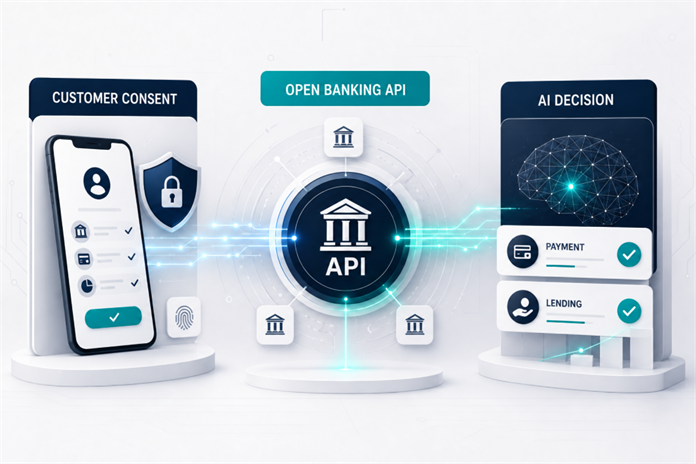
Open banking lets customers share bank data through secure digital links and pay straight from a bank account. A secure link provides access, but it cannot explain a payment or judge a loan request. AI in open banking adds the decision layer by turning consented data into useful payment and lending signals.
The two parts play different roles. Open banking gives safe access to data and payment services. AI sorts the data, finds patterns and supports a decision. Together, they can cut payment friction and give lenders a fresher view of cash flow.
However, access must have clear limits. A customer should know what data is requested and why. The customer should also know how long access will last.
How AI in Open Banking Works
First, a customer allows a regulated firm to view selected account data. The firm receives that data through an application programming interface, or API. Therefore, the customer does not need to upload bank statements or share login details.
Next, an AI model can do a few clear tasks:
- Sort payments into groups such as salary, rent, and utilities.
- Find regular income and spending patterns.
- Flag unusual activity that may need an extra check.
- Estimate cash-flow strength and ability to repay a loan.
- Warn that an account may soon face a cash shortfall.
- Suggest a suitable payment or review path.
Still, the model should not see every available data point. It should receive only the data needed for the stated task.
Smarter Payments with AI in Open Banking
Account-to-account payments move money straight between bank accounts. They give merchants another way to accept digital payments. In practice, the customer approves a transfer from a bank account without typing account details by hand.
AI can improve the checks around that payment. For example, a risk model can review the device, payment value, and past use. It can also check the payee, place, and time. A normal payment may then pass with little delay.
By contrast, an unusual transfer may trigger a warning or an extra identity check. That does not mean every new payment should be blocked. A sound model must tell a real threat from a valid first purchase.
As a result, the provider can apply more checks where risk is high. It can also keep low-risk payments quick and simple. This balance matters because too much friction can cause buyers to leave.
Open-banking payments are now moving beyond small trials. Open Banking Limited reported 351 million UK open-banking payments in 2025. That was 57% more than in 2024. Therefore, strong risk checks and reliable APIs are now core operating needs.
How AI in Open Banking Supports Lending
Traditional credit checks often rely on credit history and stated income. Those sources remain useful. However, they may not show the borrower’s cash position today. Data shared with consent can offer a more recent view.
For example, a small-business model can check if sales are steady. It can review repeat costs, tax payments, and current debt. It can also find seasonal rises and falls in cash flow.
Similarly, a model for an individual can study income and key expenses. It can check whether loan payments have been made on time. This evidence may help people and firms with a thin credit file.
The Reserve Bank of India’s Account Aggregator guidance states that data is shared only on the customer’s instructions. It also notes that the system can cut loan processing time. In addition, the framework can support cash-flow lending for small firms and MSMEs.
AI should support a loan decision and keep the reasoning visible. A lender still needs clear rules and data checks. It also needs a way to review a poor or disputed result. After all, a model can sort a payment wrongly, and income can change.
A Practical AI in Open Banking Decision Flow
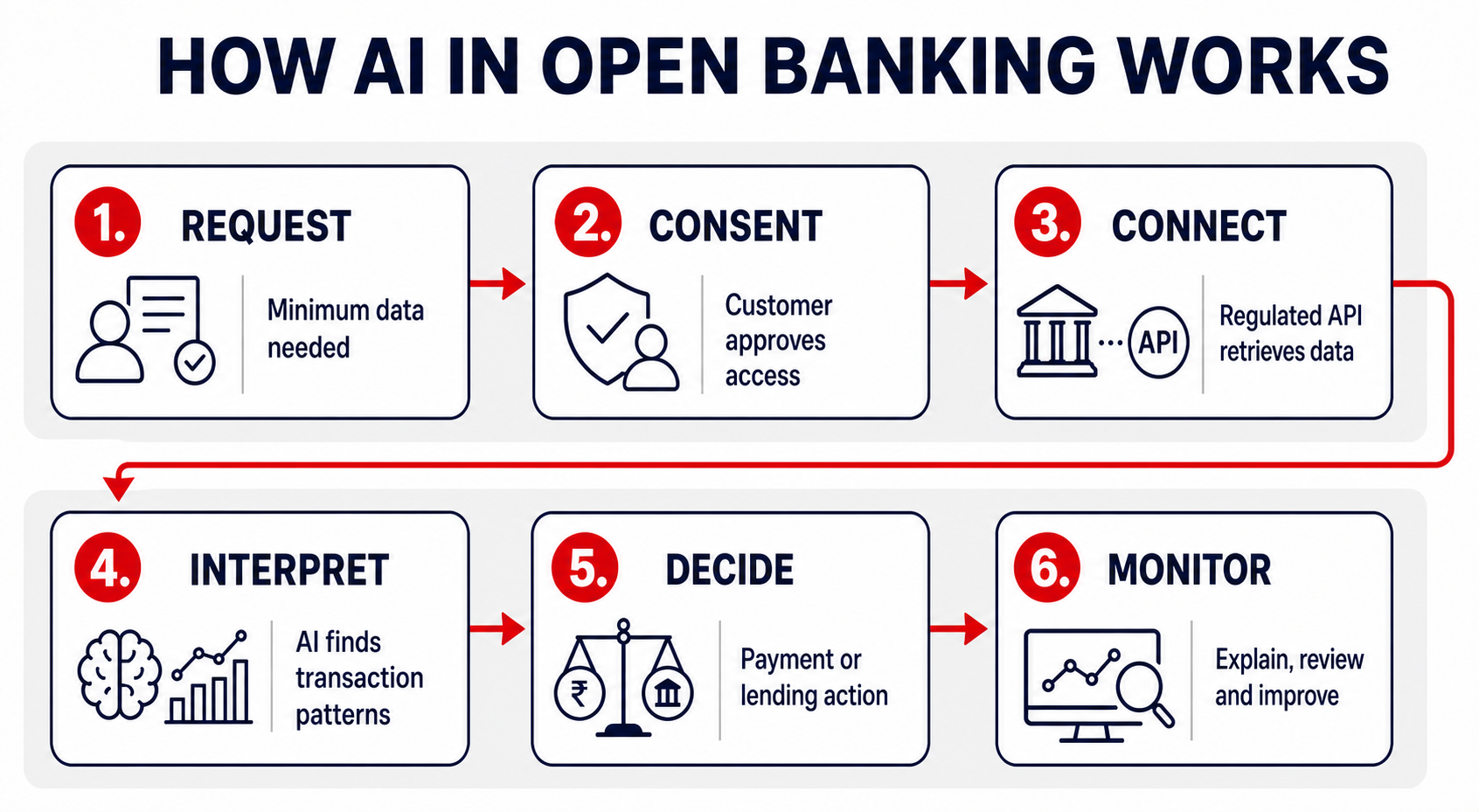
A sound process has six steps:
- Request: The firm asks for the least data needed.
- Consent: The customer approves the accounts, data, and time limit.
- Connect: A regulated API retrieves the approved data.
- Interpret: AI sorts payments and finds useful patterns.
- Decide: A payment or loan engine suggests an action.
- Monitor: The firm explains results and checks for errors.
Finally, the firm must test the model after launch. Payment labels can change, and new fraud methods can appear. Therefore, past model success does not promise good results forever.
Four Controls That Should Not Be Optional
Purpose-Limited Consent
First, consent should cover one clear purpose. It should not hide inside a broad screen. The customer must also have a simple way to end access.
Data Minimization
Second, each task should use only the data it needs. For example, a payment risk check may need far less history than a business loan review.
Human Review
Third, a customer needs a way to challenge an important decision. Human review is vital when data is missing or model confidence is low.
Outcome Testing
Finally, providers should track false declines, fraud losses, and complaints. They should also compare results across customer groups. A model that lifts approvals while treating one group unfairly is unsound.
Where Open Banking Fits in a Payment Strategy
Open banking will not replace every payment method. Cards remain easy to use and widely accepted. Meanwhile, real-time systems offer speed and broad reach. Wallets also make the checkout journey simple.
Open-banking payments add another choice. They can help when a direct bank payment lowers cost or improves control. In addition, shared data can give the provider more context for a risk decision.
Payment leaders should ask where open banking improves the customer journey. AI can help answer that question for each payment.
This role complements AI payment routing. Routing tools choose a good processing path after a payment request. By contrast, open banking adds new data and payment choices before that decision.
Better Context Creates the Real Advantage
The main value of AI in open banking is better context. For example, shared account data can show if a payment fits normal behavior. It can also show whether a small firm has steady cash flow.
However, that value depends on careful use. Providers need clear consent and limited data access. They also need reasons for key decisions, human review, and regular tests.
When those controls are in place, AI in open banking can make payments smoother. It can also make loan decisions more current without treating customer data as an unlimited resource.
Explore more analysis in AI in Payments and Lending and AI in Finance.
FINTECH BRIEFING · A FUTURECENTRAL BRIEFING
Get practical financial AI analysis in your inbox.
Useful signals, focused analysis and decision questions on AI in banking, payments, lending, insurance, wealth and risk.
Free to subscribe. Confirm your email after signing up. Unsubscribe at any time.