

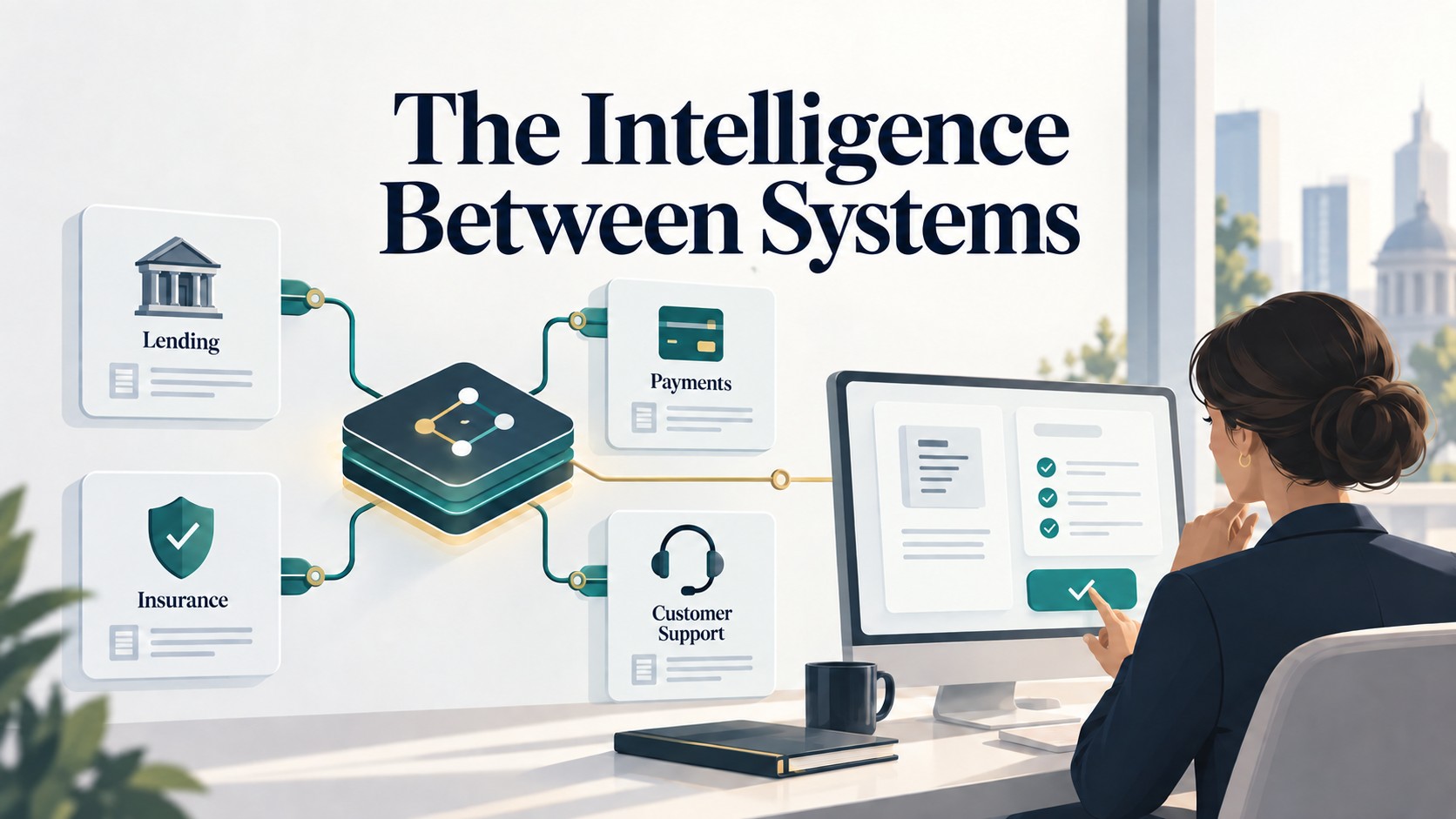
Workflow intelligence could give fintech its next advantage by connecting the systems financial institutions already depend on. For a decade, fintech competed on applications: faster onboarding, simpler payments, smarter lending, and easier-to-use wealth tools. It worked. As a result, customers got better products.
The next opportunity is to understand, coordinate, and safely act across those systems. That calls for a view of the whole workflow, including the points where work passes between teams.
Finance has a coordination problem
Every industry has disconnected systems. Finance is different because core decisions span several of them, often in seconds or minutes. At the same time, those decisions face regulatory scrutiny, with money on the line.
Take lending. A single credit decision might run through this chain:
Application → bureau pull → bank statements → income verification → underwriting rules → fraud checks → decision → servicing
Each system may work well on its own. However, the credit decision depends on context spread across all of them. The bureau score says one thing, while the bank statements suggest another and a fraud check flags a minor concern. An analyst has to hold the full picture in their head while switching between screens.
Payments follow a similar chain:
Transaction → fraud screening → payment processor → reconciliation → dispute → customer service
For example, a payout mismatch may appear in reconciliation days after the customer notices it. Meanwhile, the fraud and support teams each hold half the story. Workflow intelligence needs a view across both systems to help resolve it.
Insurance claims, know-your-customer (KYC) reviews, and chargebacks follow the same pattern. In finance, handoffs can be expensive.
Integration needs a decision layer
The standard answer to this problem is integration. Reliable data movement takes real engineering, and nothing works without it. Once the data flows, teams still need to decide what should happen next.
Who or what looks across those signals and makes that decision?
This is where I think the industry is asking the wrong question. Teams keep asking which system they should add AI to. I would start by asking where the work crosses systems and what intelligence is missing at those handoffs.
The goal is to make the whole workflow intelligent.
What workflow intelligence needs to do
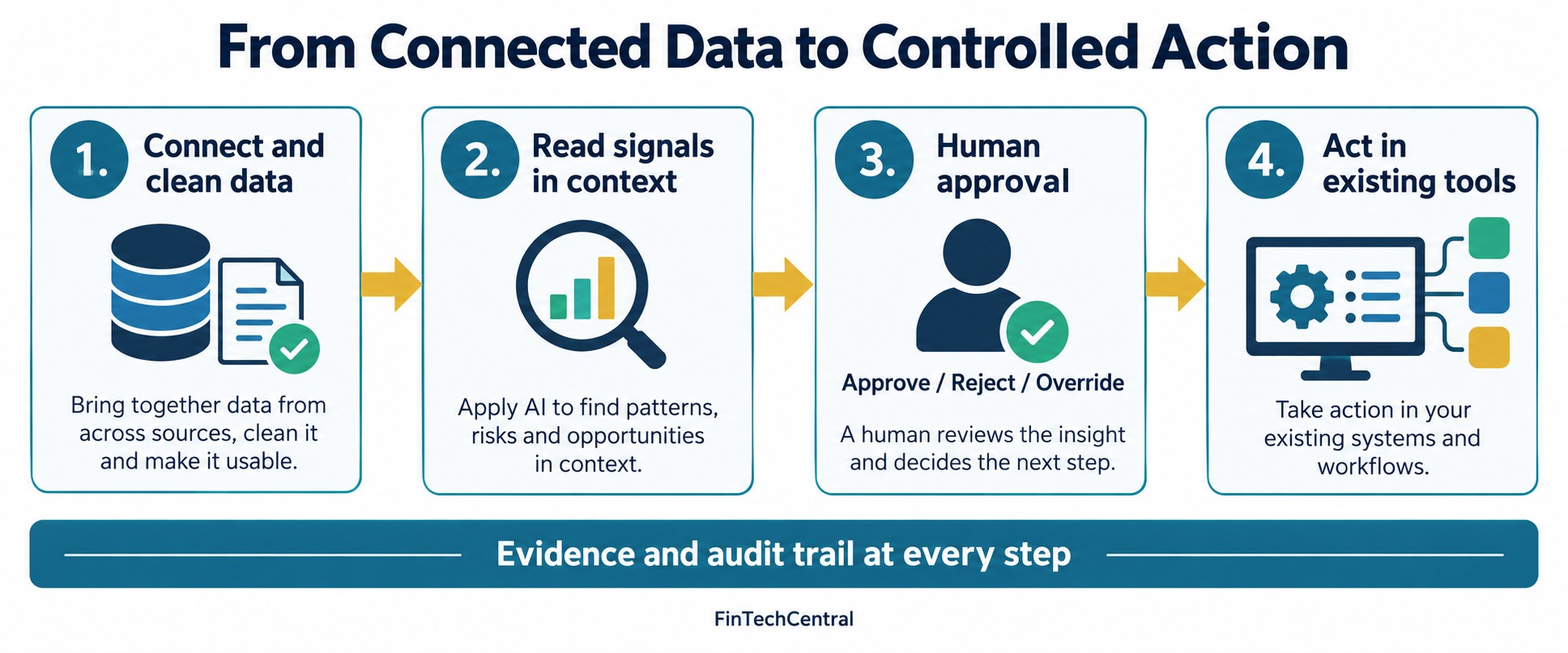
The systems of record, which hold the official business records, stay where they are. A workflow intelligence layer helps teams see the whole flow. In practice, it needs to:
- Read signals across systems in context. For example, it should connect a transaction with the customer’s history, an open ticket, and the relevant policy rule.
- Recommend or take the next action. Depending on its permissions, it might route a case, flag a risk, or propose a resolution.
- Act through the tools teams already use. That could mean creating a ticket, updating a record, or triggering a workflow.
- Show its evidence. For that reason, a reviewer should be able to check the data, rule, transaction, document, or signal behind a recommendation. Since AI-generated explanations can be wrong, the source must remain available for review.
The lesson that surprised us: adoption depends on control
In one recent insurance deployment, six AI agents were connected to Jira, ServiceNow, and Splunk, with a live dashboard on top. AI agents are software tools that can carry out tasks within set limits. The existing stack stayed in place, while the operations team changed how it interacted with those tools.
What surprised us was how much adoption depended on control.
People trusted the agents once they could see what each was doing and approve, reject, or override its actions. When full automation was the goal, hesitation followed, while usage grew when a human stayed in the loop. In regulated financial services, a wrong decision can create compliance problems and damage a customer relationship. That makes control even more important.
For a broader reference on oversight, NIST’s voluntary AI Risk Management Framework addresses human responsibilities, explainability, and documented controls.
Workflow intelligence starts with connected data
The most common mistake I see is starting with the intelligence. For example, teams add AI to inconsistent, duplicated, or stale data and expect clarity.
Bad data can lead to faster bad decisions when AI acts on it. As a result, teams need to fix the inputs before trusting the output.
So the sequence matters:
- Map the handoffs. Find where work crosses systems or teams, especially where people rekey data or chase status.
- Pick one workflow with a measurable cost. For example, track turnaround time, error rates, or manual effort so you can test the impact.
- Connect and clean the data for that workflow first.
- Keep humans approving decisions at the start. Widen autonomy only after teams have demonstrated accuracy and built trust.
- Build audit trails from day one. In particular, each record should show what happened, the evidence behind the action, and who approved it.
Teams can begin this work with the front-end applications they already have.
The human role in workflow intelligence
Better-connected systems can change how people spend their time:
- As reconciliation takes less time, teams can focus on exceptions.
- Once data gathering becomes easier, people have more time to exercise judgment.
- When teams spend less time chasing status, they can spend more time making decisions.
An underwriter who no longer spends the morning collating documents can focus on borderline cases where experience matters most. Because those cases carry real consequences, a financial institution needs care when deciding what to automate.
Where fintech leaders can start
I expect the next fintech advantage to come from making existing financial infrastructure work as a coordinated system. In practice, workflow intelligence offers a way to do that, provided teams define where software can act and where a human must retain control.
Start with one costly handoff. Connect the evidence, keep approval visible, and measure whether the workflow improves.
Further reading from FinTechCentral
About the Author

Chetan Saundankar is the Founder and CEO of Coditation Systems and Plant360.ai. He has more than two decades of experience in software engineering, data systems, modernization, and AI, working with enterprises on complex technology transformation and AI adoption.
FINTECH BRIEFING · A FUTURECENTRAL BRIEFING
Get practical financial AI analysis in your inbox.
Useful signals, focused analysis and decision questions on AI in banking, payments, lending, insurance, wealth and risk.
Free to subscribe. Confirm your email after signing up. Unsubscribe at any time.