

Financial RAG can attach a real source to an answer that is still wrong. The document may be outdated, apply to another product, or fail to support the claim beside its citation.
Consider a hypothetical bank employee asking an internal AI tool about a fee waiver. The tool finds an old policy and gives a confident answer with a link.
The citation opens correctly. However, a later policy changed the rule for that customer’s account. Staff who check only that the link works may accept the wrong answer.
For teams building financial knowledge tools, the test must check more than whether a citation appears. It needs to follow the evidence from the user’s question to the source and then to the final claim.
Understand what financial RAG adds
Retrieval-augmented generation, or RAG, adds a search step before a language model writes its answer. The system retrieves material and supplies it as context for the model.
The NIST glossary describes RAG as a way to pair generation with retrieved information. This can bring relevant external knowledge into the answer.
Still, several things must work. The right document must exist, the search must find the right passage, and the model must use it correctly.
Our AI sourcing guide helps separate those layers and assign an owner to each. The bank must assign responsibility for its source library, even when a vendor supplies the model.
Check whether the source applies to this question
A document can look relevant while describing a different situation. Product names, dates, legal entities, and customer types can change which rule applies.
For the fee-waiver example, the test should identify the account type and the date of the decision. It should also check which policy version was in force then.
An old policy may be the right source for a past dispute. Therefore, simply favoring the newest document will not solve every question.
Store the details needed to choose between versions. Record effective dates, status, scope, and links to documents that replace earlier guidance.
Also give staff a route for reporting conflicts. If two approved sources disagree, the tool should not silently choose the one that ranks higher in search.
Test the claim beside each citation
After finding the source, compare the answer with the exact passage. Does the text support the claim, or does it merely discuss the same topic?
For example, a policy may say staff can request a waiver after review. An answer that says the customer qualifies without review changes the meaning.
The source can also contain an exception in a separate paragraph or table. Splitting documents into small passages may separate the main rule from that limit.
Use tests that require both parts of the evidence. Include tables, footnotes, and cross-references that staff encounter in real work.
The NIST Generative AI Profile describes the risk of confident false content and misleading supporting logic or citations. So staff must check whether each cited passage supports the claim.
Separate search failure from answer failure
When financial RAG gives a wrong answer, inspect the retrieved passages before changing the prompt. The failure may have happened before the model began writing.
If the library lacks the current rule, fix the source collection. When search misses a source that exists, check how the system reads, labels, and ranks documents.
When the model receives the right passage but changes its meaning, test the writing and checking steps. A longer prompt alone may not address the cause.
Build a small test set with known questions, approved source passages, and expected answer limits. Keep it when changing the model or search system so you can compare results.
Also include questions that the library cannot answer. The tool needs a way to state the gap and route the question to the right person.
Recheck answers when sources or access rights change
A knowledge tool needs upkeep after launch. Source documents change, and cached answers may continue repeating an old rule.
When a policy changes, check how the team updates search records and stored answers. Test a question that previously relied on the retired policy.
Access rights matter too. A user who cannot read a restricted document should not receive its contents through a generated summary.
Check the user’s access rights before passing source material to the model. Also review logs and shared conversation histories, which may retain private text after the original query.
These are design checks to apply within the bank’s own data and security rules. The team must also determine which obligations apply to the deployment.
Give reviewers the evidence they need
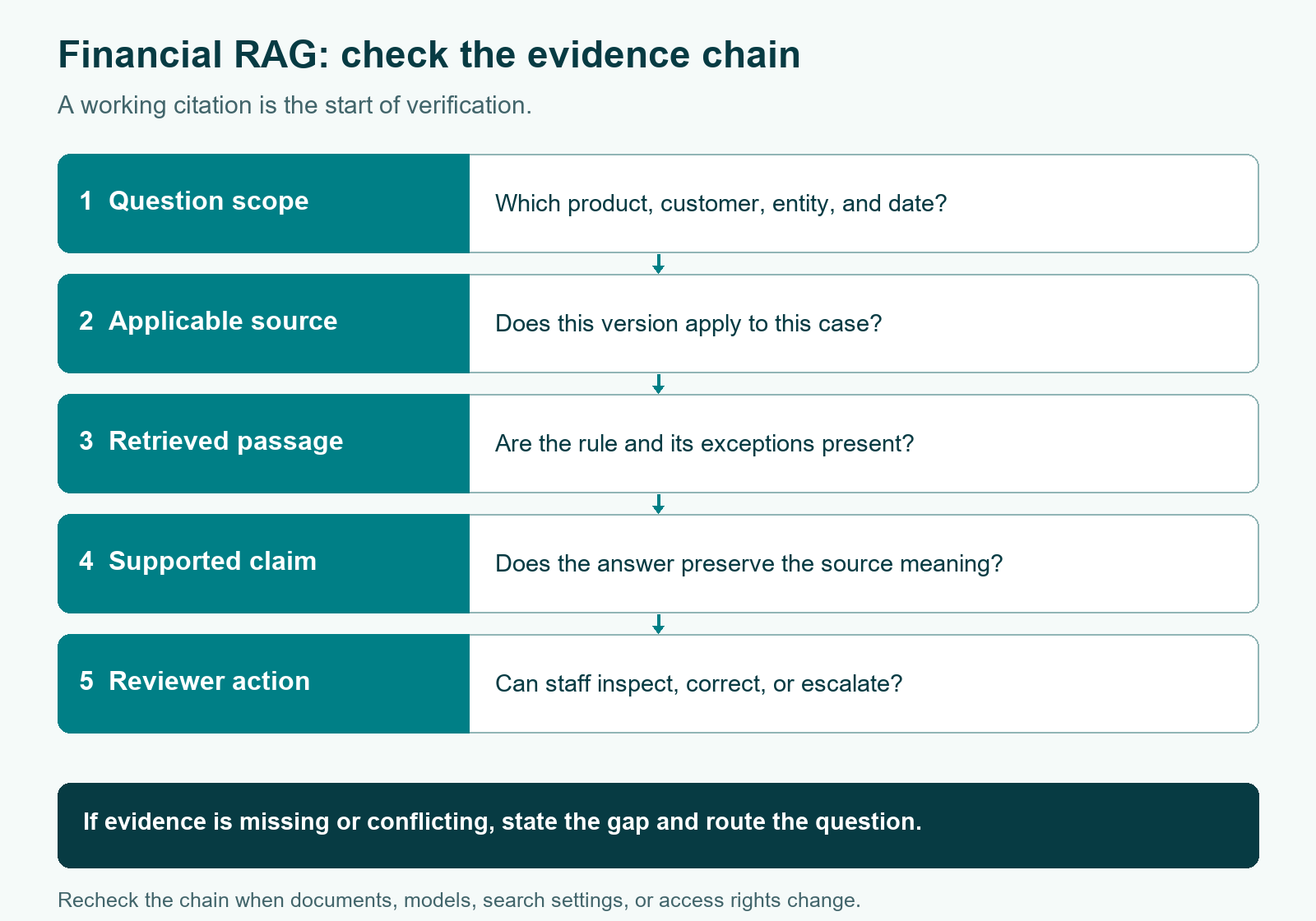
For a high-stakes answer, staff need to see the right passage, its scope, and its date. A link to the front page of a long manual may make checking impractical.
Our human review guide shows why the reviewer must be able to find an error and act on it. Test the whole review task, including the time staff need to open the source.
Before expanding financial RAG, ask the team to demonstrate a wrong-version case, an unsupported claim, and a question with no answer. Show the expected response for each.
For the fee-waiver query, success means finding the rule that applies and explaining its limits. The citation is useful because it helps staff verify that work.
For more practical financial AI analysis, subscribe to FinTech Briefing.
FINTECH BRIEFING · A FUTURECENTRAL BRIEFING
Get practical financial AI analysis in your inbox.
Useful signals, focused analysis and decision questions on AI in banking, payments, lending, insurance, wealth and risk.
Free to subscribe. Confirm your email after signing up. Unsubscribe at any time.