


India AI inference gives a bank a new answer to one question: where does the model process a supported request?
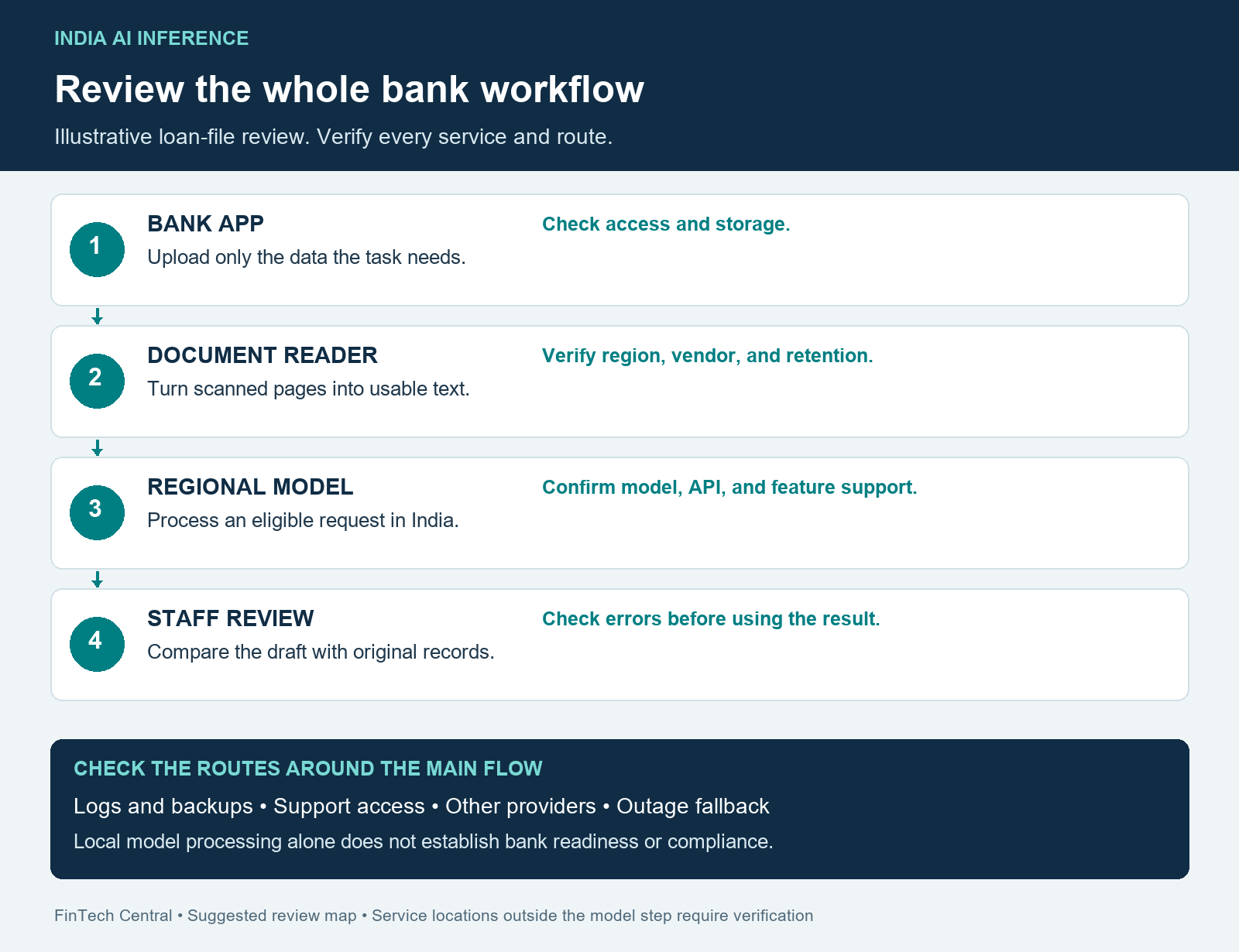
Now imagine a loan officer asking an AI service to summarize a borrower’s file. The model may run in India. Yet the file could also pass through the bank’s app, a document reader, a support service, and several logs.
Before staff rely on it, the bank needs to know who gets the data and what happens if the answer is wrong.
Local processing can remove a barrier to use. However, a bank-ready service also needs sound data controls, tested results, and a way to keep working when the supplier fails.
What changed for India AI inference
OpenAI’s November 10 release note says inference residency is generally available for GPT-6 Luna in India, Japan, and Australia. For supported requests, processing and model inference take place in the chosen country. The launch requires approved, active Zero Data Retention and a regional API project with Storage & Processing selected.
The current technical guide lists the India domain as in.api.openai.com. Regional processing supports GPT-6 Luna through Responses and Chat Completions, with text and image inputs and text output. It supports Standard pay-as-you-go; hosted tools are unavailable for this processing path.
Therefore, a bank should verify its exact model, API, and feature combination before planning the workflow. A service may store a file in India yet lack support for processing a given task there.
Check the price and terms too. The guide describes a residency price uplift for eligible newer models. Then compare the current regional quote with the cost of the complete service, including staff review and failed requests.
These details describe the API offering checked on November 17, 2026. They do not show the same support for every ChatGPT plan or every global model.
Keep location, retention, and control separate
Storage residency concerns where data rests. Inference residency concerns where the model runs to produce an answer. Retention concerns how long a service keeps data. Each answers a different question.
Control goes further because location leaves other questions open. Can the bank restrict access, inspect records, stop a task, and change suppliers? Data sovereignty also concerns which laws apply and which public bodies can reach the data. A local server address alone cannot answer those questions.
OpenAI’s guide excludes system data from residency commitments. Examples include account, billing, usage, and support information. It also excludes third-party services and transfers caused by the customer’s own infrastructure. These limits belong in the bank’s data-flow review.
Zero Data Retention needs a separate check. OpenAI’s data-controls guide explains that endpoint and feature limits still apply. Some features may keep data needed to run the service even when that setting is enabled. Avoid turning a retention label into a promise that no component stores anything.
For our imagined loan file, trace the full route. Where does the bank upload it? Which service reads scanned pages? Where do staff view the answer?
Then check logs, backups, and support access along that route.
Our guide to permissioned data in financial AI adds another question: does each use stay within the bank’s valid rights and stated purpose?
Bank readiness still needs a review of outside services
For the commercial banks within their scope, RBI’s Managing Risks in Outsourcing Directions, 2025 address material IT outsourcing and cloud services. They cover provider review, agreements, monitoring, continuity, and exit. Outsourcing does not reduce the bank’s own obligations.
The scope matters. That definition of commercial banks excludes small finance banks, local area banks, payments banks, and regional rural banks. Compliance teams should identify the directions for their own entity and arrangement, including later changes.
A supplier’s residency feature therefore leaves legal checks to do. Ask who owns the service inside the bank, which data it may use, and who can pause it. Then map the arrangement to the bank’s policies and the rules that apply.
Review the supplier chain as well. Ask which firms handle the request and what audit or access rights the bank has. Also confirm how staff report an incident, get help, and recover records after a dispute.
Next, test an outage. If the chosen regional path fails, what does the app do? Any fallback needs an explicit design decision because switching routes could change where data goes. A clear stop or manual queue may fit the task better.
These are preparation questions for the bank’s review. Neither a regional product announcement nor this checklist establishes RBI approval or privacy compliance for a deployment.
Choose a task before approving India AI inference
Start with a task whose limits staff can enforce. For example, a staff assistant could answer questions from approved internal guides. Test whether it names the right source and stops when the material cannot answer.
However, document review adds a different risk. In the loan-file example, compare the summary with the original pages. Check names, dates, missing pages, and figures that appear in more than one place. A fluent answer can still join the wrong facts.
Customer service brings the answer to a real person. Before release, test whether the system can distinguish a general query from a complaint or a request for advice. Then check that staff receive the case when the service hands it over.
Before using AI for credit decisions or payments, assess who may act and what the rules allow. A model that can read a file should not gain the right to sanction a loan or move money. Even with local processing, the bank needs to assess the harm and check those powers.
Use the same test cases when comparing models. Also include the bank’s own document formats and languages. Our financial AI risk guide explains why a model test needs to sit inside a review of the wider service.
A vendor scorecard for India AI inference
Use a simple evidence register before starting a pilot. For each question, record the claim and the contract terms. Then add what the bank has tested.
- Location and coverage: Which model, API, and features use the India processing path? Which parts of the workflow sit elsewhere?
- Data and access: What may each service retain, who can see it, and which other firms handle it?
- Quality and review: What errors did the bank find in its own tests? Who checks the output and handles exceptions?
- Outages and exit: What happens during an outage? Can the bank recover its records and continue with another route it has approved?
- Cost and change: After staff check the result, what does the complete task cost? What happens if the model, price, terms, or regional support changes?
For the loan-file pilot, an acceptable result might be a draft summary that staff check against the source. It should also flag pages it cannot read and facts it cannot find. Also record the extra review time before claiming that the service saves work.
If proof is missing, narrow the pilot or keep it in testing. Once the firm can show that the full workflow meets its needs, it can decide whether to expand.
India-based processing gives teams a new way to use models. Before launch, name the task, its data, its limits, and the proof that supports the decision.
Follow the FinTech Briefing for practical analysis of financial AI and the decisions behind deployment.
FINTECH BRIEFING · A FUTURECENTRAL BRIEFING
Get practical financial AI analysis in your inbox.
Useful signals, focused analysis and decision questions on AI in banking, payments, lending, insurance, wealth and risk.
Free to subscribe. Confirm your email after signing up. Unsubscribe at any time.