

Financial services RAG connects a generative AI model to approved institutional knowledge before it answers a question. Retrieval-augmented generation searches a controlled knowledge base and supplies relevant passages alongside the knowledge learned during model training.
This architecture can help banks, insurers, lenders, and investment firms build assistants that use current policies, product documents, research, and operating procedures. It does not guarantee a correct answer. The quality of the source material, retrieval process, access controls, and review workflow still determines whether the system is dependable.
What financial services RAG does
The original retrieval-augmented generation research combined a language model with an external knowledge store. In a financial institution, that store might contain approved policy manuals, product terms, regulatory guidance, research notes, or customer-service procedures.
When a user asks a question, the system looks for relevant material, adds selected passages to the prompt, and asks the model to produce an answer from that context. A well-designed application can also show citations so the user can check the source.
This differs from fine-tuning. Fine-tuning changes model behaviour by training it on examples. RAG retrieves information at the time of the request. Institutions may use both, but retrieval is often better suited to knowledge that changes frequently or must remain traceable.
The four-stage financial services RAG pipeline
The workflow has four linked stages. A weakness in any one of them can undermine the final answer.
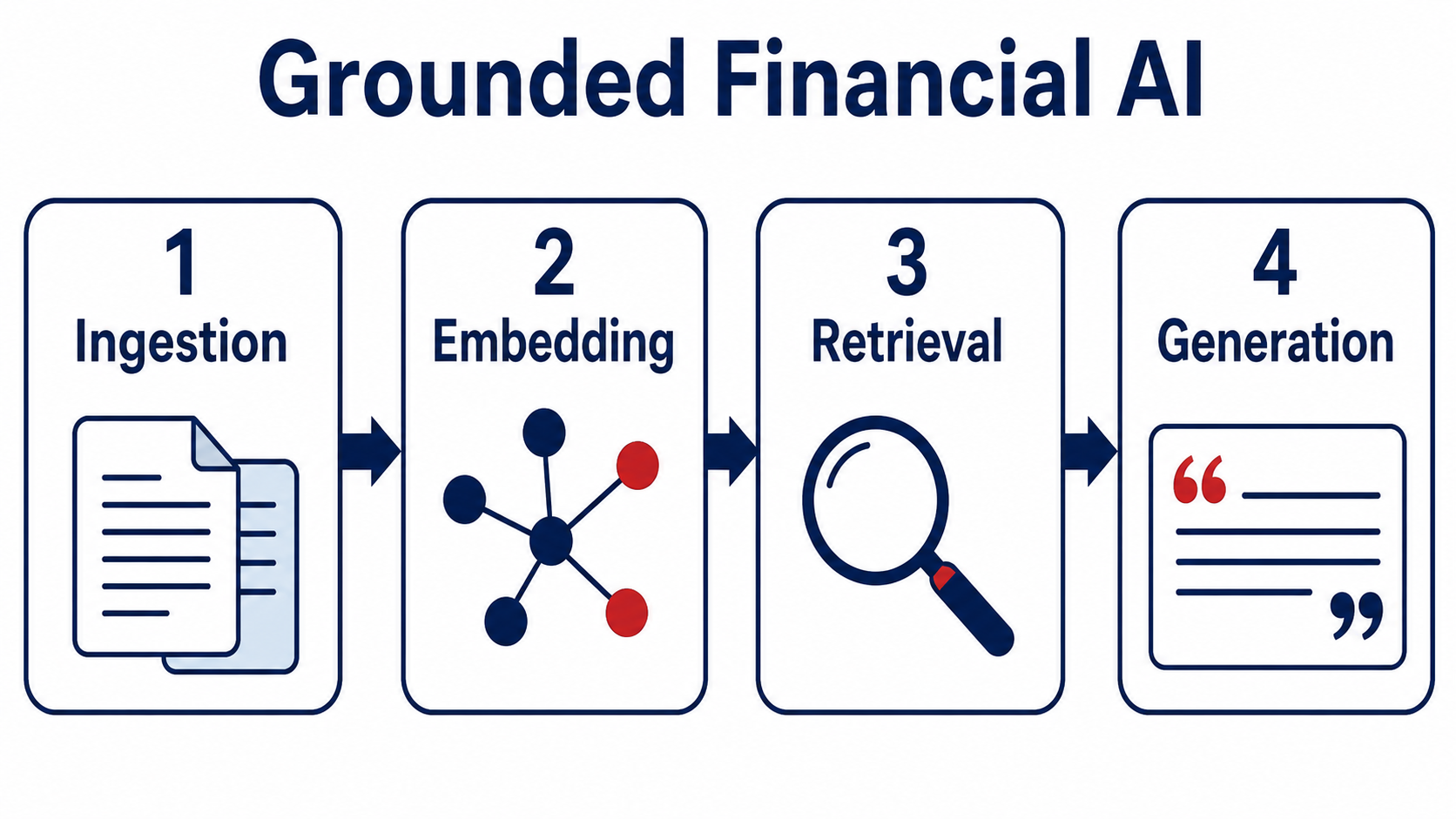
1. Ingestion
The institution selects documents, removes duplicates, records ownership, and checks whether each source is approved for the intended use. It then divides documents into smaller passages, or chunks. Chunk boundaries matter: a clause separated from its exception may retrieve an incomplete rule.
Each item should carry metadata such as business owner, jurisdiction, effective date, confidentiality level, and review date. That information supports filtering and later audits.
2. Embedding
The system converts each passage into a numerical representation that captures aspects of meaning. These embeddings are stored in an index, often a vector database, together with the text and its metadata.
Embedding does not satisfy governance requirements by itself. Sensitive material remains sensitive after conversion. The index needs the same access discipline as the original documents.
3. Retrieval
The application converts the user’s question into a search representation and finds likely passages. It may combine semantic search with keywords, metadata filters, or reranking. Access rules should be applied before material reaches the model.
Retrieval quality depends on the query, chunk design, index freshness, and ranking method. A fluent answer built from the wrong passages is still wrong.
4. Generation
The model receives the question, selected passages, and instructions about how to respond. It may be required to cite sources, state uncertainty, or decline when the evidence is insufficient. Output checks can then look for unsupported claims, prohibited content, or sensitive data before the response reaches the user.
Where financial services RAG creates value
Financial services RAG is most useful when employees or customers need fast access to a large body of controlled information.
A service assistant can retrieve approved product terms and procedures, reducing the risk of an improvised answer. A compliance tool can find relevant policy clauses for an analyst, while leaving the final interpretation to an authorized professional. Research teams can search internal notes and licensed material, provided permissions travel with every retrieved passage.
RAG can also support the knowledge layer of AI-native banking. The operating model still needs accountable owners, monitoring, and escalation paths. Retrieval makes knowledge available; it does not decide who is responsible for its use.
Five financial services RAG failure modes
Outdated or conflicting sources
An index may contain an old policy beside its replacement. Without effective dates and version controls, the retriever can surface both. The business owner should define which document is authoritative and how withdrawn material is removed.
Poor chunking
Chunks that are too small lose context. Chunks that are too large can dilute the relevant passage and consume the model’s context window. Teams should test real questions and inspect the evidence retrieved. Answer style alone cannot establish retrieval quality.
Weak retrieval
The correct answer may exist in the repository but never reach the model. Evaluation should therefore measure retrieval separately from generation. Useful measures include whether the correct source appears among the top results and whether the final claim is supported by the cited passage.
Access-control leakage
A user may be allowed to ask a question but not to see every document that could answer it. Permissions must be enforced during retrieval, with controls for user role, customer relationship, jurisdiction, and data sensitivity.
Prompt injection in retrieved content
Retrieved files can contain text that tries to override the application’s instructions. The OWASP prompt-injection guidance recommends layered controls, including input validation, separation of instructions from data, least privilege, output monitoring, and regular security testing.
Governance for financial services RAG
A production system needs more than a vector database and a model endpoint. It needs a knowledge owner, a model or application owner, and a risk owner. Each should understand where responsibility begins and ends.
The NIST Generative AI Profile provides a useful cross-sector framework for governing, mapping, measuring, and managing generative AI risks. A financial institution can translate those functions into controls for source approval, retrieval testing, human review, security monitoring, and incident response.
This governance should fit the wider bank AI operating model. Central teams can set common controls, while business units remain accountable for use-case knowledge and customer outcomes.
A financial services RAG implementation checklist
Before launch, a team should be able to answer these questions:
- Which sources are approved, and who owns them?
- How are effective dates, versions, and jurisdictions recorded?
- Are permissions enforced before retrieval?
- Can users see the source behind material claims?
- What happens when the evidence is weak or conflicting?
- How are retrieval accuracy and answer groundedness tested?
- Which outputs require human approval?
- How are incidents, user corrections, and source changes handled?
The business case should also be measured. FinTech Central’s framework for measuring bank AI value separates model performance from workflow adoption, economics, and risk. A RAG assistant that retrieves well but slows employees or creates extra review work may not deliver net value.
Financial services RAG needs evidence, not confidence
Retrieval-augmented generation can make financial AI more current, traceable, and useful. Its main advantage is not that the model sounds more certain. It is that the application can connect an answer to governed evidence.
That evidence chain must be maintained. Documents change, permissions shift, queries evolve, and attackers adapt. Institutions should test the complete system continuously and route high-impact decisions to qualified people.
The right standard is straightforward: retrieve approved knowledge, preserve access controls, show the evidence, and admit when the evidence is not enough.
FutureCentral pathways
Turn grounded financial AI into institutional capability
Continue with teaching resources, organizational learning and India-relevant research from FutureCentral.
FINTECH BRIEFING · A FUTURECENTRAL BRIEFING
Get practical financial AI analysis in your inbox.
Useful signals, focused analysis and decision questions on AI in banking, payments, lending, insurance, wealth and risk.
Free to subscribe. Confirm your email after signing up. Unsubscribe at any time.