


Parametric insurance can pay quickly after a disaster, yet a customer can suffer a real loss and receive nothing.
Consider a hypothetical farmer whose cover pays when rainfall falls below a set level at a named weather station. The field dries out, but the station records enough rain. The farmer loses a crop while the policy’s payout rule remains unmet.
That gap is called basis risk. It belongs at the center of product design because it can turn a promise of simple cover into a painful surprise.
For insurers and fintech teams, the key task is to test how well the chosen measure tracks the customer’s loss. AI can help with that test. Faster payment alone cannot fix a weak match.
How parametric insurance creates basis risk
A traditional indemnity policy assesses a covered loss before calculating the payment. A parametric policy uses an agreed event measure and payout rule. For example, that measure might track rainfall, wind speed, or river depth.
Swiss Re’s explanation of parametric cover describes payments linked to a defined event threshold. This can shorten the path to cash because the insurer need not assess each damaged asset in the usual way.
However, the reading may fail to reflect the customer’s loss. Rain at a station may differ from rain on a farm. A wind reading may also miss the conditions at a particular building.
Even when the event triggers payment, the sum may fall short of the customer’s loss. Conversely, the formula may produce a sum above that loss, subject to the contract’s terms.
You should therefore read the whole policy. As Swiss Re notes in its guide to common parametric myths, many corporate insurance contracts still require proof of financial loss. An event trigger does not mean every product removes all claims checks.
Start with the loss your customer needs to fund
A useful parametric insurance design begins with the customer’s cash need after an event. A farmer may need funds for replanting, while a small business may need cash during a flood closure.
Those needs can require different triggers even when the weather event is the same. Before choosing a dataset, write down the loss the product aims to address.
Next, identify the cases in which the proposed trigger would miss that loss. A rainfall policy, for instance, might offer little help when heat damages a crop despite normal rain.
This is a design choice to explain before sale. Customers need to know the limits of the event measure as well as the payout amount.
The same discipline matters in automated products. Our Etherisc guide examines how trigger data and policy terms affect blockchain-based insurance. A payment engine can apply a flawed rule with perfect speed.
Use a six-part parametric insurance design canvas
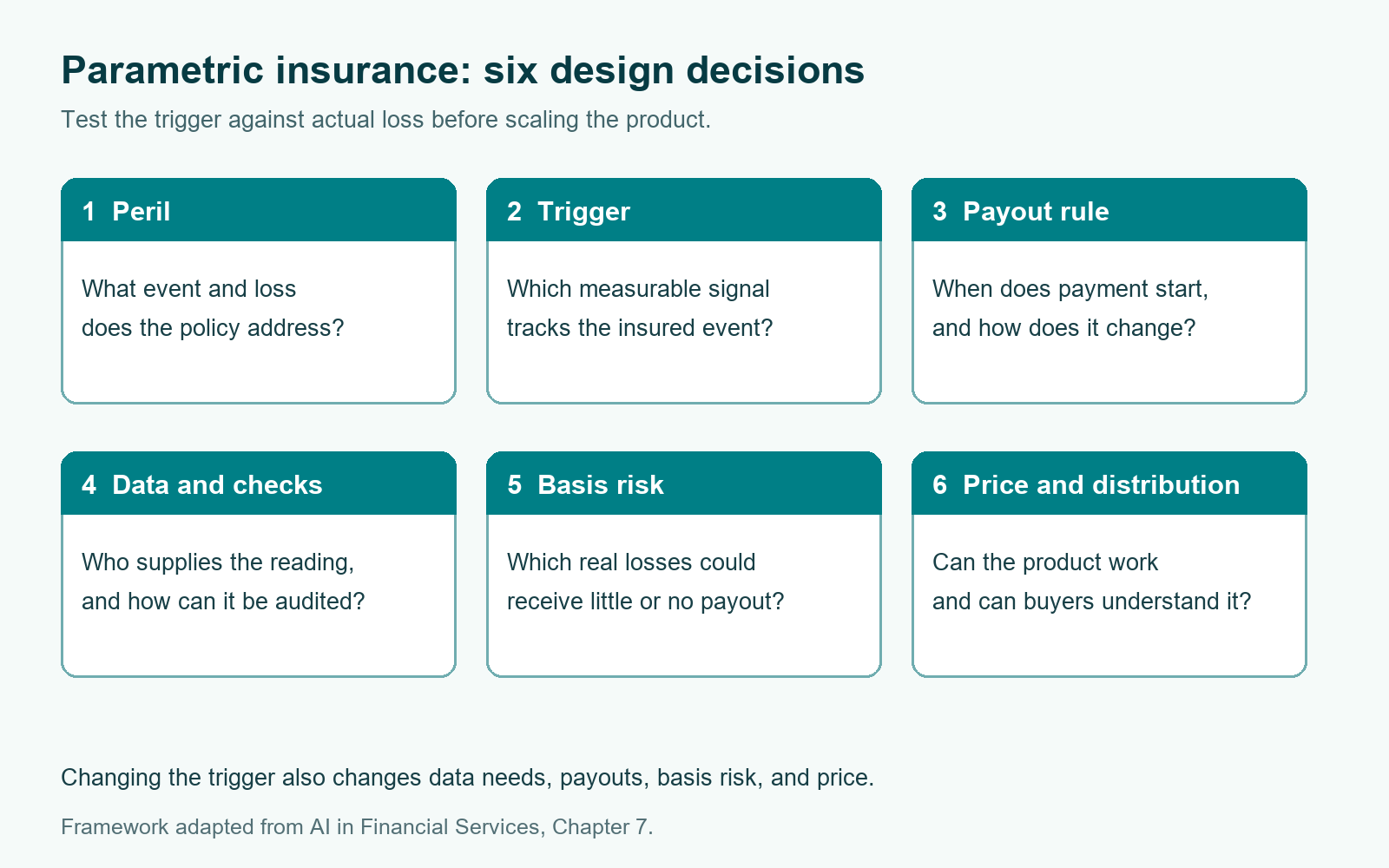
The Parametric Insurance Design Canvas organizes the main choices into six linked areas. Product teams can use the following version as a working checklist.
| Design area | Decision to make | Evidence to bring to review |
|---|---|---|
| Peril | Name the event and the loss the customer faces. | A clear account of what the cover includes and excludes. |
| Trigger | Choose a measure that tracks the insured event. | Tests of the link between that measure and loss. |
| Threshold and payout | Set when payment starts and how the sum changes. | Worked examples for events near each threshold. |
| Data and verification | Name the data source and how the team checks it. | An audit trail and a plan for missing or disputed readings. |
| Basis risk | Find losses the rule misses and payments that fail to meet the need. | Results by location, customer type, and event severity. |
| Pricing and distribution | Test the cost, sales channel, and customer’s grasp of the cover. | Expected payouts, costs, and evidence that buyers understand the terms. |
The boxes depend on one another. If you change the trigger, you must also revisit the payout rule, data needs, and price.
Still, a neat canvas does not prove that the product works. Trigger choice and basis risk can determine whether the whole design is viable. Resolve those questions before polishing the sales journey.
Use AI to test parametric insurance triggers
AI can help teams compare weather and sensor data with past losses. For example, a model can test whether soil moisture adds useful information to a rainfall measure.
It can also help identify places where a single station gives a poor account of local conditions. Combining signals may improve the match, although each added source brings its own cost and failure modes.
The key test should use events the team did not use to tune the rule. Otherwise, a model may fit the past closely and still fail when a new season arrives.
Compare the proposed design with a simple baseline as well. If a complex index adds little value, its extra data burden may be hard to justify.
For each design, inspect both missed losses and payout shortfalls. A good average can hide a group of customers whom the trigger serves poorly.
Swiss Re’s parametric insurance guide recommends testing historical and future scenarios to reduce basis risk. It also makes clear that teams cannot remove that risk entirely.
Make the no-payout case part of the sales process
For an India-focused parametric insurance product, consider a hypothetical buyer who relies on an agent’s explanation of weather cover. The agent should show a season with crop damage but no payment, alongside a season that triggers the policy.
Then ask the buyer to explain the difference in their own words. A signed form alone gives little evidence that the customer understands the rule.
The team should also state how it handles a failed weather feed, a disputed reading, or a delayed payment. The contract and the operating process must give the same answer.
Complementary coverage may address some gaps. However, combining policies requires its own review of cost, exclusions, and claims duties.
Our guide to motor claims automation explores a different claims path. It shows why the evidence and exception route deserve as much attention as processing speed.
Decide whether the product is ready
Before a pilot, ask the team to present a plausible case with a severe loss but no payout. Show the loss, the trigger reading, the resulting payment, and the explanation the buyer would receive.
If that case exposes a weak trigger, redesign it. If better data cannot support a sound rule, narrow the cover or defer the launch.
Parametric insurance earns trust when customers can understand when it pays and plan for the losses it may leave uncovered. That is the standard to test before scaling the product.
For more decision-led analysis of financial AI, subscribe to FinTech Briefing.
FINTECH BRIEFING · A FUTURECENTRAL BRIEFING
Get practical financial AI analysis in your inbox.
Useful signals, focused analysis and decision questions on AI in banking, payments, lending, insurance, wealth and risk.
Free to subscribe. Confirm your email after signing up. Unsubscribe at any time.