


Verified lending data can change a credit decision before a larger AI model writes its first answer.
For example, imagine a small metal workshop seeking a loan to buy raw materials for a new order. The owner has sales bills, a bank account, and a tax return. Yet her lender still needs to work out how much cash the business earns and when customers pay.
A model can summarize the papers. It cannot recover a missing account history from model size alone. If the file mixes sales with transfers between the owner’s accounts, a fluent summary may repeat that mistake.
For the workshop’s lender, the first task is to link the owner’s identity to records that show how her business earns and spends money. A stronger model may help analyze those records once the lender has them. Getting the right evidence into the loan file requires a process of its own.
How Yubi and Protean fit into the loan process
Two companies working on that part of lending are Yubi and Protean eGov Technologies. Yubi provides software that banks and other lenders use to manage loans. Protean supplies digital services for identity checks, consent, and online signing. Its services also support know-your-customer (KYC) checks, which establish who a customer is.
Their proposed collaboration aims to connect Protean’s verification and data services with Yubi’s lending software. For a lender assessing the workshop owner’s application, that could help bring the borrower’s records and checks into the process used to review the loan.
Protean announced the plan in a November 11, 2026 stock-exchange filing. The company’s release describes reusable KYC, consented bank statements and tax returns, and digital signing across the loan journey. The stated aims include quicker onboarding and a clearer view of credit risk.
Those are plans and company claims. The announcement does not establish lower defaults, fairer approvals, or a measured gain for this new partnership. Lenders would need results from use to test those claims.
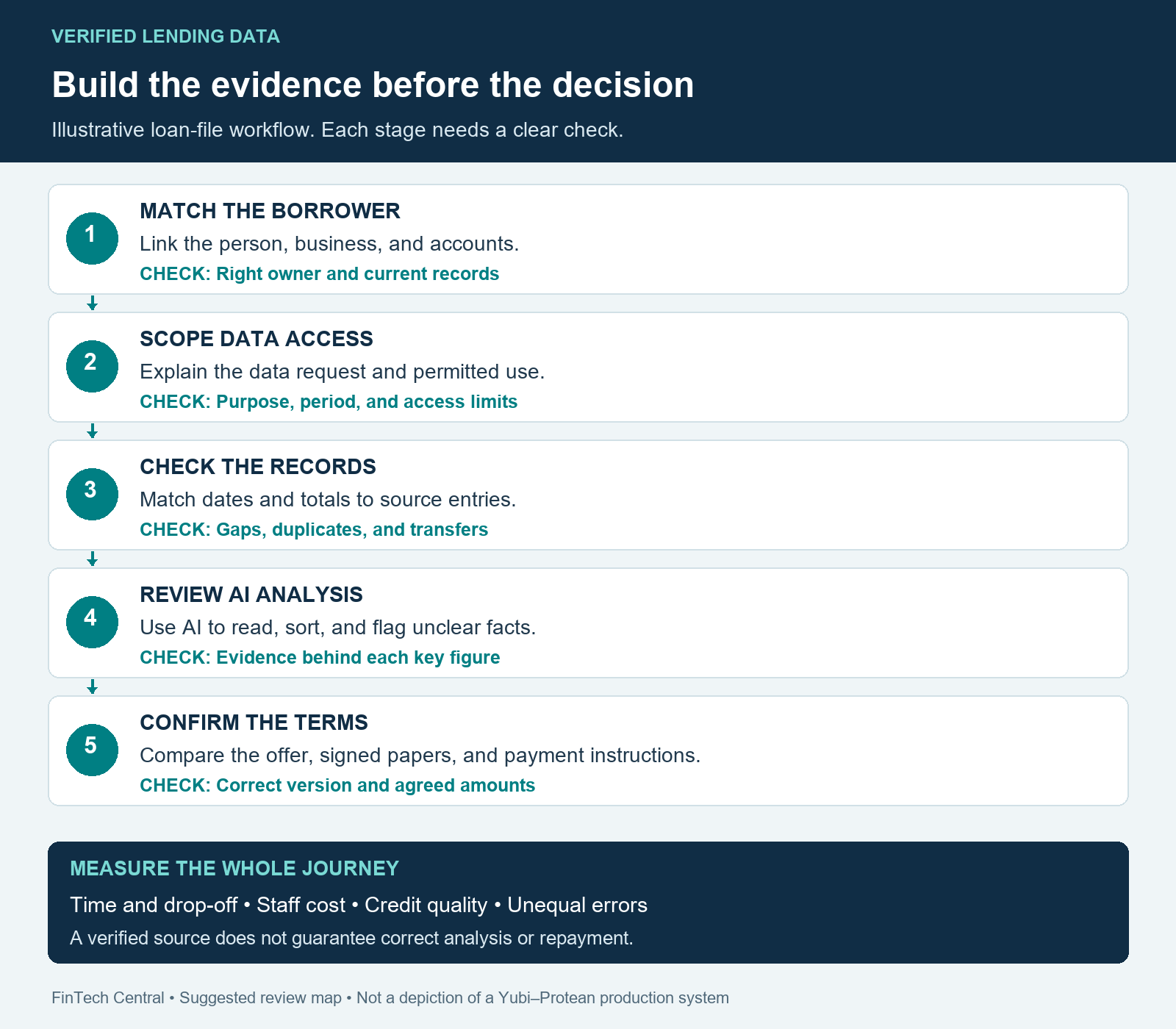
The question is how such connections could improve a loan file. The loan workflow below is our own example. It does not describe a proven Yubi–Protean deployment.
Follow verified lending data through the loan file
For our imagined owner, start by matching the person, business, and accounts. Before using it, check that each record belongs to the right borrower. Where the rules allow existing KYC records to be reused, also check whether the records are up to date.
Next, check the right to fetch and use bank and tax records. A consent screen should make the request easy to follow. Which information will the lender receive, for what purpose, and for how long?
Sahamati’s guide to informed consent explains these details for Account Aggregator data sharing. It distinguishes the data fields, purpose, access frequency, and validity of consent. Permission for one assessment should not silently turn into an open-ended right to monitor the borrower.
Then check the records themselves. A statement from a bank can still contain gaps in the period supplied. A tax return may cover a different period from the latest orders. Staff need to see the dates each source covers before joining the figures.
For example, money moved between the owner’s accounts should not count as fresh customer sales. A loan credit also differs from trading income. Match the totals and keep a route back to the entries used in the review.
Finally, carry the checked facts into the offer and signed papers. If the amount or terms change, make sure staff and the borrower see the right version. A valid signature does not show that the credit review was sound.
Give AI and verification separate jobs
Verified lending data needs a clear meaning. Here it means records with checked origins, borrower links, and scope. It does not mean that every entry is right or that the borrower will repay.
AI could help read a scan, sort transactions, or draft a cash-flow report. It could also flag a mismatch for staff to examine. However, each output needs a test against the original record.
Some checks have fixed rules. Matching an identifier to a trusted source or checking a required field does not become an AI task just because it sits inside an AI-branded platform. Also keep those checks visible in the workflow.
For example, ask the model to show which entries support its sales estimate. Then give it an account transfer, a duplicate page, and an unclear payment description. Does it flag doubt, or does it invent a neat explanation?
Test a second model on the same checked file if the first struggles. A stronger model may handle messy text or mixed languages better. But changing models cannot fix an account the lender never received or a purpose the borrower never agreed to.
Our permissioned-data guide explains the rights behind access. The article on alternative credit data explores how extra evidence can change a lending review.
Measure the full lending journey
Start with the time from a complete request to a usable decision. Also measure how many applicants leave before finishing. A quicker model response adds little if borrowers still upload the same papers twice.
Also count the staff work. Include time spent fixing extracted figures, fixing account mismatches, and chasing missing pages. Then compare cost per completed case with the old process for similar loan requests.
Check credit quality after enough time has passed to observe repayment. Keep the borrower mix and loan terms in view. However, a higher approval rate alone cannot show that the new process makes better decisions.
Fairness needs its own review. Then compare errors and results across borrower groups where the lender can lawfully do so. For refused loan requests, a fresh review by other staff may expose missing facts or uneven treatment. It cannot reveal repayment outcomes for loans the lender never made.
Also review fraud alerts. Record which flagged cases staff cleared and why. Sample unflagged cases to look for missed issues. Keep known errors separate from cases whose truth remains unknown.
These are proposed pilot measures. The partnership announcement supplies no basis for claiming a particular improvement in them.
A pilot checklist for verified lending data
Choose one loan type and a defined group of applications. Before launch, name the person who owns the decision and the staff who handle errors. Then keep an evidence file for each stage.
- Source and identity: Can staff trace the record to its provider and match it to the borrower and period?
- Purpose and access: What allows this use? Can the borrower understand and manage the data request?
- Analysis and review: Which facts did AI extract or infer? Who checks unclear entries and disputed figures?
- Terms and records: Do the approved offer, signed papers, and payment instructions agree?
- Outcomes and correction: How will the lender track cost, repayment, and unequal errors? How can a borrower challenge a mistake?
Compliance remains part of that design. For commercial banks within its scope, RBI’s Credit Facilities Directions, updated through October 2026, require need-based data collection with prior, explicit borrower consent and an audit trail for digital lending apps. Other lenders should map the rules for their own entity and service.
For the metal-business pilot, success could mean fewer requests for the same papers and less time fixing the file. The lender would still need to track credit quality and borrower treatment before offering it more widely.
Begin with the evidence gap. Test whether better access and clearer checks resolve it. Then compare models on the remaining work, using the same records and review standard.
Follow the FinTech Briefing for practical analysis of financial AI and the workflows behind it.
FINTECH BRIEFING · A FUTURECENTRAL BRIEFING
Get practical financial AI analysis in your inbox.
Useful signals, focused analysis and decision questions on AI in banking, payments, lending, insurance, wealth and risk.
Free to subscribe. Confirm your email after signing up. Unsubscribe at any time.