


SEBI AI rules become a real concern when a draft leaves an employee’s screen and reaches a client.
Imagine an adviser using an AI tool to turn research notes into a client update. A broker uses the same tool to answer account questions. At an asset manager, it helps staff review news before a fund meeting.
Each team may call this assistance. Yet the risks change once the tool suggests a trade, shares client data, or sends a reply without review.
The useful management question is simple: can the firm show what the tool did and who checked it?
Separate SEBI AI rules from proposals
Start with the status of each source. SEBI’s June 2025 consultation paper proposed principles for AI and machine learning in securities markets. It covered model governance, investor disclosure, testing, fairness, data privacy, and cyber security. A consultation asks for views; its proposals do not, by themselves, create binding duties.
However, AI accountability did not start with that paper. The 2025 text of the Intermediaries Regulations, at Regulation 16C, already assigns responsibility for AI use to the regulated firm. It covers investor data, outputs the firm relies on, and compliance with applicable law, including when outside vendors supply the tools.
For investment advisers, Regulation 15(14) also addresses responsibility for AI used to serve clients. Therefore, buying software does not settle the firm’s own duties.
The checklist below contains our own preparation advice. Its suggested controls need a separate check against binding requirements. Before approving a service, compliance staff should check the current rules for that entity and activity, including later amendments and circulars.
Map where AI reaches investors
Begin with the work people do. Ask each team to list its tools, including features built into software it already buys. Also ask about staff using public chat tools outside approved systems.
A useful register starts with the task and its owner. Then record the vendor, model version where available, data used, and people affected. Describe whether the tool drafts, ranks options, recommends a choice, or acts on it.
For example, a research summary may stay inside the firm. Once an adviser uses it to support a client recommendation, the review needs to cover that next step. A label such as internal tool can hide this change.
Look beyond research and advice. Include portfolio tools, client chats, market surveillance, and back-office work. A tool that sorts alerts can affect which cases staff ever see.
Next, trace access to data. Can the service read one approved document, or can it search client files across teams? Our guide to permissioned data in financial AI explains why access should follow the task.
Build evidence for SEBI AI rules readiness
For each use, give a named business owner power to pause the service. Also name the staff who test it and the person who decides when staff must raise an issue. A vendor contact alone cannot perform those roles inside your firm.
Keep a short evidence file beside the register. Record the intended task, uses the firm forbids, and the checks before release. Add test results, known failures, changes after launch, and the route back to manual work.
Then ask the vendor concrete questions. Where does client data go? Who can access it? Does the supplier reuse it for training, and can the firm enforce the agreed limits?
Check the contract and technical settings together because either can leave gaps.
For a client-facing service, draft a plain explanation of what AI does and where a person takes over. Avoid promising that a human checks every answer unless the workflow makes that true. Compliance staff should map any required disclosure to the rules that apply.
Finally, keep incident records that staff can use. Save enough context to explain a disputed result, while limiting access to private data. A log that stores every client detail without a clear need can create a fresh problem.
Match oversight to the harm a tool can cause
Consider an imagined client asking whether to sell a fund after a sharp market fall. A service bot may begin with a factual query and drift into a personal recommendation. Test that boundary before launch.
For example, check whether it can recognize that the request needs an adviser, stop making recommendations, and pass useful context to staff. Then test the handoff when that adviser is unavailable. An escalation button adds little if no one owns the queue.
An internal drafting tool needs checks for stale facts and invented sources. A recommendation tool also needs tests against the client’s circumstances and the firm’s permitted service. If software can place orders, assess those powers separately before giving it access.
For surveillance, review a sample of cases the system leaves out. Looking only at the alerts it raises cannot show whether it missed important conduct. Also test unusual market conditions because routine examples can hide weak controls.
Give reviewers time to challenge an answer. They need the underlying records and a way to reject the output. Our article on AI wealth advisory handoffs explores how that review fits into a client service.
A thirty-day plan for SEBI AI rules preparation
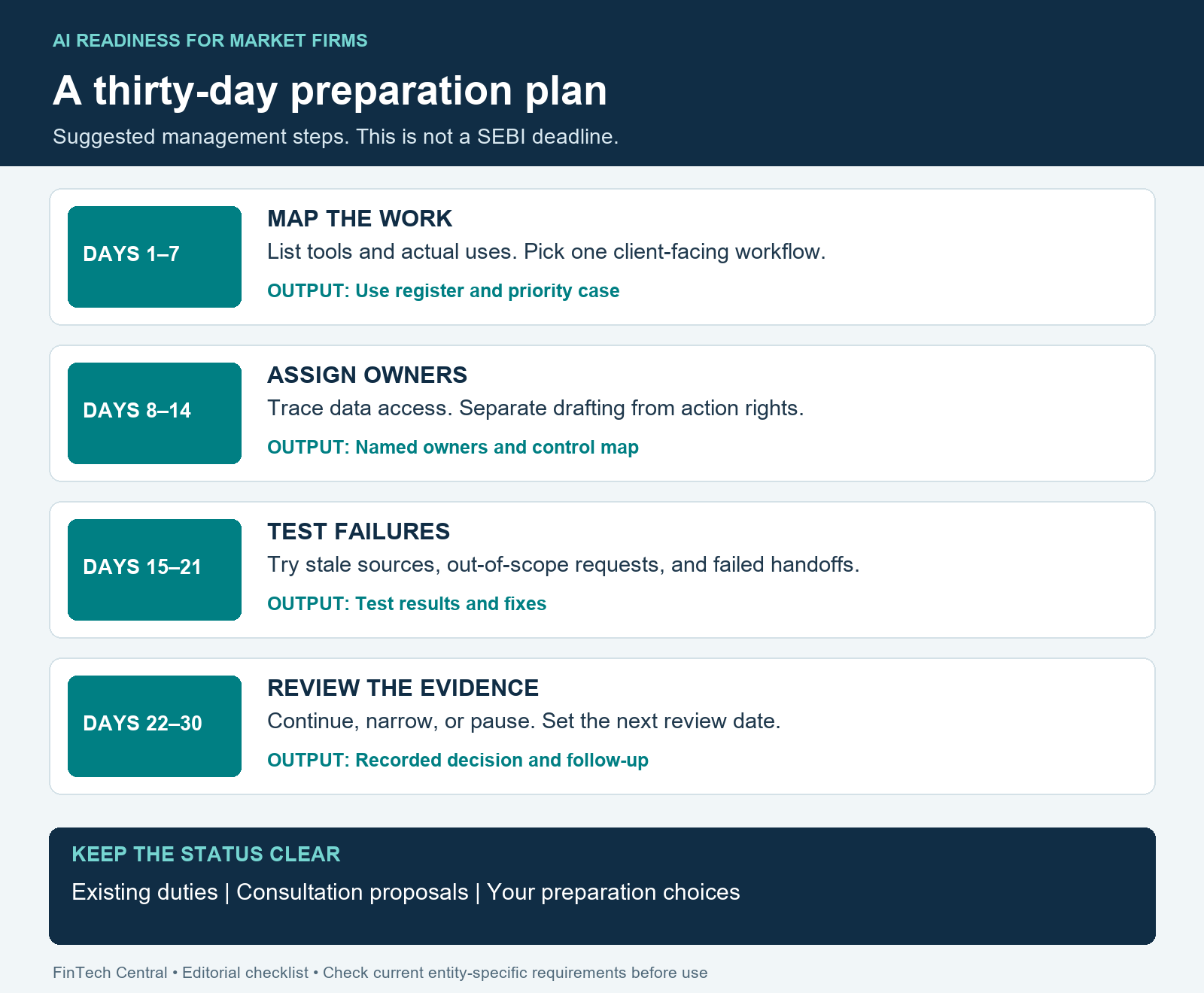
Treat these as suggested steps for your team. Thirty days is our planning horizon, not a SEBI deadline.
During days one to seven, map the tools and their actual uses. Ask team heads to check the list with staff. Pick one client-facing workflow for a closer review, and find any unapproved access that needs prompt attention.
During days eight to fourteen, name owners and trace the data flow. Separate drafting rights from rights to contact clients or place orders. Then ask compliance staff to map existing duties and mark any unclear points for review.
During days fifteen to twenty-one, test failures in the chosen workflow. Try an outdated source, a request outside its role, and a failed handoff. Keep the results, including what staff changed after each test.
During days twenty-two to thirty, review the evidence with the business owner and compliance team. Decide whether to continue, narrow the task, or pause it. Set a date for the next review and identify changes that would trigger earlier testing.
For a small firm, one well-tested service is a useful start. A larger firm can reuse the register format across teams while keeping ownership close to each task.
The outcome should be a clear decision: this tool may do this task, with these limits and these checks. As SEBI publishes more guidance, compare its scope and effective dates with that record. Update the controls where the text requires a change.
Follow the FinTech Briefing for practical analysis of financial AI and the decisions it creates.
FINTECH BRIEFING · A FUTURECENTRAL BRIEFING
Get practical financial AI analysis in your inbox.
Useful signals, focused analysis and decision questions on AI in banking, payments, lending, insurance, wealth and risk.
Free to subscribe. Confirm your email after signing up. Unsubscribe at any time.